
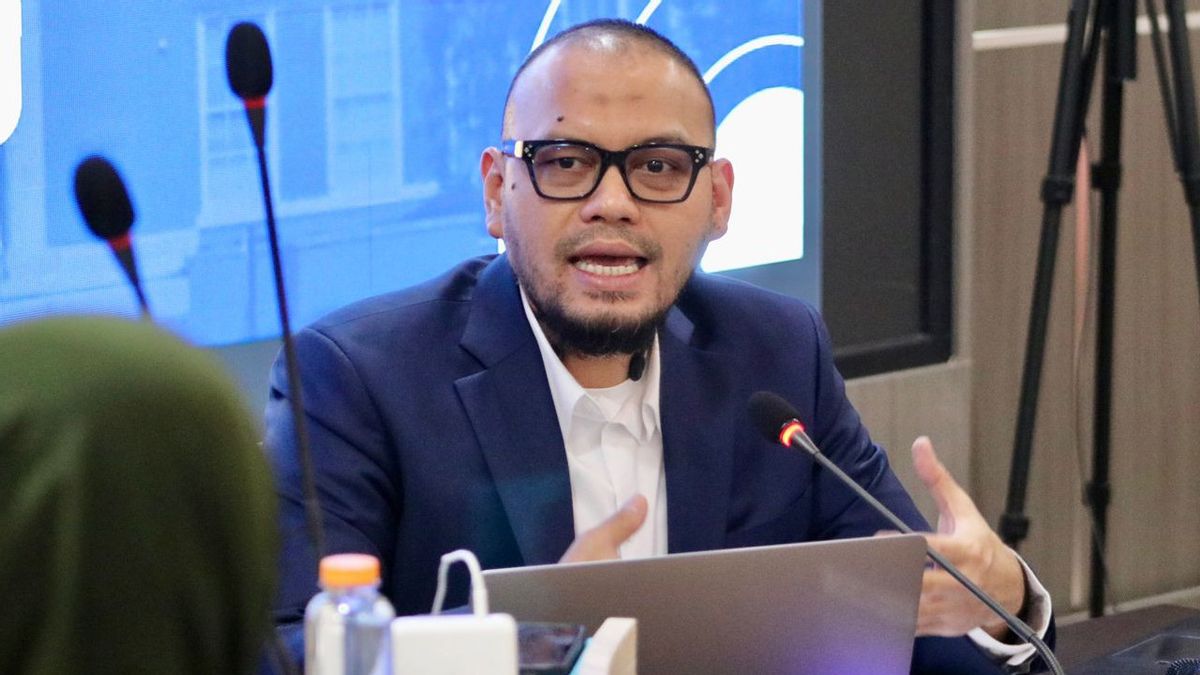


JAKARTA - Legal and Development Observer Hardjuno Wiwoho confirmed that the alleged Rp60 billion bribery that dragged the Chairman of the South Jakarta District Court (PN) in the case of acquittal of three cooking oil corporations was an act that destroyed the legal foundation.
According to him, the involvement of judges in decision arrangements for the sake of corporations is the most brutal form of the robbery of justice.
"If judges can be bought by corporations, what else is left of our legal state? This is not just an ethical violation, this is legal sales to capital owners," said Hardjuno in Jakarta, Monday, April 14.
According to Hardjuno, bribery by corporations is far more dangerous than ordinary bureaucratic corruption. If bureaucratic corruption robs the budget, then corporate bribes rob the system.
"This is a different class. Bureaucratic corruption steals funds, but corporate bribes hijack the law in order to perpetuate economic power. They not only avoid punishment, but they buy justice and regulate the direction of the state according to their interests," he said.
"Imagine, the state poured out trillions of rupiah for cooking oil subsidies for the people. But behind the scenes, corporations actually bribed judges so that they were free from legal snares. It was not just an insult to the state, but a betrayal of the people," he said.
The Attorney General's Office previously named South Jakarta District Court Chairman Muhammad Arif Nuryanta as a suspect along with three other people in the alleged bribery case for the release verdict for the Wilmar Group, Permata Hijau Group, and Musim Mas Group.
The bribe money allegedly flows through corporate lawyers and court officials. Hardjuno, who is also a Doctorate for Law and Development at Airlangga University (Unair), assessed that this case shows that legal issues in Indonesia are not only a matter of personal integrity, but are already systemic.
"When large corporations can buy decisions, the small people have no hope before the law," he said.
Therefore, this anti-corruption activist figure also urged that massive improvements be made within the Supreme Court and the judge's supervisory system. One of the ideas is the establishment of an independent supervisory agency that can audit the wealth, lifestyle, and relationship network of judges.
If there is Rp60 billion flowing into the courtroom, it means that there is a system that has been dilapidated for a long time and is allowed. We need a total audit, not just a case, but anyone who plays behind the scenes," he said.
Furthermore, Hardjuno again emphasized the importance of ratifying and implementing the Asset Confiscation Law as the main instrument for prosecution and prevention. According to him, bribery actors like this are not enough to just be sentenced to prison.
SEE ALSO:
-
 | EKONOMI
Terminal 2F Soetta Resmi jadi Pusat Layanan Penerbangan Umrah Mulai Hari Ini
21 Maret 2025, 11:48 -
 | EKONOMI
Kemenkop Dorong Pembentukan Kopdes Merah Putih di Daerah 3T Indonesia Timur
21 Maret 2025, 11:05
"If the proceeds of crime are not confiscated, then the prison will only be a pause. They will still live a prosperous life after being released. The Asset Confiscation Law will ensure that the proceeds of bribery and corruption are returned to the state, and perpetrators will no longer be able to buy freedom with dirty money. There is also a deterrent effect with the application of the law, "he said.
Furthermore, Hardjuno expressed his appreciation for the success of the Attorney General's Office in dismantling the bribery network within the judiciary. Moreover, the AGO is able to develop investigations from one case to another in layers and structured.
"All of this is not standing alone. The Prosecutor's Office initially investigated the judge's bribery case in the case of Ronald Tannur's acquittal in Surabaya. From there, investigators found evidence that led to allegations of bribery in other cases, including the findings of nearly Rp1 trillion in cash and gold bullion at the house of a former Supreme Court official," he explained.
"This evidence then opened the door to a bigger case, namely the alleged Rp60 billion bribery to the Chairman of the South Jakarta District Court in the case of the release of three large cooking oil corporations. This shows that the Prosecutor's Office is moving systematically, tracing one by one traces of money and power that undermines our legal integrity," Hardjuno continued.
Hardjuno assessed that this success was not just an institutional achievement, but an important signal that there was still the courage to touch the big actors behind the legal mafia.
"This is not just a job. This is a clean-up that starts from facts, not just rhetoric," he concluded.
The English, Chinese, Japanese, Arabic, and French versions are automatically generated by the AI. So there may still be inaccuracies in translating, please always see Indonesian as our main language. (system supported by DigitalSiber.id)
Popular


