

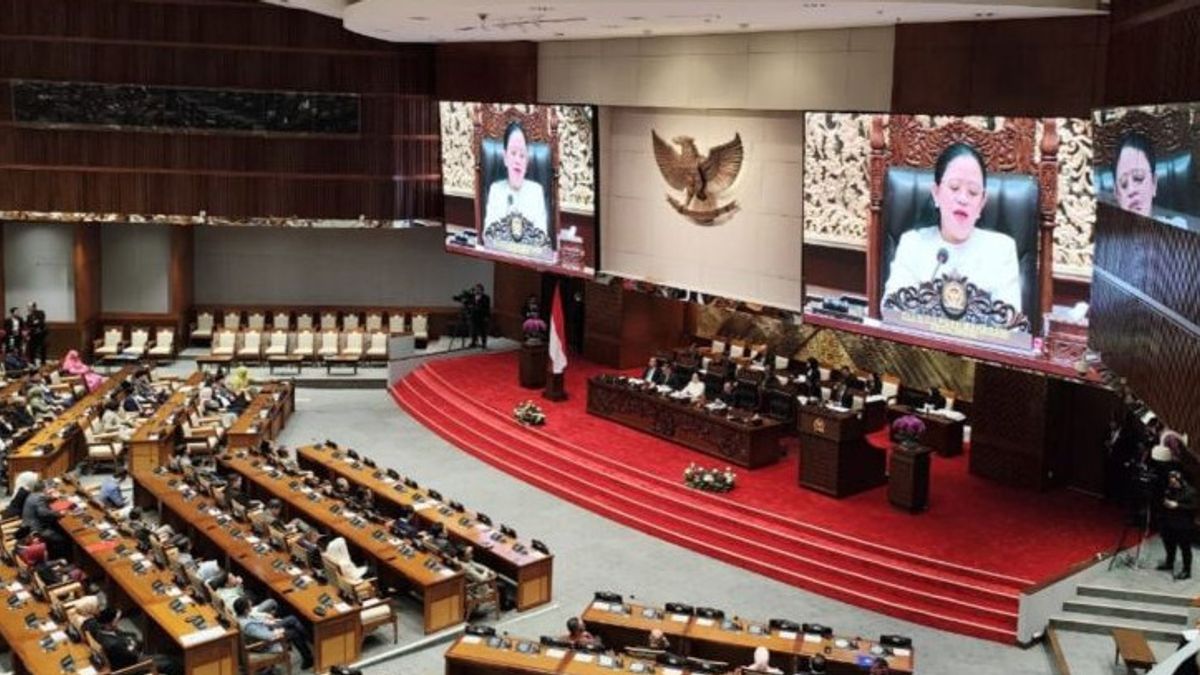


JAKARTA - The 15th Plenary Session of the Indonesian House of Representatives (DPR) of the Second Session of the 2024–2025 Session Year at the parliament complex, Jakarta, approved the Draft Law on Amendments to Law Number 34 of 2004 concerning the Indonesian National Armed Forces or the Indonesian Armed Forces (TNI) Bill to be passed into law.
"Can the Draft Law on Amendments to Law Number 34 of 2004 concerning the Indonesian National Armed Forces be approved to be passed into law?" said the Speaker of the Indonesian House of Representatives Puan Maharani, which was answered in the affirmative by the meeting participants, Thursday, March 20.
The approval of the TNI Bill was witnessed by Minister of Defense Sjafrie Sjamsoeddin, Minister of State Secretary Prasetyo Hadi, TNI Commander General Agus Subiyanto, as well as the ranks of the Ministry of Law and Ministry of Finance.
In the TNI Bill, there are four points of change, the first is Article 3 concerning the position of the TNI which remains under the president regarding the deployment and use of force. Meanwhile, defense strategies and administrative support related to strategic planning are under the coordination of the Ministry of Defense.
Then Article 7 concerning military operations other than war (OMSP), which increases the scope of the TNI's main tasks from the original 14 tasks to 16 tasks. The addition of the two main tasks includes assisting in dealing with cyber threats and assisting in protecting and saving citizens, as well as national interests abroad.
Then the third change, namely in Article 47 concerning civil positions that can be filled by active TNI soldiers. In the old law there were 10 civil positions that could be filled by active TNI soldiers, while in the bill it increased to 14 civil positions.
These positions can be filled by active TNI soldiers only based on the request of the ministry/institution and must comply with the applicable provisions and administration. Outside of that, the TNI must resign or retire from military service if they want to fill a civil position.
The last change, namely in Article 53 concerning the extension of the retirement age for soldiers at all levels of rank. The retirement age limit for non-commissioned officers and privates is 55 years old, while officers up to the rank of colonel have a retirement age limit of 58 years old.
SEE ALSO:
-
 | BERITA
Prakiraan Cuaca 20 Maret: Hujan Melanda Pulau Jawa, Sumatra, hingga Papua
20 Maret 2025, 06:06 -
 | TEKNOLOGI
CEO Nvidia Jensen Huang: Perusahaan Siap Hadapi Pergeseran Industri AI
20 Maret 2025, 02:05

For high-ranking officers, the service period is extended, especially for four-star officers, namely 63 years and a maximum of 65 years. Meanwhile, in the old law, military service was up to a maximum age of 58 years for officers and 53 years for non-commissioned officers and privates.
"We emphasize that the amendment to Law Number 34 of 2004 concerning the TNI remains based on the values and principles of democracy, civil supremacy, human rights, and meets the provisions of national and international law that have been ratified," said Chairman of Commission I of the Indonesian House of Representatives Utut Adianto when presenting the report on the bill.
The English, Chinese, Japanese, Arabic, and French versions are automatically generated by the AI. So there may still be inaccuracies in translating, please always see Indonesian as our main language. (system supported by DigitalSiber.id)
Most Popular Tags
#Prabowo Subianto #donald trump #2026 World Cup #venezuela #Bhayangkara hut #konflik timur tengahPopular


