
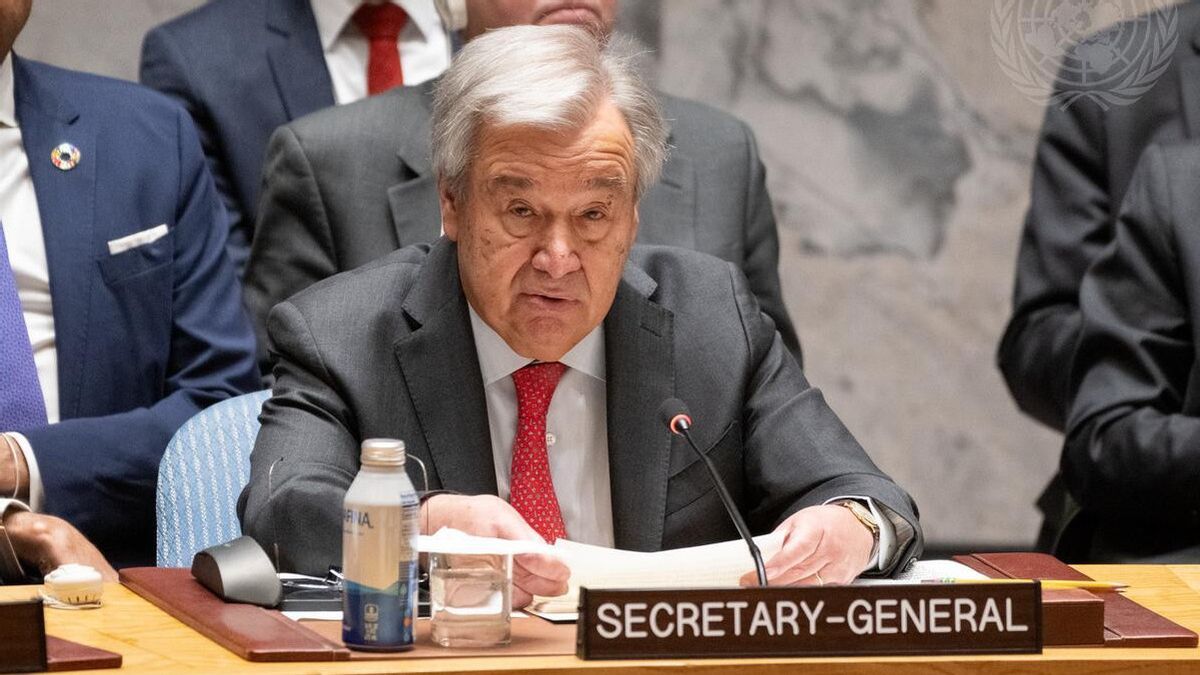


JAKARTA - United Nations Secretary-General Antonio Guterres said on Wednesday eased the tremendous suffering in the Gaza Strip, Palestine, was a priority after a ceasefire agreement between militant groups Hamas and Israel was reached.
During the 15-month war, Israel had destroyed large parts of Gaza and a population before the war of 2.3 million people had fled several times.
UN Secretary General Guterres described the humanitarian situation in the Palestinian enclave as "a major disaster."
"The United Nations is ready to support the implementation of this agreement and to increase the delivery of sustainable humanitarian aid to many Palestinians who continue to suffer," he told reporters.
"It is imperative that this ceasefire eliminate significant security and political barriers to sending aid across Gaza so that we can support a major increase in urgent humanitarian support to save lives," said Secretary General Guterres.
The United Nations has long described its humanitarian operations as opportunistic - facing problems with Israeli military operations - restrictions on access by Israel to and across Gaza and looting by armed gangs recently.
Important details of the surge in aid still need to be resolved, according to sources familiar with the matter, and will be discussed in talks in Cairo on Thursday involving the United Nations, aid groups, governments, and other parties.
The source, speaking on condition of anonymity, said security in Gaza would be the most difficult problem.
"Security is not (responsibility) for humanitarian workers. And it is a very chaotic environment. The risk is that with a vacancy, it will become more chaotic," a senior UN official, who also spoke on condition of anonymity, told Reuters.
"Without any agreement, it would be very difficult to increase shipments in the short term," he added.
As previously reported, Palestinian militant groups Hamas and Israel reached a three-stage ceasefire agreement on Wednesday, following months of mediation with intermediaries Qatar, Egypt, and the United States.
This elaborate gradual agreement outlines an initial six-week ceasefire with the gradual withdrawal of Israeli troops from the Gaza Strip, where tens of thousands of people have been killed.
The hostages held by the militant group Hamas, which controls Gaza, will be released in exchange for Palestinian prisoners detained by Israel.
If successful, the ceasefire would halt the fighting that has devastated much of Gaza's densely populated territory and displaced most of the small enclave's 2.3 million people before the war.
That is expected to ease tensions across the wider Middle East, the wargrounds have sparked conflict in the Israeli-occupied West Bank, in Lebanon, Syria, Yemen, and Iraq, and raised fears of an all-out war between Israel's regional arch-enemy and Iran.
The first phase of the deal includes the release of 33 Israeli hostages, including all women, children, and men over 50 years old. Two American hostages, Keith Siegel and Sagui Dekel-Chen, were among those to be released in the first phase, a source said.
Negotiations to carry out the second phase of the deal will begin on the first 16th day, and this stage is expected to include the release of all remaining hostages, permanent ceasefire, and the full withdrawal of Israeli troops from Gaza.
The third stage is expected to discuss the repatriation of all the remaining bodies and the start of the reconstruction of Gaza supervised by Egypt, Qatar, and the United Nations.
The deal requires 600 aid trucks to be allowed into Gaza every day for six weeks of an initial ceasefire, including 50 trucks carrying fuel. Half of the 600 aid trucks will be delivered to the northern region of Gaza, where experts have warned hunger is in sight.
"We will do whatever is humanely possible, realize the serious challenges and obstacles we will face. We hope that our efforts can be balanced by other humanitarian actors, the private sector, and bilateral initiatives," said Secretary General Guterres.
SEE ALSO:
-
 | BERITA
Perwakilan AS, Qatar dan Mesir akan Pantau Gencatan Senjata Hamas-Israel dari Kairo
16 Januari 2025, 07:07 -
 | BERITA
PM Mustafa Sebut Otoritas Palestina harus Memerintah Jalur Gaza Setelah Perang
16 Januari 2025, 06:00


For more than a year, the United Nations has warned that hunger threatens Gaza. Israel says there is no shortage of aid, citing more than one million tons of shipments.
On the other hand, Israel accused Hamas of stealing aid, which Hamas denies, instead of blaming Israel for the shortfall.
The United Nations said in June, Israel - as a occupation force in the Gaza Strip - was responsible for restoring public order and security in the Palestinian territories so aid could be delivered.
The English, Chinese, Japanese, Arabic, and French versions are automatically generated by the AI. So there may still be inaccuracies in translating, please always see Indonesian as our main language. (system supported by DigitalSiber.id)
Most Popular Tags
#Prabowo Subianto #donald trump #2026 World Cup #Febrie Adriansyah #8791Popular


