

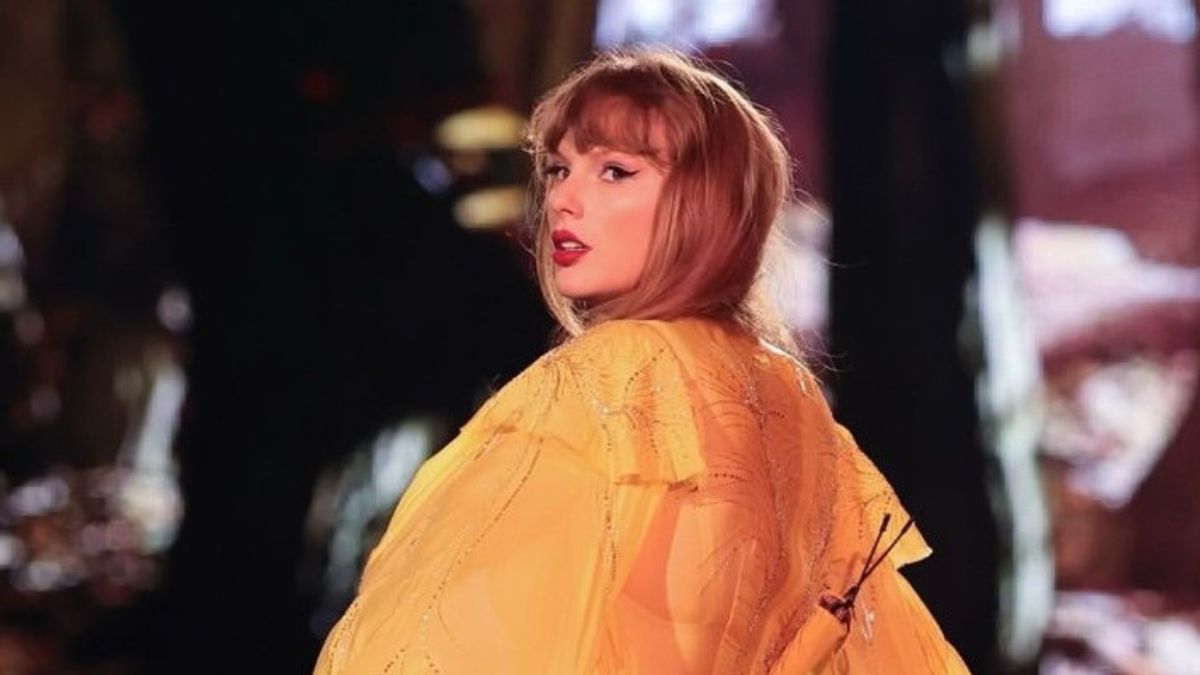


JAKARTA - Taylor Swift is rumored to have taken a strategic legal step to protect her digital identity amid the rapid threat of artificial intelligence or artificial intelligence (AI).
This move follows in the footsteps of Oscar-winning actor Matthew McConaughey, who has previously taken a similar path to mitigate the misuse of deepfake technology.
Citing Variety, Swift's company, TAS Rights Management, has filed three trademark applications with the United States Patent and Trademark Office (USPTO). Two of them are related to voice trademarks that include iconic phrases, namely "Hey, it's Taylor Swift" and "Hey, it's Taylor".
In addition to the sound, the singer of "Anti-Hero" also registered a very specific visual trademark. The description in the document includes a photo of Taylor Swift holding a pink guitar with a black strap, wearing a shiny multicolored bodysuit, and silver boots, while standing on stage under the glow of purple lights.
Gerben IP's intellectual property rights lawyer, Josh Gerben, assessed that Swift's actions were a real response to the anxiety of artists in the global entertainment industry. AI is considered to have great potential to steal artists' ability to control their voice and self-image without permission or consensus.
Historically, trademarks are not designed to protect a person's persona in general. However, the legal strategy also applied by Matthew McConaughey's team aims to provide additional legal grounds at the federal level - beyond traditional publicity rights that usually only apply at the state level, such as California or New York.
"Theoretically, if a lawsuit is filed related to AI that uses Swift's voice, he can claim that any use of the voice that sounds like the registered trademark has violated his trademark rights," Josh Gerben said, quoted Tuesday, April 28.
Swift's preventive steps are not without strong reasons. His image has been recorded as having been repeatedly misused through AI technology, ranging from the creation of fake pornographic content that went viral, to photo manipulation by irresponsible parties in the political campaign vortex in the United States.
Gerben added that the very detailed visual registration down to the type of clothing and pose aims to provide a more solid legal basis.
"By protecting the distinctive visual, the Swift team may gain additional footing in pursuing claims against manipulated or AI-generated images that evoke its likeness," the lawyer added.
Although this "registering yourself as a brand" approach has not been fully comprehensively tested in AI-related courts, in theory it allows artists to issue content removal orders more effectively.
For example, by the end of 2025, Disney managed to force the AI platform owned by the technology giant to delete videos that plagiarized their branded characters in just a short time.
"In the end, Taylor Swift and Matthew McConaughey's latest trademark filings are an attempt to test new theories about how trademark law will work in the AI era," Gerben concluded.
The English, Chinese, Japanese, Arabic, and French versions are automatically generated by the AI. So there may still be inaccuracies in translating, please always see Indonesian as our main language. (system supported by DigitalSiber.id)
Popular


