

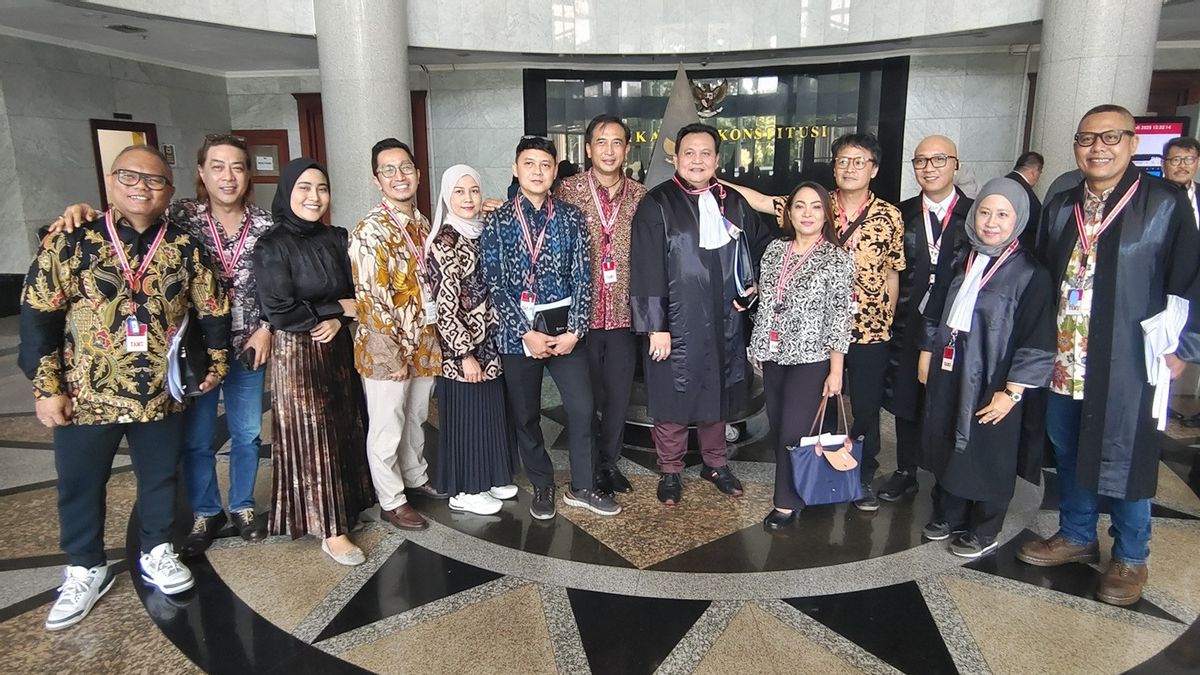


JAKARTA - The judicial review of the Copyright Law (UU Hak Cipta) continues at the Constitutional Court (MK) on Thursday, July 10, with the agenda of hearing information from the Related Parties from the National Collective Management Institute (LMKN), the Association of Singer Artists, Songwriters and Musicians of the Republic of Indonesia (PAPPRI), and Satriyo Yudi Wahono alias Piyu et al. (AKSI).
In his statement, Dharma Oratmangun as General Chair of LMKN requested that the application of the Petitioners' Case Number 28/PUU-XXIII/2025 be by members of the Indonesian Voice Vibration (VISION) and Case Number 37/PUU-XXIII/2025 by T'Koos' personnel be rejected by the Constitutional Court Panel of Judges.
Related parties have asked His Excellency the Panel of Judges of the Constitutional Court to declare that the Petitioners do not have legal standing, so the a quo application must be declared unacceptable, "said Dharma.
"Rejecting the Petitioners' Applications in its entirety or stating that the Applications are unacceptable," he added.
Dharma also explained that arguments with the arguments at this trial would not be of maximum benefit if users did not want to pay royalties.
"And this is a fact. They have made the potential loss of trillions of rupiah, to only less than Rp. 100 billion from the analog that we collect. Songwriters and performers only get droplets from their rights, so they are far from prosperous and end up fighting each other," he explained. Let us all think together on how to make these users who do not comply with this law get the maximum sanction through a simple, short, and cheap trial.
Similar to the request of LMKN, ACTIONs that speak through Piyu and her attorney, Singgih Tomi Gumilang stated, the articles proposed by VISI and T'Koos to be tested are constitutional and in line with the principles guaranteed by the 1945 Constitution.
"Protection of copyright is not only a matter of legality, but also a matter of ethics, justice, and the future of the national creative industry," said Piyu.
SEE ALSO:
"The state must not lose to market forces. So the existing system needs to be maintained and needs to be strengthened. We ask that the Panel of Judges of the Constitutional Court consider the integration of these norms and maintain their complete validity," he added.
Singgih continued, most of the songwriter groups are marginalized groups economically, which do not have the power of negotiations, do not have media access, and often do not understand the law and do not have a qualified legal understanding.
The Copyright Law is not only present as a legal product, but as a tool of social justice. When the state requires permission and regulates sanctions, it is not a form of domination of power, but a form of state protection for its weak people," said Piyu et al's attorney.
"If the provisions in the Copyright Law are weakened through wrong interpretations, then the winner is not justice, but the one who will win is market power," he concluded.
Photo caption: Members of ACTION and attorneys after the judicial review trial of the Copyright Law at the Constitutional Court (10/7/2025). (Ivan Two Men/VOI)
The Chairperson and Commissioner of LMKN after the judicial review of the Copyright Law at the Constitutional Court (10/7/2025). (Ivan Two Men/VOI)
The English, Chinese, Japanese, Arabic, and French versions are automatically generated by the AI. So there may still be inaccuracies in translating, please always see Indonesian as our main language. (system supported by DigitalSiber.id)


