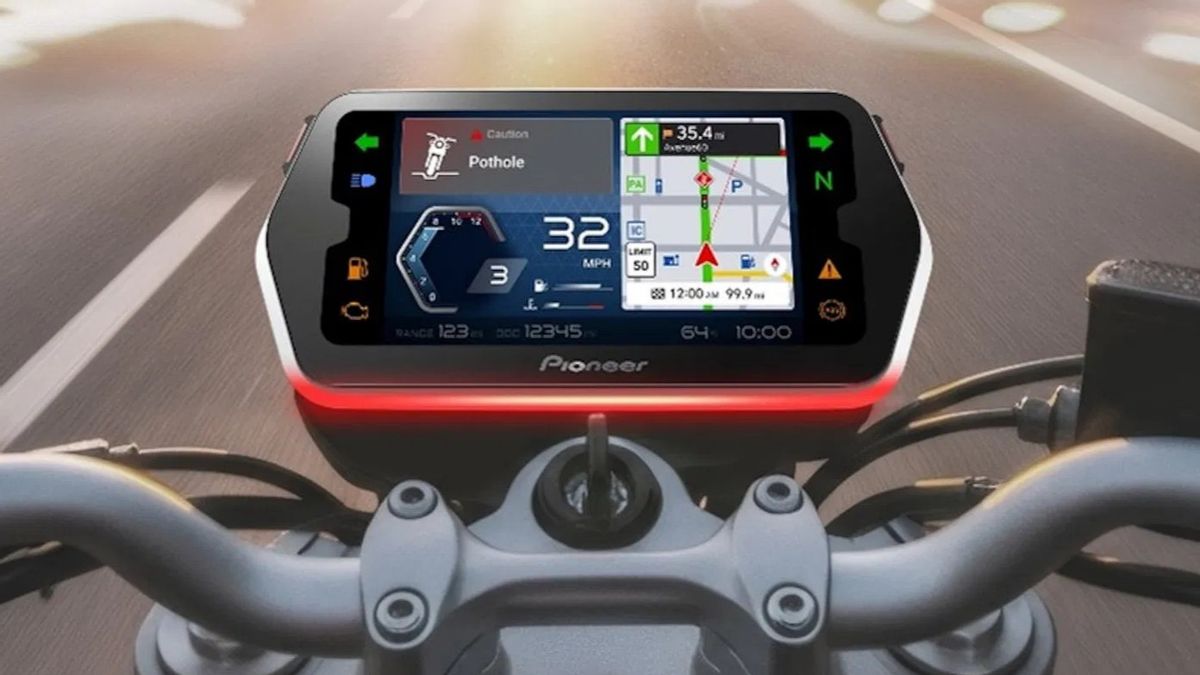


Pioneer took advantage of the Consumer Electronics Show or CES 2026 stage by introducing Ride Connect, the latest connected display system for motorcycles. Although it claims to present a revolutionary UX, the approach carried out is actually simpler.
Reported by Visordown, Ride Connect will simplify the way modern motorcycle dashboards work by relying on the rider's smartphone. Instead of developing increasingly complex and expensive instrument panels, Ride Connect moves most of the computing to the phone.
The dashboard of the motorcycle serves as a screen, while maps, navigation, and real-time data are processed on the phone and then sent via Bluetooth Low Energy (BLE). This is not a big technological leap, but a realistic recognition that the phone is already more capable than most of today's motorcycle hardware.
This shift has actually been predicted for a long time, a number of brands have offered similar systems that run alongside the TFT screen that is now the standard. Users can access software such as Apple CarPlay and Android Auto, as is also available on high-end motorcycles such as the latest generation Honda Gold Wing.
In practice, this system mirrors the phone screen, displaying apps, maps, and call information directly in front of the driver. Pioneer developed the user interface and screen projection technology, while mapping and navigation were handled by HERE Technologies through an existing SDK.
This collaboration gives access to global maps, routes, and traffic data in more than 120 countries, without forcing manufacturers to build or maintain their own infrastructure. In practice, Ride Connect displays navigation and connected information from the phone to the motorcycle screen without the heavy processing load of an integrated infotainment system.
Pioneer believes this approach is able to reduce production costs, reduce power consumption, and avoid the risk of systems quickly becoming obsolete in the middle of the model's life. For manufacturers (OEMs), this has the potential to be an important selling point.
Navigation is claimed to be optimized for the needs of motorcycles and supports offline maps for areas with limited cellular signal. Not entirely new, but relevant if this system is indeed intended for use outside the city, not just a demonstration.
Pioneer also highlights the Voice Tap interface, a voice control system designed to reduce physical interaction while driving. The concept is promising, but its effectiveness will depend heavily on performance in real conditions, from helmet use to wind noise.
The term "edge AI" is also used to share traffic, weather, and potential danger information. Behind the technical jargon, the function is similar to local processing-based warnings from connected data sources, similar to notifications on Google Maps or Waze.
The potential is huge, provided it is accurate and does not interfere with driving concentration. Overall, Ride Connect does not target drivers directly, nor does it try to redefine the driving experience.
The platform is designed to be friendly for OEMs to cut development costs, simplify global implementation, and keep the dashboard relevant through software updates, not hardware redesign. The real test begins when this technology is present on production motorcycles and tested on the streets.
"Pioneer Ride Connect is a revolutionary platform that continues to provide software-based improvements to the motorcycle UX," said Pioneer Executive Director Seiji Tanezawa.
"Pioneer Ride Connect is transforming the concept of a smarter and safer two-wheeled vehicle into a tangible reality. I am very happy to be able to introduce cutting-edge technology and our ambitious vision," he continued.
The English, Chinese, Japanese, Arabic, and French versions are automatically generated by the AI. So there may still be inaccuracies in translating, please always see Indonesian as our main language. (system supported by DigitalSiber.id)
Most Popular Tags
#Prabowo Subianto #donald trump #2026 World Cup #Febrie Adriansyah #8791Popular