

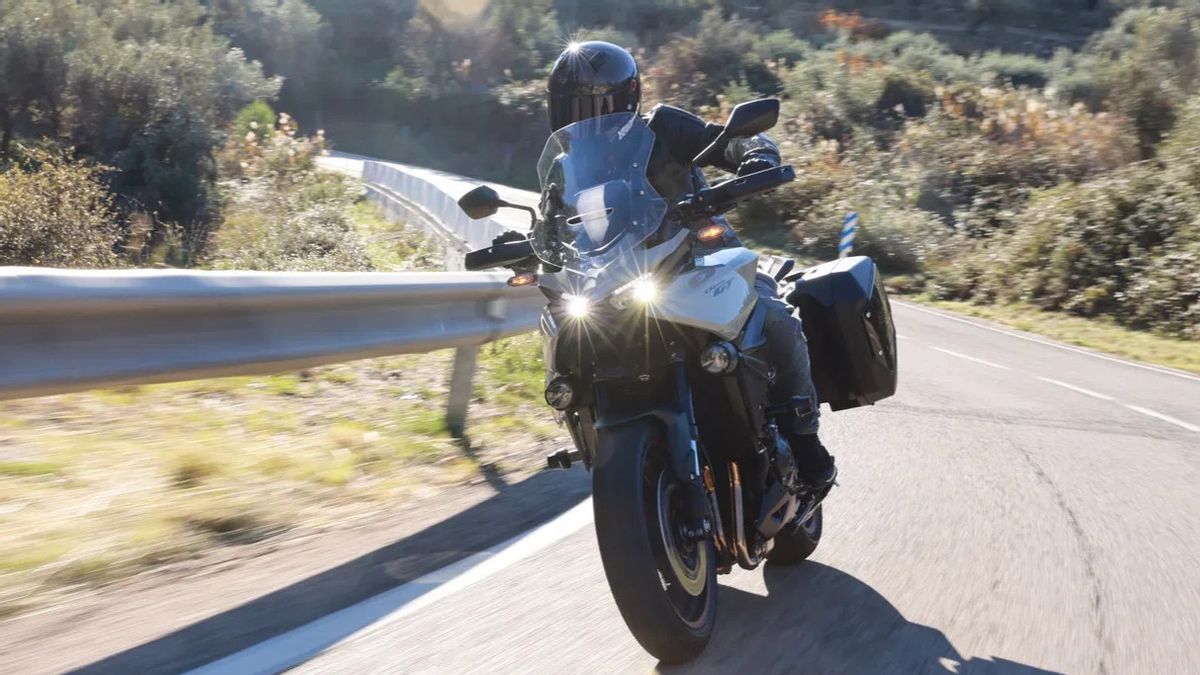


JAKARTA - Honda again surprised by filing a patent for a motorcycle steering assist system that allows the motorcycle to "interfere" in determining the direction when the system judges the danger to be too close. This technology is to minimize motorcycle rider accidents.
Until now, electronic safety technology is known as a life saver, ranging from ABS, traction control, wheelie control to airbags. All of them have proven to help reduce the risk of accidents in both two-wheeled and four-wheeled vehicles.
However, all of these technologies work to support the driver's input, not replace it. Quoted from Visordown, Monday, December 29, Honda's latest patent goes further.
In the document filed, an emergency steering system is explained that utilizes cameras, blind spot detection, and steering control to actively steer the motorcycle away from danger. The concept is similar to the lane keep assist system on a car, but applied to a motorcycle, something that has long been considered very sensitive.
Honda imagines this system working in two scenarios. First, when the system detects that the rider has reacted, whether by braking, turning, or setting the gas, the steering assistance will be supportive to stabilize the direction of the motorcycle.
The second, if the system judges the driver has not realized the threat, the steering assistance will be more active to help avoid danger without triggering panic or disturbing the balance.
On paper, this idea sounds smart, but in the real world many questions will arise. Because riding a motorcycle depends heavily on situational awareness.
From the very beginning of learning, riders are taught to always consider themselves "invisible" and prepare an escape route in every condition. Every decision on the road, position, speed, to the point of view is taken based on an instant assessment that is constantly changing.
This is where the doubts arise, how accurate is the system in reading complex and dynamic road situations? Avoiding one potential accident is ideal, but what if the automatic maneuver actually directs the motorcycle to another danger?
Another risk is the issue of control, a system that automatically turns the handlebars has the potential to reduce the driver's control sharpness. Even small unexpected inputs on the handlebars can have a big impact, something that is often felt when passengers suddenly shift their weight.
With technology like this, the sensation of surprise is feared to become more frequent. In the end, riding a motorcycle is about constant judgment, positioning, and escape planning.
Any system that physically takes over the steering wheel risks undermining that instinct. Or worse, it could steer the bike in a direction the rider doesn't want at all because the system reads a danger.
The English, Chinese, Japanese, Arabic, and French versions are automatically generated by the AI. So there may still be inaccuracies in translating, please always see Indonesian as our main language. (system supported by DigitalSiber.id)


