

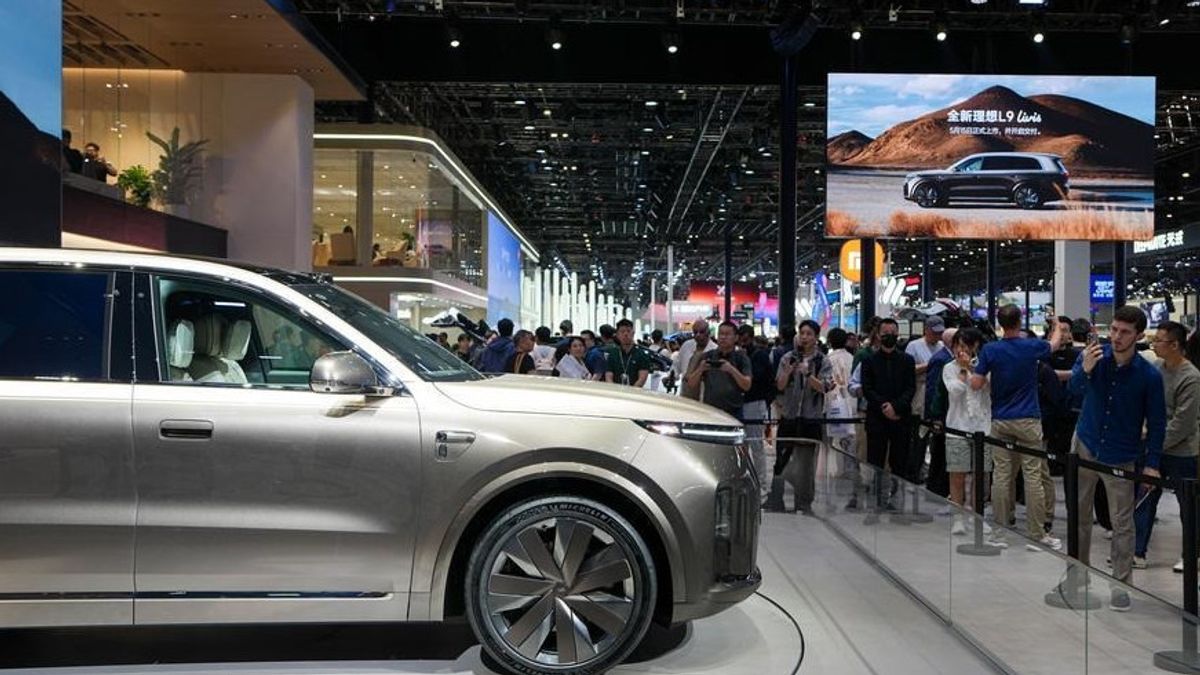


JAKARTA - The increase in fuel prices and turmoil in the Middle East have given an additional wind to Chinese electric cars. At the Beijing International Automotive Exhibition, the issue of cost savings is now stealing the stage from design, engine power, and smart features.
As reported by Xinhua, Thursday, April 30, the world's largest automotive exhibition occupies an area of 380,000 square meters and features 1,451 vehicles. The big highlight is on China-made new energy vehicles or NEVs, including the Formula S from BYD, the L9 Livis from Li Auto, and the ES9 from NIO.
Global brands are also accelerating electrification. Volvo is bringing the EX90, Volkswagen is showing off the ID.ERA 9X, while Nissan is showing the NX8.
On the exhibition floor, the conversation began to shift. Consumers and dealers are not only talking about engine power. They start to calculate fuel consumption, electricity costs, and charging speed.
"With the current political situation, especially the conflict involving America, Israel, and Iran, the price of oil and gas has risen sharply and it seems that it will not come down soon," said Jaroslaw Kochanowski, Managing Director of the Polish automotive dealer NeoDrive, quoted by Xinhua.
According to the International Energy Agency or IEA, the war in the Middle East triggered a major energy crisis, including the largest supply disruption in the history of the global oil market.
"In this situation, most people are looking for ways to save money. Many will be forced to find more affordable transportation solutions," said Kochanowski. "In that sense, electric vehicles are the next logical step."
Kochanowski said electric vehicles also give a sense of "energy independence". Homeowners can use rooftop solar panels to charge vehicles, although the cost of installing solar devices is still expensive.
"After all, you're almost impossible to produce gasoline yourself," he said.
In China, gasoline prices rose 3.8 percent year-on-year in March. However, electric vehicles remain attractive because of low electricity prices.
A Beijing resident surnamed Wang, owner of NIO, told Xinhua that his travel costs had dropped sharply after switching from a gasoline car. His electric car uses 17 kWh per 100 kilometers, costing about 7 yuan or about 1 US dollar. His old car used 9.2 liters of gasoline for the same distance, worth about 78 yuan.
China's electric vehicle exports have also been boosted. Zeekr recorded a record export in the first quarter of 2026. The Zeekr 7X model received strong interest in Australia, amid tight fuel supplies and high gasoline prices.
In March, China's NEV deliveries reached 371,000 units, more than double the previous year.
"High oil prices significantly increase the cost advantage of NEVs and provide a strong impetus for their adoption," said Cui Dongshu, Secretary-General of the China Passenger Car Association.
However, the low price is not the only attraction. A young visitor from Hungary named George said the increase in fuel prices was not the main reason for his interest in Chinese electric cars. He saw more driving performance and technology offered.
China's NEV industry is now supported by an integrated supply chain, competitive costs, and rapid innovation. By 2025, NEV production and sales in China will both exceed 16 million units. NEVs also account for more than 50 percent of new car sales in the domestic market.
The challenge remains. In many countries, charging networks are still limited, standards are not uniform, and concerns about mileage have not disappeared. Public charging costs in Poland, for example, are still relatively high so that savings compared to gasoline cars are not too big.
Lang Xuehong of the China Automobile Dealers Association, still referring to the same source, said global demand for China's NEV was not enough to support high oil prices. China needs to bring its industry ecosystem abroad, from battery suppliers, components, local supply chains, to local production.
The English, Chinese, Japanese, Arabic, and French versions are automatically generated by the AI. So there may still be inaccuracies in translating, please always see Indonesian as our main language. (system supported by DigitalSiber.id)


