
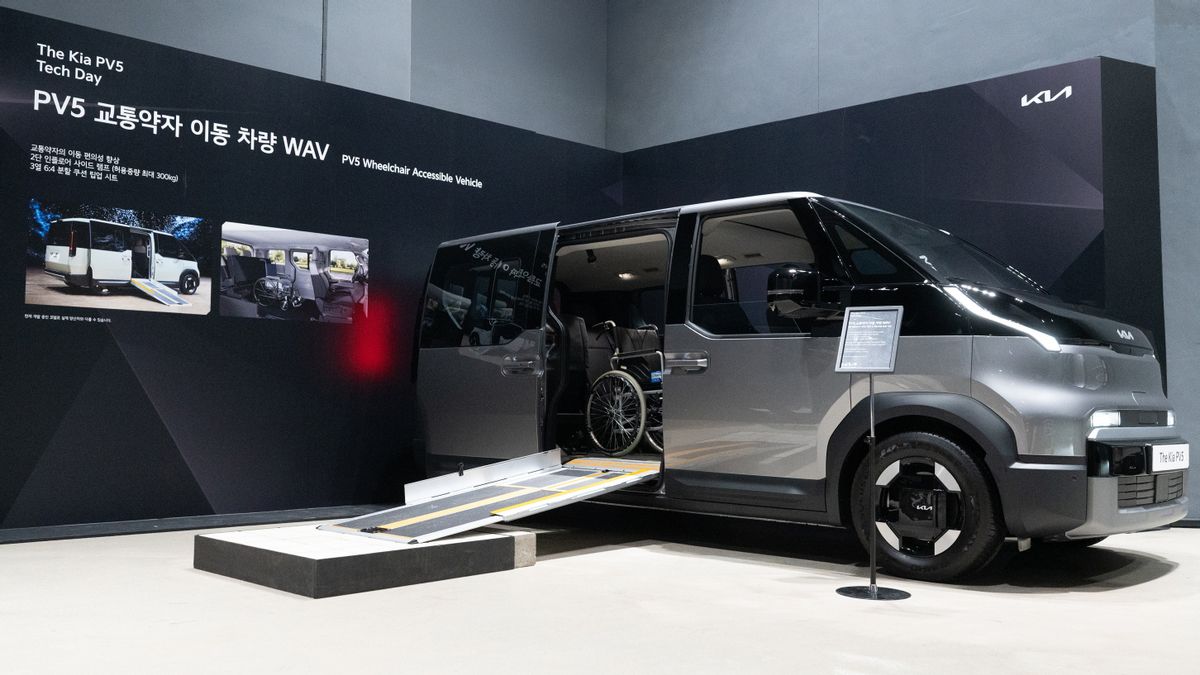


JAKARTA - Kia Corporation has just explained the full story of Kia PV5, the first vehicle from the Kia Beyond Vehicle (PBV) platform, at the Kia PV5 Tech Day event at IVEX Studio, Gwangmyeong, South Korea.
The event highlights the innovative concepts, advanced technologies, and customer input-based development that are at the core of PV5. Kia PV5 is designed to redefine commercial vehicle markets, focusing on sustainable and flexible mobility solutions that can adapt to various business and lifestyle needs.
Launching the HMGnewsroom page, Wednesday, July 23, it is mentioned that one of the most prominent aspects of PV5 development is a customer-centric approach. Kia is not only conducting traditional market research, but actively collaborating with more than 120 global business clients from various sectors, including mobility, logistics, shipping, and utility, through PBV Partners Day events in 2022 and 2023. Direct input from these partners significantly affects the main features of PV5, such as removing front passenger seats to expand cargo space, use of stain-resistant materials, and 'walk-through' options on high roof versions that allow easy access between cabins and cargo areas.
The heart of PV5 is the first PBV-specific platform of the Hyundai Motor Group, Electric-Global Modular Platform for Service (E-GMP.S). This platform integrates an Integrated Modular Architecture (IMA) that standardizes complex systems such as batteries, motors, and suspensions, significantly reduces development time and improves scalability. The E-GMP.S is designed to maximize the interior space with an optimal low-floor and PE (Power Electric) component layout, ensuring the extraordinary cargo capacity and driver comfort. Additionally, fleet management (FMS) and Android-based infotainment systems Automotive will enable business customers to manage and monitor their vehicles in real-time.
Kia also introduced a revolutionary Body Flexible System at PV5. This modular design and production approach allows the main components such as body structures, doors, and exterior/interior panels to be swapped like building blocks. This allows Kia to configure up to 16 different PV5 variants with just a few modular assemblies, providing extraordinary flexibility in development and production. Initially, seven basic configurations would be offered, including passenger models, standard cargo, long cargo, and high roof cargo, which could be easily adapted for a wide range of uses.
SEE ALSO:

Intelligent PV5 designs maximize interior space and usage capabilities. Although the size is on par with segment C vehicles, the axis distance of the 2,995 mm wheel and its low-floor design provide extensive cargo spaces of up to 3.6 m3 on passenger variants with folded second row seats, and up to 5.1 m3 on high roof variants. Additional features such as infotainment systems tailored to businesses, AddGear platforms for the installation of accessories, and Kia original accessories are further improving the utility of these vehicles. Kia also ensures PV5 is ready for conversion, with dedicated conversion centers and online portals providing access to technical data for global partners.
PV5 is available with a choice of three battery configurations: 43.3 kWh LFP packages, 51.5 kWh NCM packages, and 71.2 kWh NCM packages all combined with 120 kW electric motors that generate 250 Nm torque.
Mass production of the PV5 Passenger and Cargo Panjang models began this month, with additional variants following. Kia has ambitious plans to expand their PBV line, with PV7 scheduled for 2027 and PV9 in 2029, offering a larger model to meet the spectrum of wider business and lifestyle needs.
The English, Chinese, Japanese, Arabic, and French versions are automatically generated by the AI. So there may still be inaccuracies in translating, please always see Indonesian as our main language. (system supported by DigitalSiber.id)


