

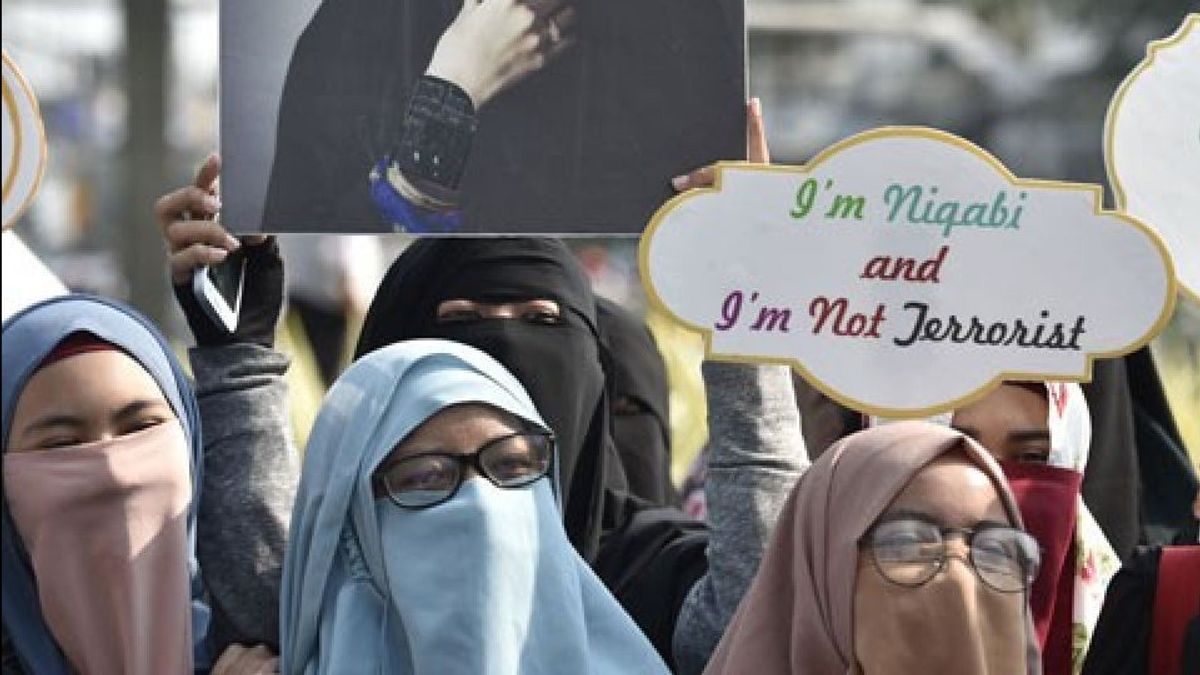


History today, six years ago, March 5, 2020, the Minister of State Apparatus Development and Bureaucratic Reform (Menpan-RB), Tjahjo Kumolo, explained the reason for prohibiting the use of veils for state civil servants (ASN) while working. He emphasized that the use of veils could interfere with public services.
Previously, Tjahjo dared to confirm the ban on the use of veils for ASN in the environment of the Ministry of Manpower and Transmigration while working. He considers his ministry to have its own rules about clothing. He only allows ASN to use veils again when they go home from work or outside the office.
Dress matters are the right of every citizen. They are free to use any clothing that enters the decency corridor. However, each government agency has its own rules regarding clothing.
The narrative was acknowledged by Tjahjo Kumolo. The Minister of Social Affairs considered that the dress code in his ministry environment should not be violated. He emphasized that the ASN of the Ministry of Social Affairs and Human Development was prohibited from wearing veils during work, which was implemented in mid-2019.
He considers the rule not to be part of combating radicalism. He considers the ban on veils as a form of enforcing discipline. The narrative is supported by the absence of a ban on the use of headscarves. The use of headscarves and peci for men is allowed.
Tjahjo only limits the prohibition of veils during work or in the office environment. Those who have finished working and are outside the office are allowed to use veils. Tjahjo also limits that the rule prohibiting veils is only within the scope of the Ministry of Social Affairs and Politics.
He has no plans to expand the rules to other government agencies. Other government agencies depend on the leadership. Tjahjo also does not want to implement the rules for regulating cingkrang pants at the Ministry of Pan-RB as advocated by the Ministry of Religion under the leadership of Fachrul Razi.
"If it's me (Kemenpan-RB) I have to wear a veil. So if you want to wear a veil outside the office, please, he is a citizen, free. If Kemenpan-RB has a white uniform. If it's national days, wear korpri, there are other clothes. Only, if in the office for me, don't wear a veil. If you wear a veil, please outside the office. "
"How can I meet you, you wear a veil. Muslims please wear a hijab, there is no problem. Want to wear a hijab inside (collar), want to wear a hijab that covers (chest) it's each other's rights. Want to wear a peci please, but if you wear a veil, how can you see it," said Tjahjo as quoted by the ANTARA website, November 4, 2019.
Pro and cons arise from the policy rolled out by Tjahjo. Those who are pro consider that each office has the right to have its own authority in matters of dress code. Those who are against think that the state cannot go too far into religious affairs - in this case, the veil.
Tjahjo himself continues to carry out the existing rules. He then revealed the reason for the prohibition of the use of veils in the Ministry of Social Affairs and Politics on March 5, 2020. Tjahjo considers that veils will disrupt public services. Moreover, ASN's work is at the level of serving the community.
Tjahjo also remained firm if ASN wanted to use a veil. The ban only applies during working hours at the Ministry of Manpower and Transmigration. However, ASN can use the veil again when they go home and when they are outside the office.
"Each Ministry of Institutions has a sample regulation in my ministry 'Sir, can I not work wearing a veil?' Loh so you are from home wearing a veil please. Once you get to the office door, you have to take off the veil, how to serve the community wearing a veil," said Tjahjo as quoted by the Kumparan page, March 5, 2020.
The English, Chinese, Japanese, Arabic, and French versions are automatically generated by the AI. So there may still be inaccuracies in translating, please always see Indonesian as our main language. (system supported by DigitalSiber.id)


