

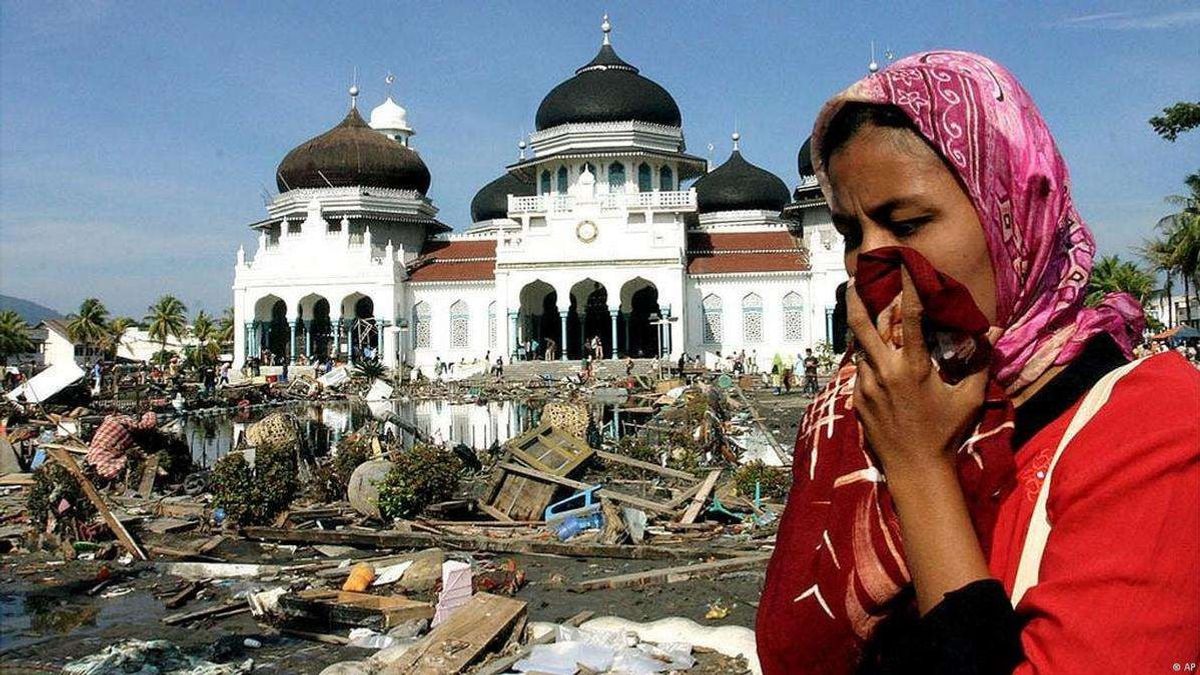


JAKARTA - No Indonesian people do not know the ferocity of the 2004 Aceh tsunami. The earthquake and the huge sea waves brought disaster to the Land of the Porch of Mecca. The victims fell, the buildings collapsed. The losses are incalculable.
The whole of Nusantara is in mourning. However, not all Aceh regions contribute high death rates. Take the example of Simeulue Regency. The majority of Simeulue residents are safe, out of a total of 78 thousand people, only seven people died. They survived thanks to being accustomed to hearing the art of speech: the Smong poem.
The Indonesian government has never been serious about disaster mitigation. In fact, mitigation efforts are very important in order to reduce the risk and the bad impact of disasters. Mitigation can also increase the awareness of all citizens when a disaster occurs, they can be ready to escape to save themselves.
The portrait is clearly visible when the earthquake and tsunami hit Aceh on December 26, 2004. The government's inability to provide early warning of a potentially tsunami-causing earthquake resulted in fatal consequences. This condition is exacerbated by the fact that not all people have knowledge about the characteristics of a tsunami.
As a result, many did not take quick action to save themselves. Especially when the big earthquake that is the hallmark of a tsunami occurs. The disaster also appeared. A huge wave of almost 30 meters high came sweeping away all of Aceh.
The number of victims fell. The number is not a small number, reaching 220 thousand people. The losses suffered by the people of Aceh are incalculable. As a result, it is not only Indonesian citizens who are grieving, but the world. This condition makes the government confused in dealing with disasters.
The government admitted that it could not face the tsunami disaster alone. This condition made the world to be in solidarity. Humanitarian aid flowed from everywhere, from within and outside the country. Volunteers from various regions also came to help evacuate tsunami victims.
The wounds and trauma caused by the tsunami continue to be etched in the hearts of the people of Aceh. Moreover, those who were left behind by relatives died. This condition makes the world forget for a moment that in Aceh there is a government military operation against the Free Aceh Movement (GAM).
"Every December 26, we who pay attention to the 2004 earthquake and tsunami that hit Aceh and several other areas in Southeast Asia share memories of the scale of the earthquake, the height of the sea waves, and the massive death afterwards. For those who survived the tsunami, the remnants of the apocalypse that did not come on Sunday were the sea wind holes. "
"From the gaps of collapsed buildings, tsunami puddles, aftershocks, the roar of helicopters carrying logistical aid, ambulances carrying broken bodies, and the roar of trucks carrying bodies to mass graves. The world was shocked and intervened in the largest death feast in the first decade of the millennium. The 2004 tsunami was consecrated as an international disaster," said Reza Idria in his article in Tempo magazine titled Aceh yang Asing dan Jauh (2014).
Syair SmongThe tsunami almost certainly left a trail of many casualties throughout Aceh. However, not with the residents of Simeulue Regency. The residents of Semeulue are seen as the most agile in saving themselves when a major earthquake occurs.
Once a major earthquake occurs, the residents of Semeulue immediately take their families to high ground to save themselves. As a result, the number of casualties who fell was not much. The majority survived, out of a total of 78 thousand people, only seven people died.
The condition is not because it relies on mere intuition. It is also not because of the early warning of the tsunami by the government which is clearly absent. Everything is because the residents of Simeulue have been poisoned by listening to the poem Smong. Smong in the local language is seen as a tsunami.
Syair Smong itself is none other than a classic literary art typical of Semeulue which contains advice and guidance related to tsunami disaster mitigation. Smong which is usually sung and told continues to be inherited from generation to generation.
Whoever hears the poem Smong will certainly have important knowledge to save himself. Smong poem is not a work that suddenly appeared. Smong came because the tsunami wave had hit the residents of Semeulue in 1907.
The tsunami in the Dutch East Indies era brought disaster. Many Semeulue residents died. Survivors did not want the same thing to happen again. They then continued to preserve the Smong poem to be heard by their grandchildren.
Smong was then considered a savior poem. A poem that contains a mitigation message that when there are signs of disaster they can save themselves, without having to wait for the government's instructions.
"Nurliani (a resident of Simeulue) remembers the verses of the smong poem that he often heard. Anga linon ne mali, uwek suruik sahuli, maheya mihawali fano me singa tenggi, ede smong kahanne. That is, if the flood is strong, followed by receding water, immediately find your higher place, that is the name of smong," read the report in Tempo magazine titled "Traveling with Smong Poems" (2014).
The English, Chinese, Japanese, Arabic, and French versions are automatically generated by the AI. So there may still be inaccuracies in translating, please always see Indonesian as our main language. (system supported by DigitalSiber.id)


