

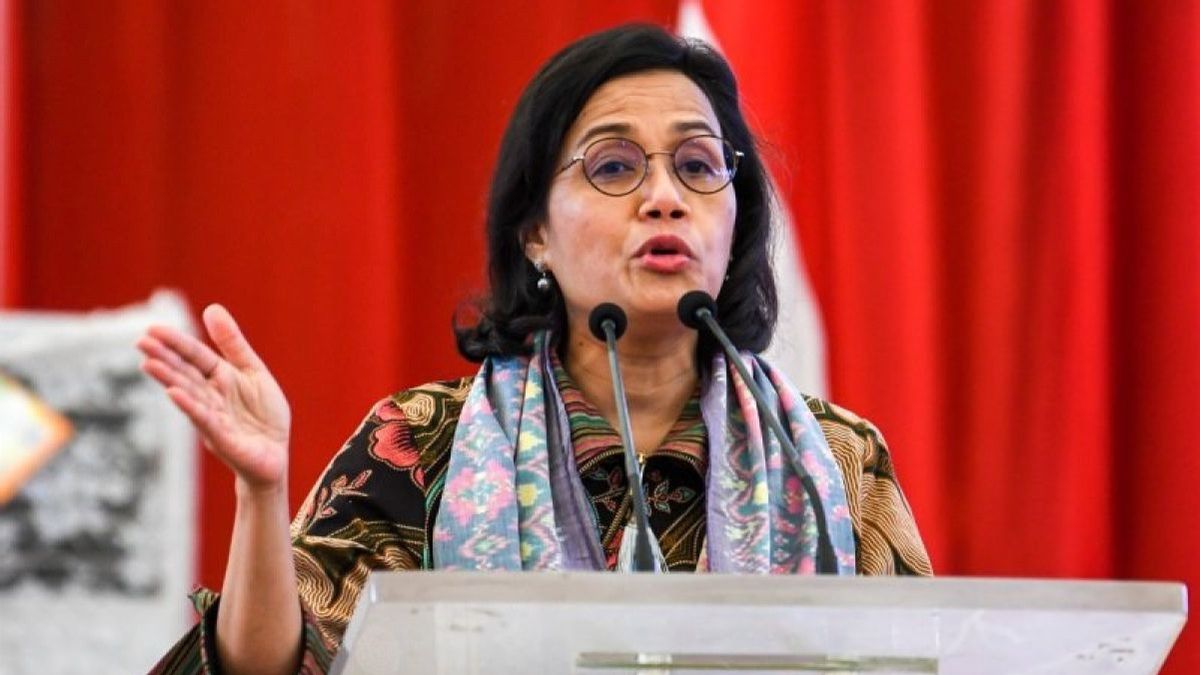


JAKARTA - Taxes are a crucial instrument for regulating a nation's growth and development. This situation forces the Ministry of Finance (Kemenkeu) to work tirelessly. They serve as the government's go-to person for collecting and managing tax revenues.
This practice is clearly not easy. Sri Mulyani Indrawati concurs. The Minister of Finance from 2014 to 2025 was overwhelmed with tax collection. She constantly sought new tax loopholes – trying to capture the potential of anything. As a result, Sri was often labeled a tax extortionist. She was also sometimes labeled a tyrannical Minister of Finance.
No one doubts the vital role the Ministry of Finance plays in a nation. This situation makes the position of Minister of Finance a difficult one for just anyone. Unlike other ministerial positions, a single wrongdoer can disrupt the entire nation.
This is because the Minister of Finance is heavily involved in managing state finances. This figure must be proficient in matters ranging from budget regulation to state financial management. President Joko Widodo (Jokowi) fully understands this.

He didn't want the position of Minister of Finance to be filled by someone who didn't understand the ins and outs of economics. As a result, Jokowi chose Sri Mulyani as the new Minister of Finance since 2014. Sri's selection was considered a sensible and optimal choice.
Sri Mulyani had experience as Minister of Finance under Susilo Bambang Yudhoyono (SBY). Sri also had experience as Managing Director of the World Bank from 2010 to 2016. Sri tried to fulfill the trust of Jokowi and the Indonesian people.
She viewed her new position as Minister of Finance as a challenge. She began thinking about increasing state revenue – primarily from taxes. Sri began to examine which activities had the potential to be taxed.
She once proposed robots to replace human taxable tasks. Sri also considered the potential taxation of online sellers. This situation often led to Sri's criticism. She was considered no different from the previous Minister of Finance: an extortionist.
"The problem is that this tax creates a new door. Those who want to enter e-commerce must submit a Taxpayer Identification Number (NPWP). If it were taxed to each seller, that wouldn't be a problem. It's as if we're being asked to help entrepreneurs register their NPWPs. What about social media and chat, which are also used for selling? Will they be taxed as well?"
"Whatever is decided, there must be data. To date, we haven't been shown the data, including the risks, costs, benefits, and expenses. Maybe they (the government) have it. But we haven't received it. So we're nervous. We're not anti-tax, but we want to consider the greater good. Whatever is decided will have consequences. But this isn't a threat," criticized the chairman of the Indonesian E-Commerce Association (iDEA), Ignasius Untung, as quoted by CNBC on January 14, 2019.
Cruel Finance Minister
The government's perspective on tax collection may be crucial for the country's growth. However, the constant pursuit of tax potential has left the public fed up. The Ministry of Finance, particularly Sri Mulyani, is often the target of Indonesian anger.
Sri's active pursuit of new tax potential is considered uncreative. Sri is being asked to consider other revenue instruments besides taxing the common people. The people are being exploited like cash cows. Furthermore, the benefits of tax revenues are largely ignored by the general public.
Development has always been centralized on the island of Java, with those outside Java left to fend for themselves. This situation has often earned Sri negative labels. Sri is often seen as an extortionist because her job is solely to tax ordinary people, refusing to tax the wealthy.
Sri asserts this view is reasonable. Even the Minister of Finance, whom she considers the best, Mar'ie Muhammad, has been labeled an extortionist. However, no minister has ever been labeled a tyrannical minister by the people more than she.

This view made Sri feel that her job as Minister of Finance was not easy. In fact, the task of collecting taxes involves both the Ministry of Finance and local governments. She admitted she felt sad to be seen as an oppressive minister. However, Sri persisted.
She views all forms of criticism as feedback, an encouragement to do her best for the nation and state. She continues to address the people's tax affairs to improve their lives.
"We hear that many entrepreneurs face obstacles in the form of regional taxes. There are 16 types of regional taxes and 32 types of regional levies. The problem is that when people think about taxes and levies, they always think of the Minister of Finance."
"They often complain about increases in land and building tax (PBB) and vehicle ownership (BPKB), and they complain that the Minister of Finance is very oppressive. But those are all regional taxes and levies. There are 16 taxes and 32 types of levies," said Sri Mulyani, as quoted by CNBC on September 18, 2019.
The English, Chinese, Japanese, Arabic, and French versions are automatically generated by the AI. So there may still be inaccuracies in translating, please always see Indonesian as our main language. (system supported by DigitalSiber.id)
Most Popular Tags
#Prabowo Subianto #donald trump #firearm #8791 #giias 2026Popular


