
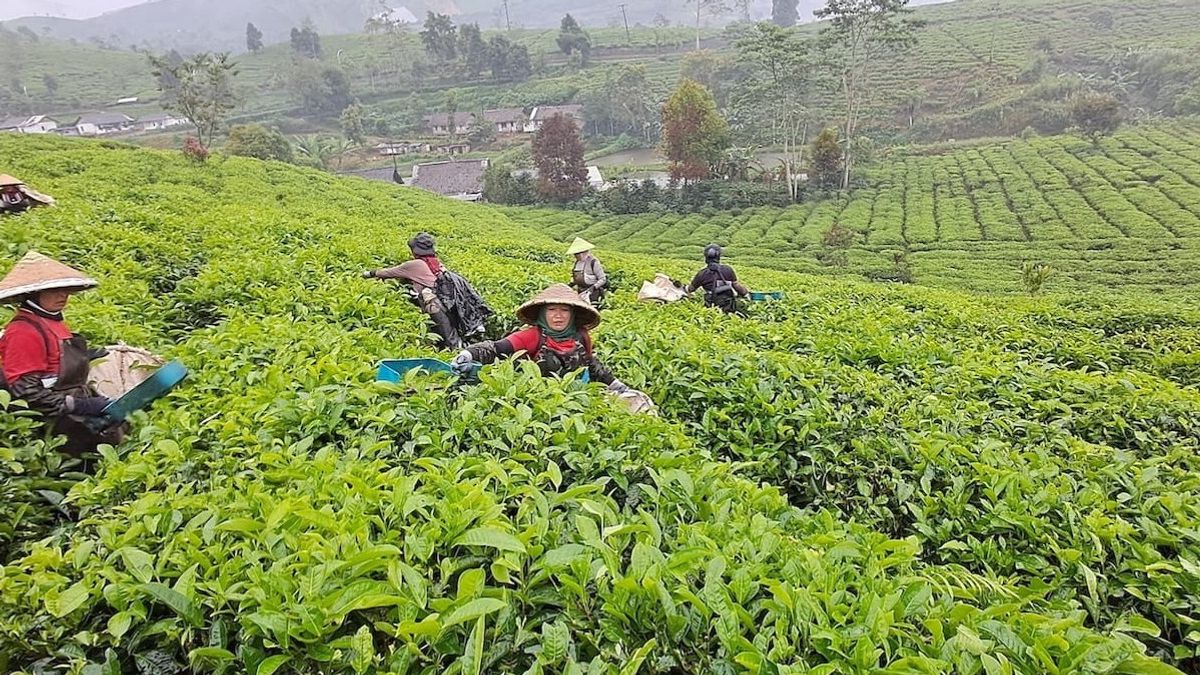


JAKARTA - For many Indonesians, tea is not just a complementary drink. Its presence has become part of a social habit that lasts across generations. Serving tea to guests, accompanying breakfast, to becoming a friend to rest in the afternoon is a familiar daily image found in many Indonesian households.
The popularity of tea in Indonesia is reflected in various national consumption data. Based on the BPS 2023-2024 National Socioeconomic Survey (SUSENAS), tea ranks as the second most consumed beverage after water.
In addition, Roy Morgan Single Source Indonesia research shows that tea products are available in around 95-97 percent of Indonesian households. This figure illustrates how tea has become an important part of people's daily consumption patterns.
The momentum of International Tea Day which is celebrated every May 21 is also a reminder that a cup of tea that people enjoy actually goes through a long journey. Not a few consumers enjoy tea without knowing that the quality of taste in the brew is greatly influenced by various factors since the plants are still growing in plantations.
The quality of tea is not only determined during the processing process at the factory, but has been formed long before the leaves are picked. The environment where the plants grow has a great influence on the taste, aroma, and final character of the tea.
According to the Food and Agriculture Organization (FAO), a number of natural factors such as land elevation, air temperature, rainfall, and humidity levels greatly affect the growth of tea plants. Plantation in highland areas with lower temperatures generally produce slower leaf growth. Interestingly, these conditions are often considered ideal in the tea industry.
"In the tea industry, slower growth is actually considered ideal because it gives plants more time to form natural compounds such as polyphenols, amino acids, and essential oils. These compounds are responsible for creating rich aromas, deeper layers of flavor, and a smooth brewing character," said Devyana Tarigan, Head of Marketing Communications & Public Relations PT Sinar Sosro Gunung Slamat, quoted from an official statement from Sosro.
The not-too-fast growth gives plants more time to form important natural compounds such as polyphenols, amino acids, and essential oils. It is these contents that contribute to the complexity of aroma, depth of taste, and a softer sensation when drinking.
In addition, the foggy mountainous environment also plays an important role. The fog helps reduce the intensity of direct sunlight exposure so that the tea leaves can develop more evenly without producing a too sharp taste.
Not all parts of the tea plant have the same quality. Young tea leaves are generally the main choice because they are considered to have the best taste and more optimal natural content.
Therefore, the picking process is an important stage that requires high accuracy. Determining the time of harvest, leaf conditions, to the way of picking must be done properly so that quality is maintained. After being picked, the tea leaves cannot be left too long because changes in temperature and exposure to air can affect freshness and its aroma profile.
In the modern tea industry, the speed of distribution from the garden to the processing process is an important part of the quality system. Late handling can affect the final result, so the connection between the cultivation and processing processes is an inseparable aspect.
Producing a consistent tea taste over time is not a simple process. Manufacturers need to maintain the quality of raw materials from the early stages, including the selection of plantation areas that match the characteristics of the tea that they want to produce.
This approach is applied by Sosro, one of the ready-to-drink tea companies in Indonesia. By managing plantations in a number of highland areas in West Java such as Pangalengan, Garut, Tasikmalaya, to Cianjur, the company strives to maintain the quality of tea leaves through environmental conditions that support optimal growth.
The process of picking raw materials is done manually by skilled workers and supported by the use of environmentally friendly battery picking machines. This step aims to maintain the quality of young tea leaves while maintaining plant health so that the productivity of the garden is maintained.
For industries such as Sosro, tea quality is not only seen from the final result in the package, but also from how each stage is maintained from the beginning. Starting from plant maintenance, picking process, to processing is an important part in producing a taste that remains consistent in the midst of seasonal changes and production dynamics.
This approach then became the foundation of various lines of tea products presented by Sosro, ranging from Sosro Bottled Tea, Sosro Fruit Tea, Sosro Dip Tea, to Sosro Heritage. In the midst of the rapid development of the beverage industry, the journey of a young tea leaf shows that the quality of taste requires a long process, accuracy, and experience that is built sustainably.
A cup of tea that is present on the community table is not just about the taste that is enjoyed for a moment. Behind it there is a long process of cultivation, management, and consistency that also determines the quality from the source.
The English, Chinese, Japanese, Arabic, and French versions are automatically generated by the AI. So there may still be inaccuracies in translating, please always see Indonesian as our main language. (system supported by DigitalSiber.id)
Popular


