
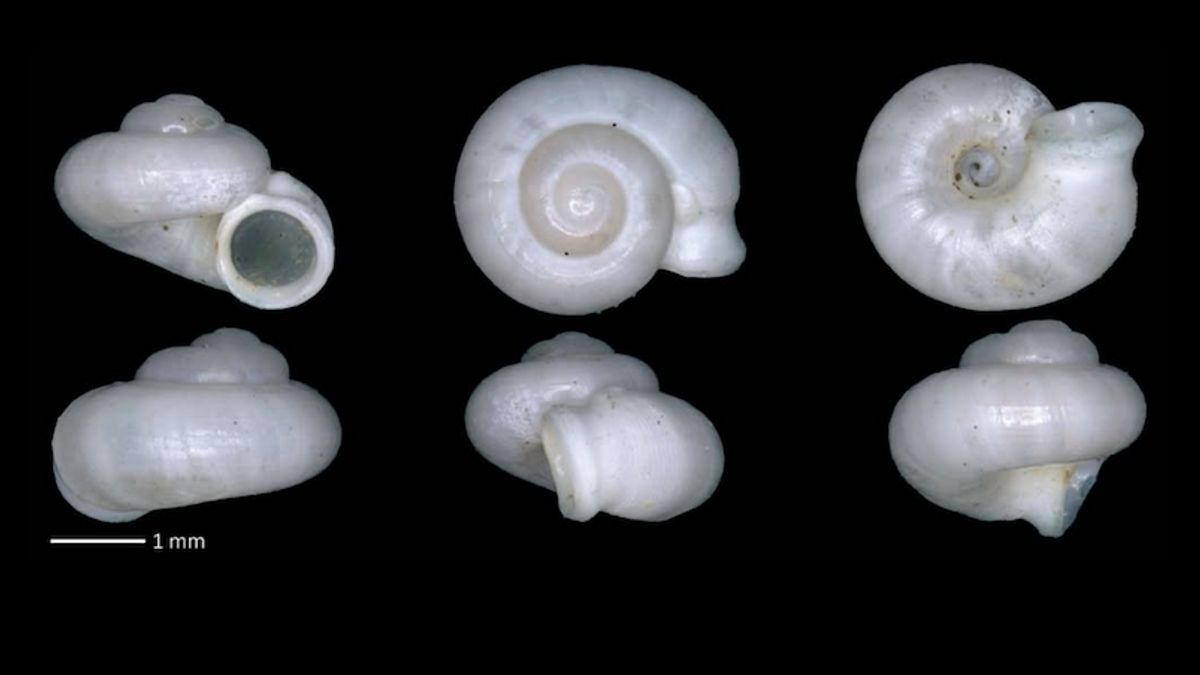


JAKARTA - Indonesia is well known as one of the countries with unique fauna wealth. The diversity of animals that live in various ecosystems ranging from tropical rainforests, karst areas, to small islands makes Indonesia an important area for biodiversity research.
Not a few species in this country are endemic, meaning they are only found in certain areas. This condition makes scientific exploration continue to be carried out to uncover various new species that have not been recorded previously.
One of the latest findings came from a team of researchers from the Center for Biosystematic and Evolutionary Research at the National Research and Innovation Agency (BRIN). They managed to describe a new endemic land snail species from South Sumatra which was given the scientific name Chamalycaeus dayangmerindu.
Researcher from the research center, Ayu Savitri Nurinsiyah, explained that the Chamalycaeus dayangmerindu species has only been found in the Padang Bindu karst area, South Sumatra.
"This condition makes them vulnerable to environmental changes, including land use changes and habitat degradation," said Ayu.
He assessed that the documentation and publication of new species is a very important initial step in conservation efforts. According to him, the process of finding and designating an organism as a new species takes a long time and various stages of scientific research.
A new species, said Ayu, must go through various scientific studies, such as morphological, anatomical, and genetic analysis. In addition, researchers also need to make comparisons with previously known species, before finally going through the process of review by international experts (peer review) and published in scientific journals.
"The long journey of revealing biodiversity has been the footsteps of every taxonomy. Starting from expeditions and exploration in the field, literature and laboratory research, to the process of writing and international recognition," he said, as quoted by ANTARA.
Although the process is long and not easy, Ayu emphasized that each stage of research has an important value for the development of science.
"Although long and full of challenges, every process in the journey will be meaningful and beneficial," he said.
The results of this research have been published in a high-ranking international scientific journal, ZooKeys, volume 1272: 1-31 (2026), with the title Operculate land snails (Gastropoda, Caenogastropoda, Cyclophoroidea) from Padang Bindu Karst, South Sumatera, Indonesia with the description of a new species, Chamalycaeus dayangmerindu.
The research is also the result of collaboration with a number of institutions, namely the State University of Surabaya (Unesa) and the Széchenyi István University in Hungary.
Through these findings, the BRIN research team hopes that exploration and biodiversity studies in Indonesia can continue to be improved, especially in the land molluscs group, as part of efforts to inventory and preserve Indonesia's biodiversity sustainably.
The English, Chinese, Japanese, Arabic, and French versions are automatically generated by the AI. So there may still be inaccuracies in translating, please always see Indonesian as our main language. (system supported by DigitalSiber.id)


