
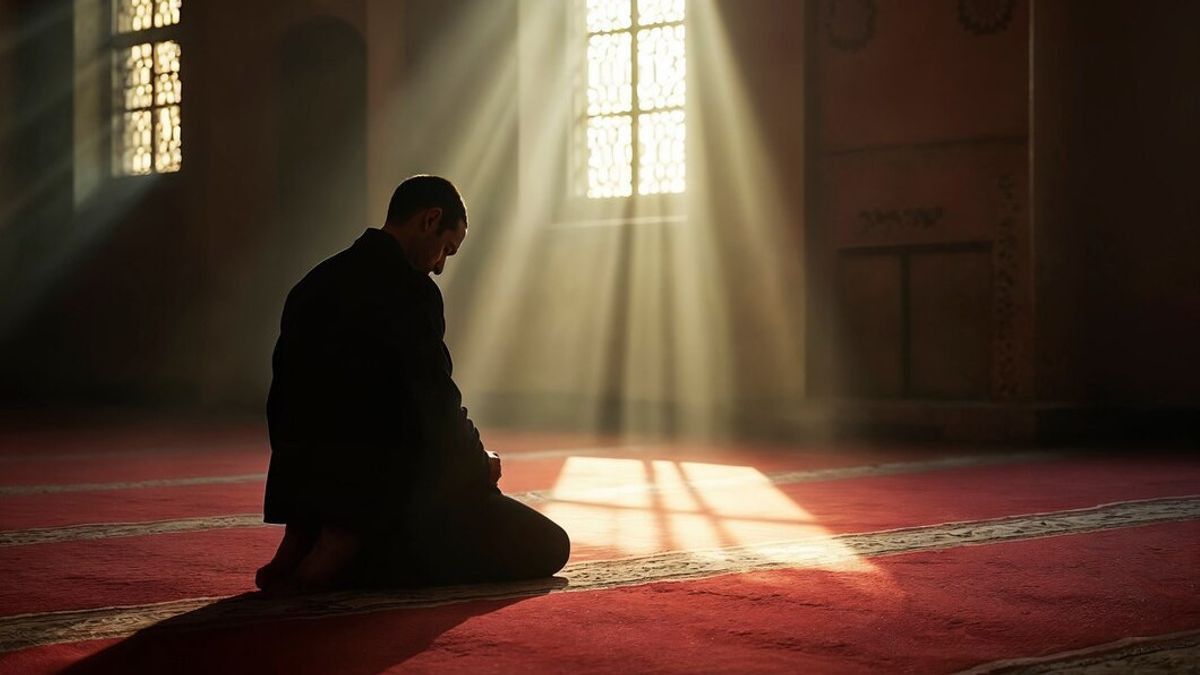


YOGYAKARTA - In the history of Islamic civilization, the name and story of Bilal bin Rabah occupy a special position. He is not a Quraish noble, nor a rich merchant, but only a black slave from Habasyah (Ethiopia) who was initially looked down upon by the Jahiliyah society. However, Islam has raised his status so high, changing his social status from a downtrodden slave to one of the most noble companions at the side of the Prophet SAW.
The Story of Bilal bin RabahThe story of Bilal bin Rabah is also a symbol of resistance against racism and a tangible proof that in Islam, a person's glory is not seen from skin color, ancestry, or wealth, but based on piety. His firmness in defending the sentence of Tawhid in the midst of heinous torture, as well as his golden voice which was chosen to call the first azan in the world, are an example for Muslims to this day.
Caned in the Middle of the Desert and Covered with a Large StoneReported by NU Online, before becoming a Muslim, Bilal was a slave belonging to Umayyah bin Khalaf, a Quraisy noble who hated and hated the Prophet Muhammad SAW. When Bilal strengthened his heart to believe, Umayyah was angry and tortured him in a very despicable way. In the heat of the desert sun of Mecca, Bilal was laid on the hot sand, whipped, and a large stone crushed his chest.
The torture was certainly intended to force Bilal to worship the idols of Latta and Uzza again. However, in the midst of unimaginable pain and gasping breath, Bilal's lips only whispered one word that shook the sky: "Sunday, Sunday" (Allah is One, Allah is One). This firmness finally moved Abu Bakr Ash-Shiddiq's heart to free him at a high price.
The Glory of Bilal: The First Muezzin and the Drum in HeavenAfter migrating to Madinah, the Prophet SAW made azan a sign of the arrival of prayer time. From the many companions, the Prophet Muhammad chose Bilal bin Rabah to call out the noble call. This is certainly an extraordinary honor, making him the First Muezzin in Islam. His loud and melodious voice is able to shake the hearts of Muslims to prostrate.
In addition to the world, Bilal's glory is also heard in the sky. The Prophet (SAW) once delivered the good news (bisyarah) that he heard the sound of Bilal's footsteps (terompah) in heaven, even though Bilal was still alive in the world.
The Prophet (peace be upon him) once asked Bilal at the time of the morning prayer:
"O Bilal, tell me about the best deed that you have done in Islam, for I have heard the sound of your wings in Paradise."
"O Bilal, tell me about the one act of worship that you hope for the most reward in Islam, for indeed I hear the sound of your footsteps (your footsteps) in front of me in Paradise."
Bilal replied: "I do not do any act that I hope for more reward than every time I make wudhu at night or day, except that I will pray sunnah (shukrul wudhu prayer) with that wudhu, as much as Allah wills for me." (HR. Bukhari no. 1149 and Muslim no. 2458)
This hadith is a shahih proof that Bilal's consistency in maintaining wudhu and sunnah prayers has made Allah SWT honor him as a resident of heaven.
The story of Bilal bin Rabah certainly teaches us that Islam came to free human beings from enslavement to other creatures to enslavement only to Allah SWT.
Bilal proved that physical limitations and social status are not an obstacle to achieving a high degree on His side.
This is a review of the story of Bilan bin Rabah which can be emulated by Muslims. Hopefully useful. Visit VOI.id for other interesting information.
The English, Chinese, Japanese, Arabic, and French versions are automatically generated by the AI. So there may still be inaccuracies in translating, please always see Indonesian as our main language. (system supported by DigitalSiber.id)
Most Popular Tags
#Prabowo Subianto #donald trump #firearm #8791 #giias 2026Popular


