

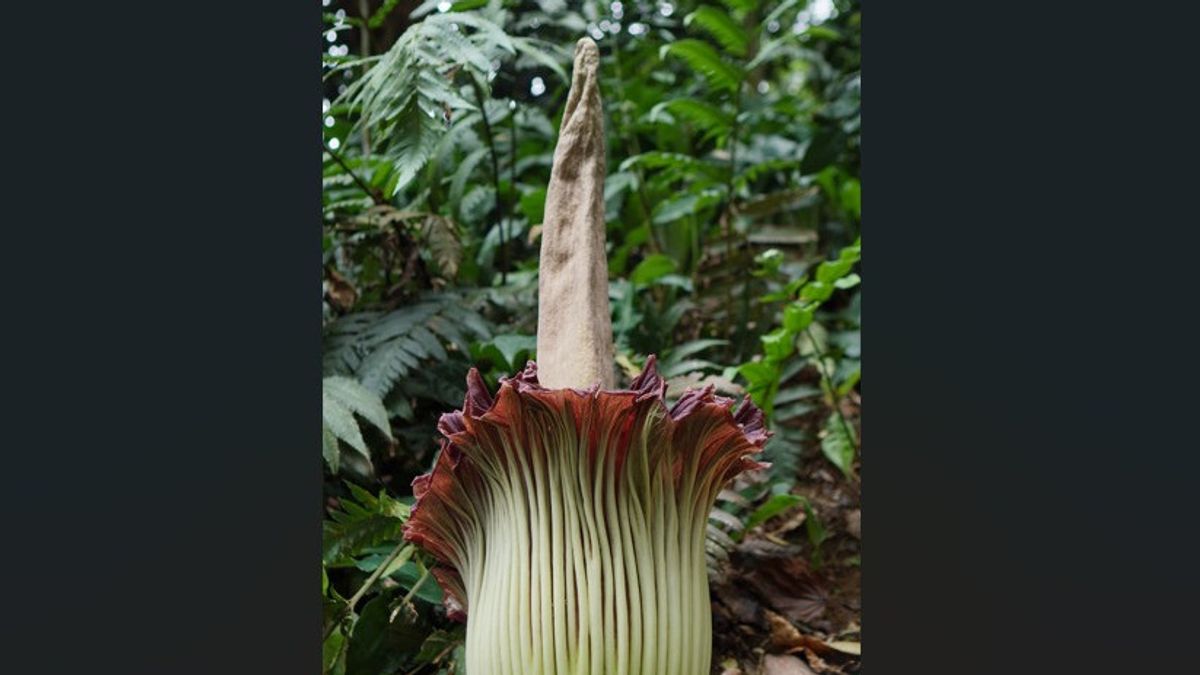


BOGOR - The giant Amorphophallus titanum corpse flower finally bloomed perfectly at the Bogor Botanical Garden, presenting a rare moment that only happens in a matter of years. This event immediately attracted the attention of the public who came since morning to witness the blooming of the titan arum.
The collection of plants in the area of the Kahuripan Spring cliff reached its peak bloom on Thursday, February 5, 2026 in the early morning. The flower spike is 140 centimeters high with a diameter of 56 centimeters.
"At 00.24 WIB, the flower bed opened perfectly. That marked the full bloom phase which is the climax of its life cycle," said Senior Horticulture Manager of PT Mitra Natura Raya, Yudhistira, in his statement, Sunday, February 8.
This flowering phase is considered very short, only lasting a few days before the flowers wither again. Therefore, each bloom is always a special event as well as a great attraction for visitors.
BRIN Associate Researcher, Dr. Dian Latifah, explained that the blooming of the titan arum is rare. This specimen last bloomed more than a decade ago. "Its life cycle is long, with vegetative, dormant, and then generative phases. So when it blooms, the moment is greatly awaited," he said.
Although known as a giant flower, the male and female flowers are actually small and hidden at the bottom of the bulb. A distinctive smell that resembles a corpse appears to attract pollinating insects. In the Bogor Botanical Garden, the pollination process is often assisted manually because the maturity is not simultaneous.
This plant itself is an old collection of the Bogor Botanical Garden which was planted since September 11, 1992 from seeds from Jambi, Sumatra.
General Manager of Corporate Communication PT Mitra Natura Raya, Zaenal Arifin, said the blooming of the corpse flower was proof of the success of the conservation of rare plants in the Botanical Garden.
"Each bloom is not only a spectacle, but also a marker that the conservation efforts are going well," he said.
With a short blooming period, visitors are urged to take advantage of this rare opportunity before the flowers close their life cycle.
The English, Chinese, Japanese, Arabic, and French versions are automatically generated by the AI. So there may still be inaccuracies in translating, please always see Indonesian as our main language. (system supported by DigitalSiber.id)


