
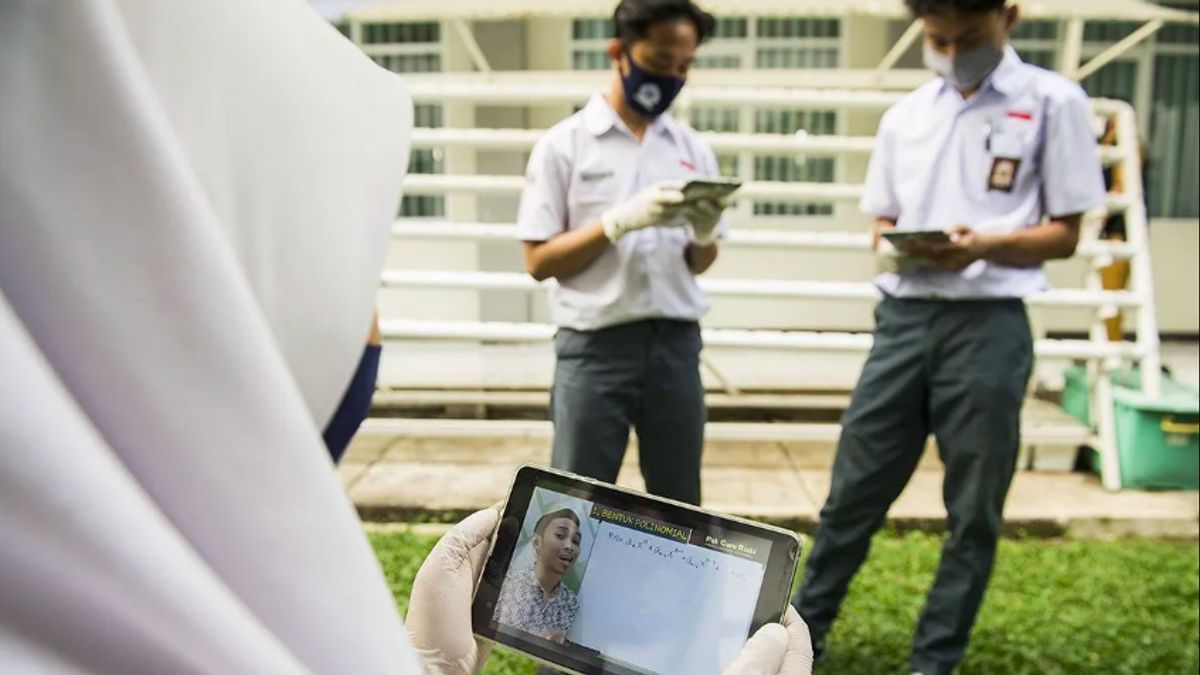


JAKARTA - In today's digital era, the use of gadgets among students is increasingly widespread, creating new challenges in the learning environment.
Kasandra Putranto, a clinical psychologist from the University of Indonesia, revealed that schools have an important role in implementing policies that limit the use of gadgets in the classroom.
With an educational approach and in context, schools can help students understand that these restrictions are not punishments, but rather an effort to create a focused and mentally healthy learning environment.
"This approach helps students understand that restrictions are not punishments, but rather an effort to create a mentally focused and healthy learning environment," Kasandra said as quoted by ANTARA.
Some of the principles he suggested include keeping cellphones during class hours except for learning purposes.
Schools can also establish a cell phone-free zone, such as in the classroom or library, and provide a certain amount of time for students to use their phones during recess, rather than banning their use altogether.
Kasandra emphasized the importance of socializing the purpose of the policy to students, so that they understand the rules that apply not only as a means of enforcing discipline. The involvement of parents and students in the formulation of policies is also very important so that all parties feel that they have the same agreement.
On the other hand, healthy communication between parents and children must also be maintained. "The key is a democratic communication style (authoritative parenting) firm but warm," explained Kasandra.
He added that healthy limits at home also need to be applied, such as avoiding excessive control over teenagers' cell phones and providing space for discussion and negotiation regarding the rules to be agreed upon. By listening to the child's point of view, parents can avoid using rules as a threat.
In the context of developmental psychology, involving adolescents in the rule-making process has been shown to produce more cooperative behavior, higher honesty, and healthier family relationships.
Previously, the Banten Provincial Education and Culture Office (Dindikbud) had started a trial of a policy to limit the use of mobile phones in the education environment for the levels of SMA, SMK, and Special Schools (SKh), both state and private, starting February 2026. This policy is expected to minimize the negative impact of using mobile phones on the concentration of learning and discipline of students.
The English, Chinese, Japanese, Arabic, and French versions are automatically generated by the AI. So there may still be inaccuracies in translating, please always see Indonesian as our main language. (system supported by DigitalSiber.id)


