
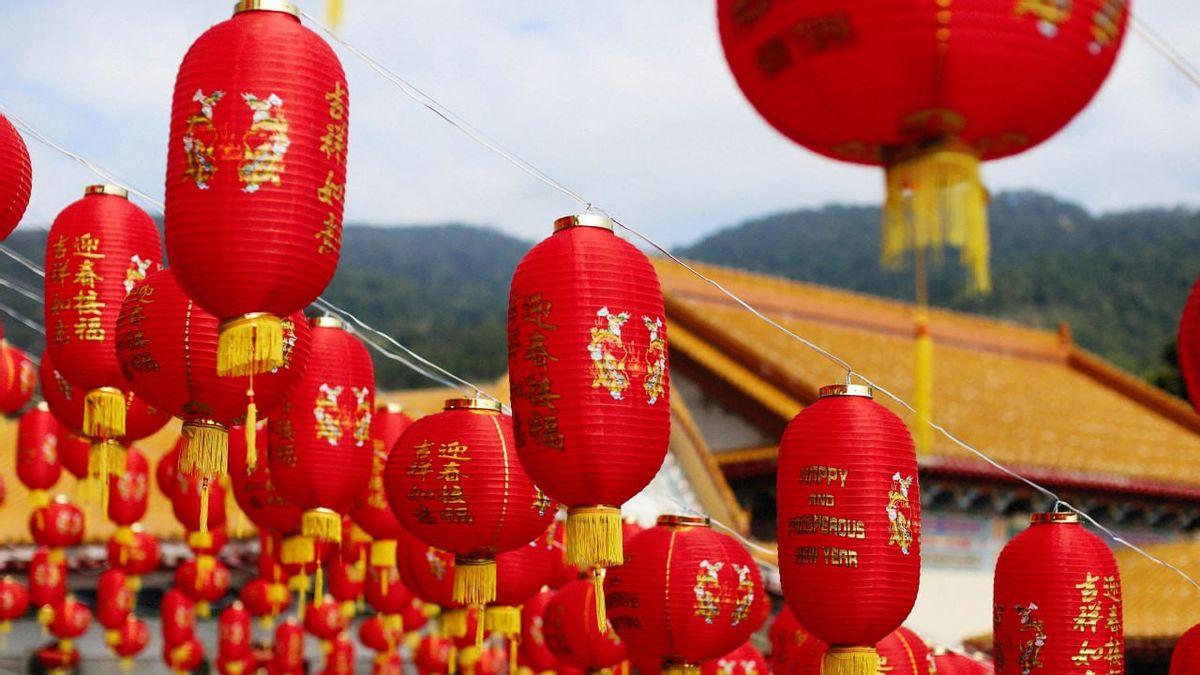


YOGYAKARTA - When entering the Chinatown area or malls a few weeks before Chinese New Year, what first caught your attention? Surely the dominance of red everywhere, from lanterns, ornaments, to various red-colored trinkets. This nuance seems to be a sign that Chinese New Year is getting closer.
But did you know, red is not just a decorative element. For the Chinese people, this color has a strong philosophical meaning and has been passed down for thousands of years. To understand why Chinese New Year is synonymous with the color red, let's explore deeper into its meaning and history.
Why is Chinese New Year associated with the color red?In Chinese culture, the color red has long been considered a lucky color. This color symbolizes happiness, prosperity, vitality, and the positive energy that is expected to be present throughout the year. Therefore, red not only appears during Chinese New Year, but also at other important moments such as weddings.
Reported by Prestige, one of the most popular reasons behind the dominance of the color red comes from the legend of Nian. It is said, Nian is a wild animal that appears every Chinese New Year night to prey on villagers, livestock, and plants. To avoid the threat, residents initially put food in front of their houses in the hope that Nian would not hurt anyone after eating it.
One night, the community realized that Nian was afraid of the color red. Nian was seen to be afraid when he saw a child wearing a red outfit. Since then, red is believed to be able to drive away evil spirits and bring protection.
This tradition then developed into the habit of hanging red lanterns and putting spring scrolls containing lucky poems on the door of the house. In addition to being a deterrent to evil, red decorations are also a symbol of prayer for the household to be filled with blessings and peace.
The greeting "Gong Xi Fa Cai" that we often hear during Chinese New Year is also related to this spirit. This greeting is not only a form of greeting, but also a prayer for someone to get happiness and prosperity. In cultural terms, the prayer and the color red will drive away negative energy.
In addition to legends, the color red also has a philosophical basis in Chinese Five Elements Theory. In this theory, red symbolizes the element of fire which is identical to life, spirit, and change. Fire is believed to be able to destroy bad things while bringing a new beginning.
The other four colors are yellow, green, white, and black. Yellow symbolizes 'earth', green or blue symbolizes 'wood', white symbolizes 'metal', and black symbolizes 'water'. In addition to red, the colors that are also considered to bring luck are yellow and green.
Red is the traditional color of the Han people (the dominant ethnic group in China) which symbolizes luck, good fortune, celebration, and prosperity. No wonder when Chinese New Year, people wear red clothes from head to toe as a symbol of a hopeful beginning.
The tradition of giving angpao or red envelopes is also inseparable from this meaning. Angpao containing money is given to children, single adults, and employees as a prayer for luck and health. Interestingly, the amount of money in the angpao must be even because odd numbers are synonymous with sadness.
Throughout the Chinese New Year series, the color red is present as a red thread that unites all traditions. From houses, clothes, to rituals, everything leads to one main message, namely the hope for luck and a better life.
The Chinese New Year celebrations were also closed with the Lantern Festival on the 15th. This evening, the cities are filled with beautifully lit red lanterns, while children carry them in a procession. This festival is a symbol of the end of winter and the beginning of a new life.
In addition to discussing the meaning and history of why Chinese New Year is synonymous with the color red, follow other interesting articles at VOI.ID. So as not to miss the latest news, follow and monitor our social media accounts!
The English, Chinese, Japanese, Arabic, and French versions are automatically generated by the AI. So there may still be inaccuracies in translating, please always see Indonesian as our main language. (system supported by DigitalSiber.id)
Popular


