
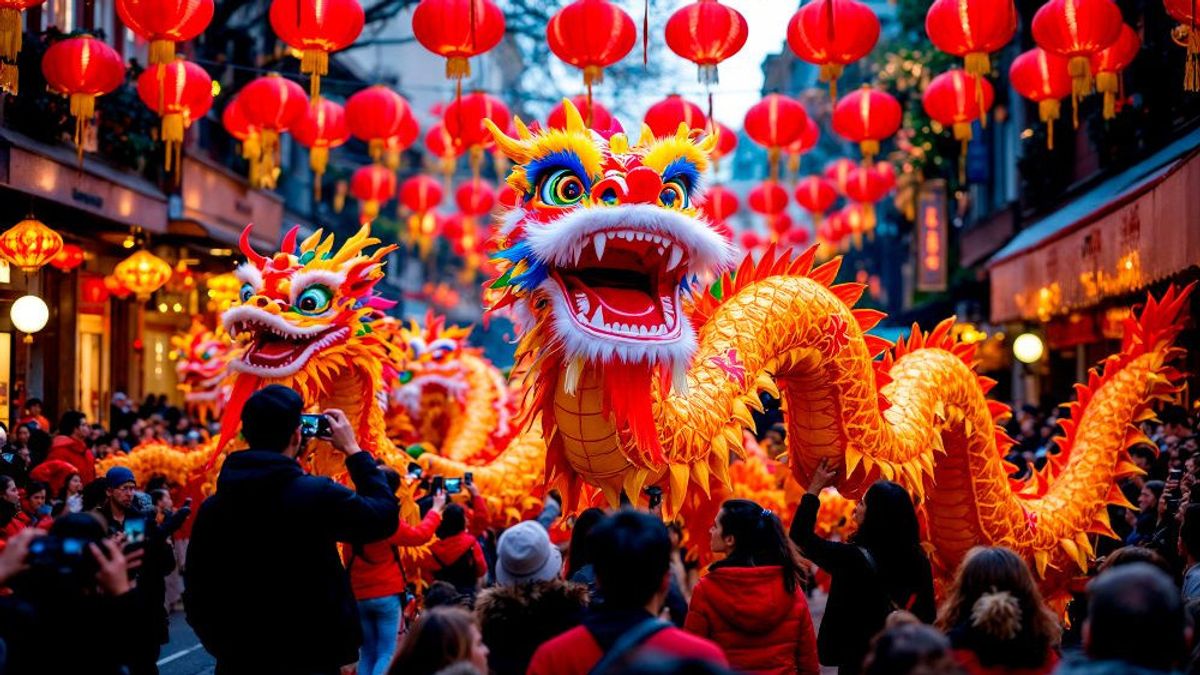


YOGYAKARTA - The type of Chinese New Year barongsai is often the main attraction during the Chinese New Year celebrations, but many people still don't understand the differences and meanings behind each type.
Not many people know, each barongsai has its own characteristics, ranging from the shape of the head, color, to the style of movement that reflects Chinese traditions and cultural values.
History of BarongsaiAs reported by VOI from the Wikipedia page, the popularity of barongsai began to strengthen during the Northern-Southern Dynasty (420-589 AD).
At that time, King Song Wen Di's troops faced an elephant attack from the Lin Yi country. A commander named Zhong Que created a lion puppet to scare the elephants. The simple strategy worked, and since then the barong dance has been legendary.
Over time, barongsai has evolved from a symbolic war tool to a performance art that is inseparable from Chinese New Year celebrations, temple ceremonies, to inauguration events and cultural festivals.
Know the Two Main Types of Chinese New Year BarongsaiIn general, lion dance is divided into two main types, namely North Lion and South Lion, with the following explanation:
Northern Lion (Bei Shi)This type in Indonesia is often called Pekingsai, has thick and long fur with striking colors such as yellow and red.
The northern lion movement tends to be acrobatic and attractive, featuring walking on balls, ropes, and balance-challenging jumps.
It is said that Pekingsai was first staged specifically to entertain the royal family in the Chinese palace.
South LionMeanwhile, the South Lion is the type of barongsai that is most often found in Indonesia. Its shape is more expressive, with a large head made of bamboo, paper, and decorated with feathers.
The Southern Lion is known for its mimicry and expression, as if it were alive and had emotions. The Southern Lion is further divided into two main styles, namely Fut San and Hok San.
Fut SanFut San has pointed horns, a high forehead, and strong movements and relies on sturdy horses. This style is widely used in traditional barongsai and is generally played by experienced kungfu practitioners.
Hok SanOn the other hand, Hok San is known to be more expressive and dynamic. This style developed in the 20th century thanks to Feng Gengzhang, who was inspired by the movements of cats.
Also read the article discussing Understanding Who is entitled to receive Chinese New Year Angpao According to Chinese Tradition
Hok San presents unique footsteps, funny mimics, and typical music accompaniment such as Seven Star Drum. In Singapore, Hok San is even nicknamed "King of the King of Barongsai".
Color, Arena, and Game Techniques in BarongsaiThe color of the barong's fur is not just aesthetics. White symbolizes the oldest age and purity, yellow symbolizes luck, black symbolizes the agile young lion, red symbolizes courage, green friendship, and gold joy.
In its development, modern barongsai now comes in new colors such as purple and pink.
Barongsai is also played in various arenas, from the floor to two-meter-high milestones. The cooperation of dancers and musicians is the key to making barongsai look alive, with expressions of surprise, doubt, and enthusiasm.
History of Barongsai in IndonesiaBarongsai is estimated to have entered Indonesia in the 17th century along with the migration of the South Chinese community. It was banned during the New Order, but barongsai resurfaced after 1998.
Now, barongsai is not only a cultural art, but also an official sport under the auspices of KONI.
The achievements of Indonesian barongsai have also been recognized by the world. Teams such as Kong Ha Hong Jakarta, HBT Padang, and PSMTI Tarakan managed to win international titles, proving that barongsai in the archipelago continues to live and develop across cultures.
By understanding the types of Chinese New Year barongsai, people not only enjoy the performance, but also appreciate the historical value, philosophy, and cultural identity that continues to live across generations.
The English, Chinese, Japanese, Arabic, and French versions are automatically generated by the AI. So there may still be inaccuracies in translating, please always see Indonesian as our main language. (system supported by DigitalSiber.id)


