
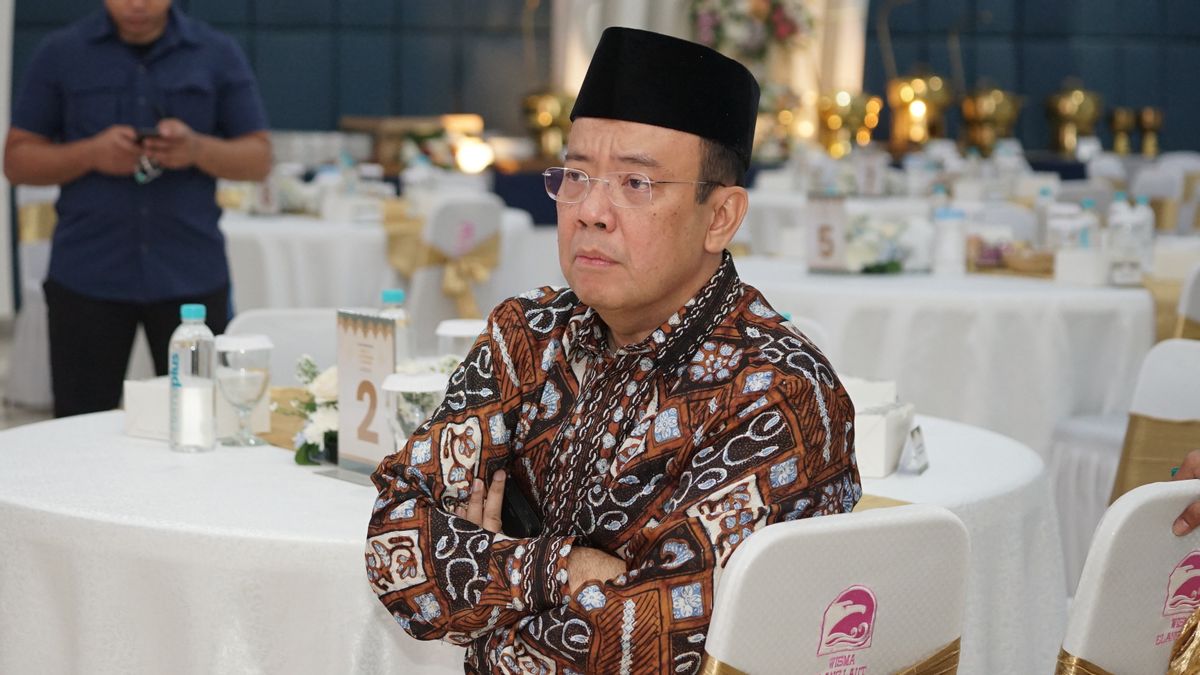


JAKARTA - The flood and landslide disasters that hit Aceh and parts of Sumatra at the end of 2025 left deep wounds for the food sector and the people's economy. In response to this condition, Professor of Agricultural Economics at UIN Syarif Hidayatullah Jakarta, Prof. Achmad Tjachja Nugraha, urged the government to carry out active ecological restoration as a long-term solution.
According to Prof. Achmad, environmental damage in Aceh today has reached a point where nature can no longer be allowed to recover on its own. "The state must be present through active ecological restoration, especially in the agricultural and fisheries sectors which are the mainstay of people's lives," he said in an official statement, Wednesday (14/1).
The Threat of a Food Crisis on the Horizon
Data shows very massive damage impacts in the Sumatra region (Aceh, North Sumatra, and West Sumatra):
Agriculture sector: It is estimated that 40,000 hectares of rice fields and horticulture are affected. These lands are submerged in water for a long time and buried in mud, which triggers the risk of national crop failure.
Fisheries Sector: The Ministry of Maritime Affairs and Fisheries recorded that around 38,875 to 40,000 hectares of cultivation ponds were damaged by flooding.
Regional Examples: In Mandailing Natal (North Sumatra), the damage reached 3,245 hectares, while in various districts in Aceh, hundreds of hectares of rice fields were reported to be totally paralyzed.
What is 'Nature-Based Solutions'?
Prof. Achmad, who also serves as the General Chair of KASAI, offers a nature-based solutions approach. The goal is not just to rebuild damaged buildings, but:
Land Rehabilitation: Restoring the fertility of the soil that was buried by the disaster materials.
River Flow Recovery: Improving the upstream to downstream ecosystem to be able to accommodate future water discharge.
Green Infrastructure: Strengthening the coast to protect fish ponds and residential areas sustainably.
Government Support and Real Steps
As an emergency measure, the central government has planned to re-print 11,000 hectares of severely damaged rice fields in the Sumatra region.
Prof. Achmad appreciated the President's quick action in forming a special Task Force (Satgas) and the readiness of the National Disaster Management Agency (BNPB) in the field. "This active response gives hope that Aceh's recovery is the responsibility of all the people," he said.
The English, Chinese, Japanese, Arabic, and French versions are automatically generated by the AI. So there may still be inaccuracies in translating, please always see Indonesian as our main language. (system supported by DigitalSiber.id)
Most Popular Tags
#Prabowo Subianto #donald trump #2026 World Cup #Febrie Adriansyah #8791Popular


