


YOGYAKARTA - Animals that do not have a backbone (invertebrates) are the largest group of animals on earth. This type of animal lives in shared habitats, ranging from land to deep oceans. Its population reaches more than 95 percent of all animals on the planet.
The following will discuss the definition of invertebrates and their main characteristics. In addition, various examples of animals that belong to the group of animals that do not have a backbone will be presented to facilitate understanding. Finally, six invertebrate animal phyla will be presented.
Invertebrates are animals that do not have a backbone or vertebral column. Most animals living on earth belong to this category. The term comes from the Latin word "vertebra" which means the joints of the spine, plus the prefix "in" which means not.
The concept of invertebrates was first introduced by the scientist Chevalier de Lamarck. This group includes almost all animals. It is estimated that there are about 12 million species of invertebrates that still exist today.
The main feature of invertebrates is that they do not have a backbone. Invertebrates are multicellular organisms without a cell wall like plants. Most invertebrates are small and move slowly because they do not have a hard internal skeleton.
Many invertebrates have an exoskeleton of chitin to protect their bodies. Most breathe through their skin because they do not have lungs. In addition, many invertebrates reproduce sexually through the fusion of male and female gametes.
Almost all invertebrates have a symmetrical body shape. They are found in a variety of environments, including extreme regions such as the deep sea and deserts. Some invertebrates are sedentary, for example sponges (Porifera), while others are highly motile such as insects.
According to data from the International Union for Conservation of Nature (IUCN) in 2009, there are more than 1.3 million invertebrate species that have been identified. The actual number may reach tens of millions of species, especially from the insect group. Common examples of invertebrates include shellfish, spiders, snails, worms, starfish, and octopuses.
Invertebrates are divided into six phyla, namely Porifera, Coelenterata, Vermes, Arthropoda, Mollusca, and Echinodermata. Each phylum has its own characteristics that distinguish it from other groups. Here is the explanation.
Porifera is an animal with a porous body like a sponge. They live in waters with a variety of body colors such as red, yellow, and green. Examples are Spongilla, Euspongia, Poterion, and Scypha.
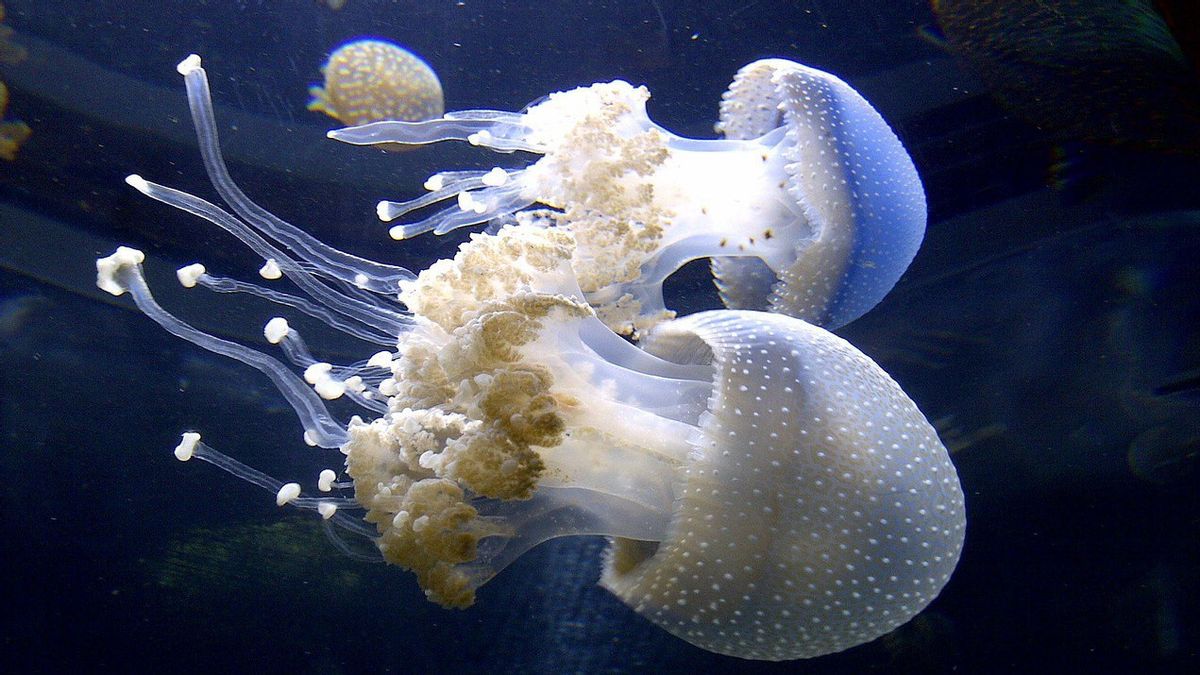
Coelenterata have a hollow body and tentacles to catch prey. Their tentacles are equipped with poisonous cells to protect themselves. Examples are jellyfish, Obelia, Hydra, and sea anemones.
Vermes are soft-bodied and bilaterally symmetrical animals. This group is divided into three types, namely flatworms, tapeworms, and tapeworms. Examples are liver worms, stomach worms, tapeworms, earthworms, and pacets.
Mollusca have a soft body and a lot of mucus. Some have a shell that serves as a protector. Examples are squid, octopus, snails, clams, and oysters.
Arthropods have jointed bodies and a hard exoskeleton of chitin. They have highly sensitive sense organs and compound eyes. Examples are grasshoppers, bees, crabs, spiders, scorpions, and millipedes.
Echinodermata have a radially symmetrical body and are covered with spines. They have an ambulacral system to move, breathe, and catch prey. Examples are starfish, sea urchins, starfish, sea lilies, and sea cucumbers.
This is an explanation of animals that do not have a backbone. By understanding this explanation, you can recognize various types of invertebrates that are often encountered in daily life.
The English, Chinese, Japanese, Arabic, and French versions are automatically generated by the AI. So there may still be inaccuracies in translating, please always see Indonesian as our main language. (system supported by DigitalSiber.id)
Most Popular Tags
#Prabowo Subianto #donald trump #firearm #8791 #giias 2026Popular


