

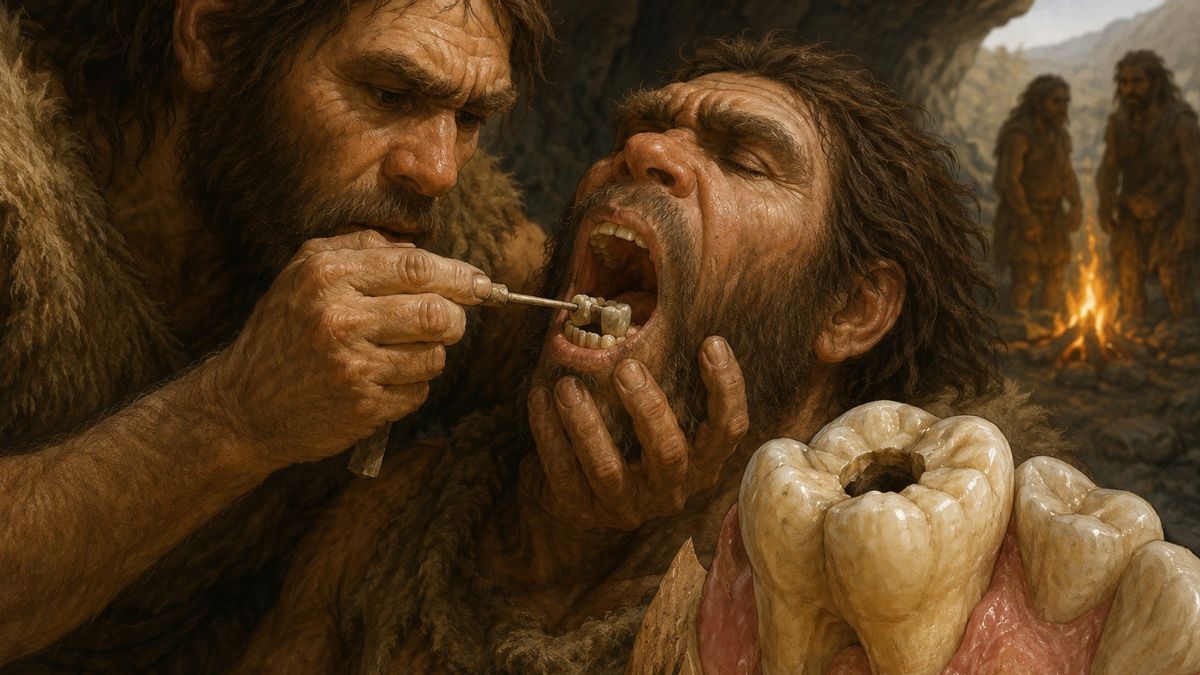


JAKARTA - A molar from Siberia suggests that Neanderthals may have used stone tools to treat cavities almost 60,000 years ago. Citing The Guardian report, Friday, May 15, this finding is said to be the earliest evidence of dental care practices.
The single tooth was found in the Chagyrskaya cave, southern Siberia. In the middle there is a deep hole that is suspected to have been made with a thin and sharp stone tool when the owner of the tooth was still alive.
This finding is also the first evidence of tooth drilling outside Homo sapiens. Its age is older than 40,000 years compared to similar evidence of dental care that has ever been known.
Dr. Kseniya Kolobova, an archaeologist from the Siberian branch of the Russian Academy of Sciences in Novosibirsk, said the findings reinforced the view that Neanderthals were not the crude early humans of old stereotypes.
According to Kolobova, this discovery adds to the evidence of Neanderthal's advanced behavior, including invasive medical actions.
Professor of dentistry from Newcastle University, Justin Durham, who reviewed the dental images but was not involved in the study, judged the work "quite good".
"If this is the task of dental students, maybe I won't give them an A. But given the conditions, the results are impressive," said Durham.
The smooth hole edges and wear patterns inside the tooth show the owner survived and was still chewing with the tooth after the act.
Microscopic X-ray imaging showed signs of severe tooth decay. According to a study published in the journal PLOS One, researchers then tested three modern human teeth with a manually rotated jasper stone tool using two fingers.
The result is that a hole with similar shape and scratches can be made. The process of penetrating the dentin - the hard layer under the tooth enamel - takes 35 to 50 minutes of continuous work.
"It must have been very painful," Kolobova said.
Durham called the action the beginning of root canal treatment. The large hole in the tooth likely reduced the pressure from the infection so that the pain temporarily eased.
In modern medicine, said Durham, doctors use diamond-tipped drills at speeds of more than 40,000 revolutions per minute to penetrate the surface of the tooth.
"This is an incredible achievement," Durham said.
However, teeth that are not patched are still prone to chronic infections.
This finding complements other evidence that Neanderthals cared for sick and vulnerable members of their group. Previously, evidence was found of adults with physical abnormalities and children with Down syndrome who were able to survive to at least six years of age.
Dr. Lydia Zotkina of the Russian Academy of Sciences said the patient likely had extraordinary resilience.
"Now, every time I go to the dentist, I always remember that person," Zotkina said.
The English, Chinese, Japanese, Arabic, and French versions are automatically generated by the AI. So there may still be inaccuracies in translating, please always see Indonesian as our main language. (system supported by DigitalSiber.id)
Popular


