
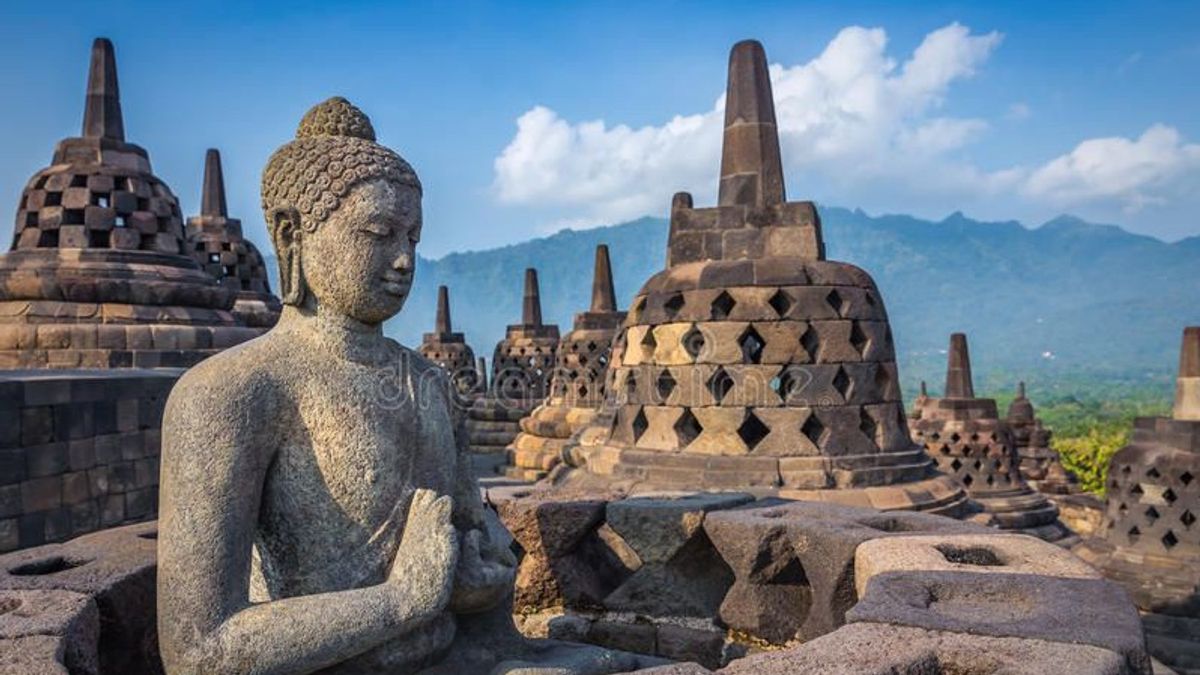


YOGYAKARTA - Culture in Indonesia is heavily influenced by Hindu-Buddha culture. Based on historical records, Hindu and Buddhist religions began to enter the archipelago around the 4th to 5th centuries AD. The process of entering this cultural influence involves trade, social, and religious relations between the ancient Indonesian nation and India.
Various theories were put forward by historical experts to explain how Hindu-Buddha teachings entered Indonesia. One of the most famous theories is Brahmin Theory. This theory places the Brahmins or Hindu priests as the main carriers of Indian teachings and culture in the archipelago.
The theory of Brahmin was put forward by a Dutch historian named JC van Leur. According to him, the entry of Hindu religions and culture into Indonesia was carried out by the Brahmins, namely the highest group in the Hindu caste system that mastered the knowledge of religion, customs, and the holy book Weda.
The Brahmins are believed to have come to the archipelago at the invitation of local rulers to lead religious ceremonies and crowned kings through Hindu religious rituals. According to JC van Leur, the Brahmans are the main carriers of Indian culture because only the Brahmins have the authority and ability to understand the holy book Weda.
This theory has strong support from Frederik David Kan Bosch (FDK Bosch), a Dutch historian and archaeologist. Bosch argued that the Brahmins came to the archipelago by sea and were welcomed by local rulers.
They were even given the honorable position at the palace as a Purhita, namely spiritual adviser or leader of the king's religious ceremony. This is because the Brahmins have a special ability to read and write Sanskrit and pallawa scripts.
SEE ALSO:
-
 | LIFESTYLE
Reaksi Menpar Widiyanti Soal Raja Ampat yang Dijadikan Tambang Nikel
04 Juni 2025, 21:55



The main evidence supporting this theory comes from inscriptions from the Hindu-Buddha kingdom in Indonesia. The inscriptions are written in Sanskrit and the inscriptions of Pallawa, two important elements in classical Indian culture which are only controlled by the Brahmins. Examples can be found in the Kutai Inscription and the Yupa Inscription in East Kalimantan.
In addition, the presence of Brahmins in the kingdoms of the archipelago is also another proof that strengthens this theory. Brahmins are known as the highest group in Hindu caste that has the authority to teach religion and perform religious rituals.
Another support for Brahmin's theory comes from the fact that the Brahmins have an important role in crowned Hindu kings. The meritorious ceremony used the Weda mantra and carried out by Brahmins shows that the process cannot be carried out without their presence.
Despite having a lot of supporting evidence, Brahmin's theory also has some drawbacks. One of his drawbacks is the prohibition in Hinduism for Brahmins to cross the ocean.
If a Brahmin violates this rule, he is considered to have lost his sacredness and is no longer included in the Brahmin caste. This raises doubts whether it is true that the Brahmins came directly to Indonesia.
Brahmin theory provides an in-depth explanation of the role of the Brahmins as the bearer of Hindu-Buddha teachings to Indonesia. This theory is still considered one of the most reasonable theories in explaining the initial process of the influence of Hindu-Buddha culture on Indonesia.
Through Brahmin theory, we can understand how the religion, culture, and social structure in the archipelago began to form and develop rapidly during the early kingdoms.
The English, Chinese, Japanese, Arabic, and French versions are automatically generated by the AI. So there may still be inaccuracies in translating, please always see Indonesian as our main language. (system supported by DigitalSiber.id)


