
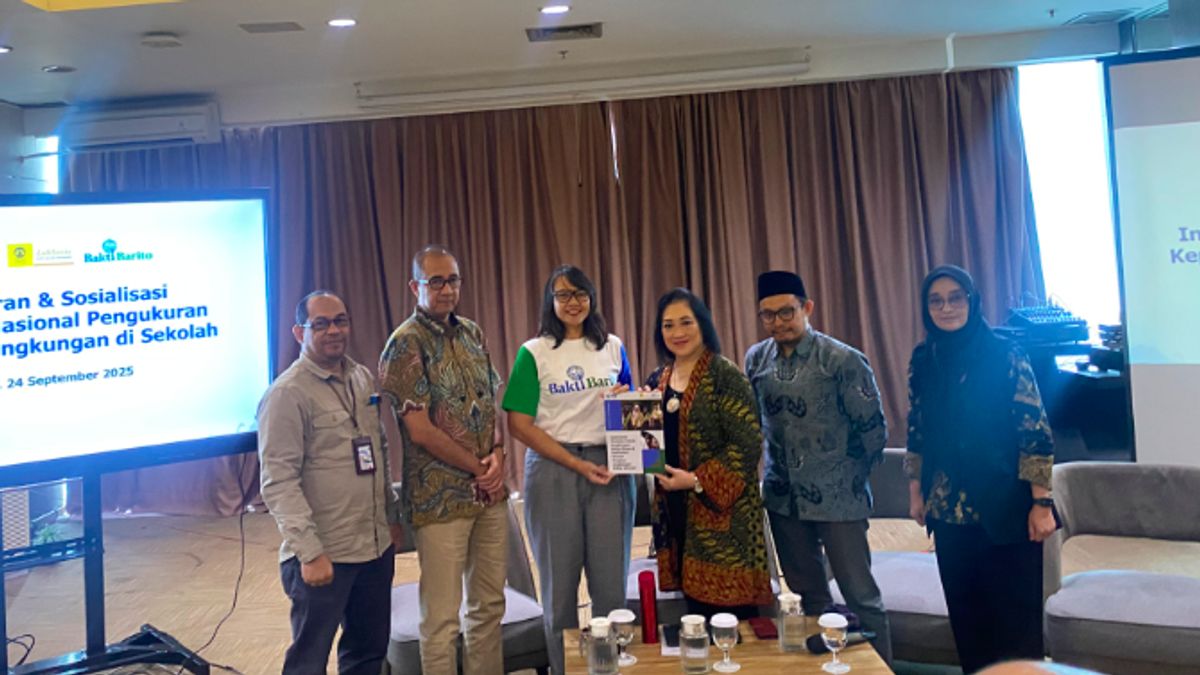


JAKARTA Through the Environmental Generation Development Center (PPGH), the Ministry of Environment/Environmental Control Agency today announced the completion of the preparation of two school assessment devices that have passed the national level validation test.
The two devices are Student Environmental Care Behavior Instruments (IPPLHS) and Performance Instruments for Environmental Care Schools (IKSPLH).
The main goal of the presence of this instrument is to help the school assess the extent to which students and educational institutions have shown environmental care practices.
The results of the measurement will later support the strengthening of the Adiwiyata program, an initiative that has been running since 2006 and has proven to encourage schools to instill environmentally friendly habits both in learning and daily activities.
"With the measurable and comprehensive data, we at the PPGH of the Ministry of Environment / Environmental Control Agency can see more clearly the real conditions in the field," said Dra. Jo Kumala Dewi, M.Sc., Head of PPGLH of the Ministry of Environment / Environmental Control Agency, when met in the Cipinang area, East Jakarta on Wednesday, September 24, 2025.
"This data is very important to know what is already going well, which areas still need to be strengthened, as well as what strategic steps must be taken in the future. That way, the environmental program in schools will not only run, but also be more targeted and sustainable," he continued.
SEE ALSO:
-
 | BERITA
Jurusan Administrasi Bisnis: Berikut Pengertian, Mata Kuliah, dan Prospek Kerja
19 September 2025, 12:26


IPPLHS is used to observe students' behavior in four main dimensions, namely their level of knowledge about environmental issues, attitudes shown towards environmental issues, individual daily habits related to the environment, and patterns of joint action in responding to environmental issues.
IKSPLH assesses the overall performance of schools. This instrument reviews the extent to which schools include environmental issues in learning, have a supporting management system, carry out real activities such as waste management and reforestation, collaborate with parents, communities, and the government, as well as carry out continuous monitoring and evaluation of environmental programs.
"This launch is an important milestone: meaning these instruments are now ready to be used across the country to inform more effective and data-based environmental education. With this instrument, schools and partners can identify what is successful, increase the scale of successful practice, and target support in areas that are most in need," said Dian A. Purbasari, Director of Bakti Barito.
Dr. Sulastri Sardjo from the research team Lab Sosio UI conveyed that the validated IPPLHS and IKSPLH instruments provide an important empirical basis for environmental education evaluation and research.
"The collaboration between academics, the government, and school practitioners makes this result relevant and ready to be used to strengthen the implementation of Adiwiyata throughout Indonesia," he explained.
The development of this instrument received full support from Bakti Barito, in collaboration with the PPGLH of the Ministry of Environment / Environmental Control Agency and the Sosio Lab, University of Indonesia.
The PPGLH of the Ministry of Environment/Environmental Control Agency will continue to coordinate with various stakeholders to ensure that the Adiwiyata program develops more focused and sustainable.
Bucket Files:
The English, Chinese, Japanese, Arabic, and French versions are automatically generated by the AI. So there may still be inaccuracies in translating, please always see Indonesian as our main language. (system supported by DigitalSiber.id)
Most Popular Tags
#Prabowo Subianto #donald trump #2026 World Cup #Febrie Adriansyah #8791Popular


