
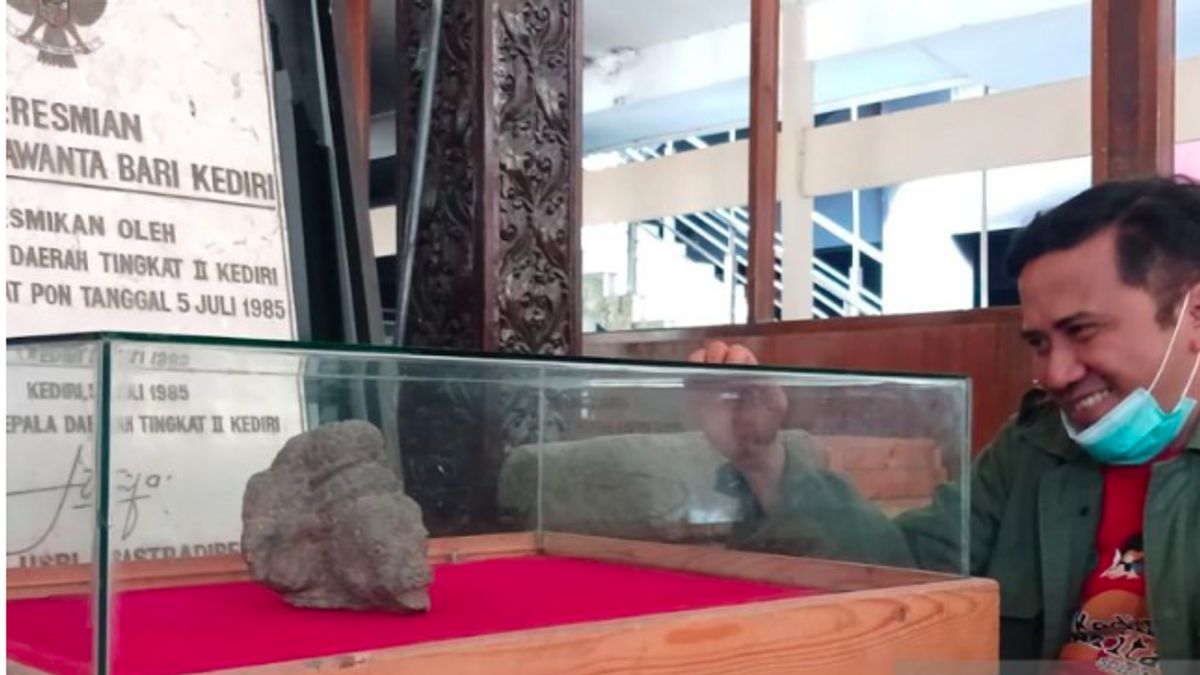


JAKARTA - The looting that took place in Kediri last weekend left deep wounds, especially because it was targeting ancient relics. A number of historical objects at the Bagawanta Bhari Museum were affected, due to the fragmentation of Ganesha's head from the 10th century which had disappeared before being finally recovered.
The Kediri Regency Government has now decided to keep the fragments of Ganesha's head in a safe house, after previously being returned for a while to the museum.
"Earlier, symbolically, I have returned and included the head of Ganesha into the museum," said Kediri Regent Hanindhito Himawan Pramana in Kediri, as quoted by ANTARA.
According to him, the district government is very careful in maintaining historical relics. Placement in a safe house is considered the right step so that the incident of looting or vandalism does not repeat itself. He emphasized that the value of the Ganesha head fragment cannot be measured with money.
"The loss of the regency government cannot be nominally estimated because there are missing objects, but thank God Ganesha's head fragments have returned," he said.
SEE ALSO:
-
 | BERITA
Ada Situs Benda Purbakala yang Ditemukan di Persawahan Desa Tlawong Boyolali
30 September 2022, 10:22 -
 | LIFESTYLE
Dinsos Tapin Percantik Makam Pahlawan Puspa Raya sebagai Ruang Edukasi Sejarah
08 Agustus 2025, 12:25
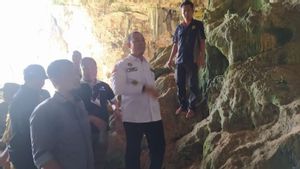
Head of the Antiquities History Division of the Kediri Regency Tourism and Culture Office, Eko Priyanto, explained that Ganesha's head fragments were initially returned by two SMKN students who found him lying on the side of the road. The fragments were then temporarily placed in the museum before being moved back to a safe house.
He admitted that the location of the museum was actually relatively safe because it was in the district government complex and was guarded. However, looting carried out by the masses is an important lesson. Apart from the fragmentation of Ganesha's head, a number of other objects were also affected, such as the prototype batik wastra for the Kediri batik prototype which was made in 2020.
Currently, the transfer of museum collections to safe houses is being carried out. Of the total 154 collections, 103 have been successfully moved. The rest are still in the process, especially those with large and heavy sizes. Meanwhile, one collection in the form of a miniature barn from the 10th to early days of the 15th century was badly damaged by the paving block.
Eko added that the long-term plan is to build a representative museum in Win Village, Pagu District, to accommodate the ancient collection. He hopes that similar acts of destruction and looting will no longer occur in Kediri, given how valuable the historical heritage is for future generations.
The English, Chinese, Japanese, Arabic, and French versions are automatically generated by the AI. So there may still be inaccuracies in translating, please always see Indonesian as our main language. (system supported by DigitalSiber.id)


