
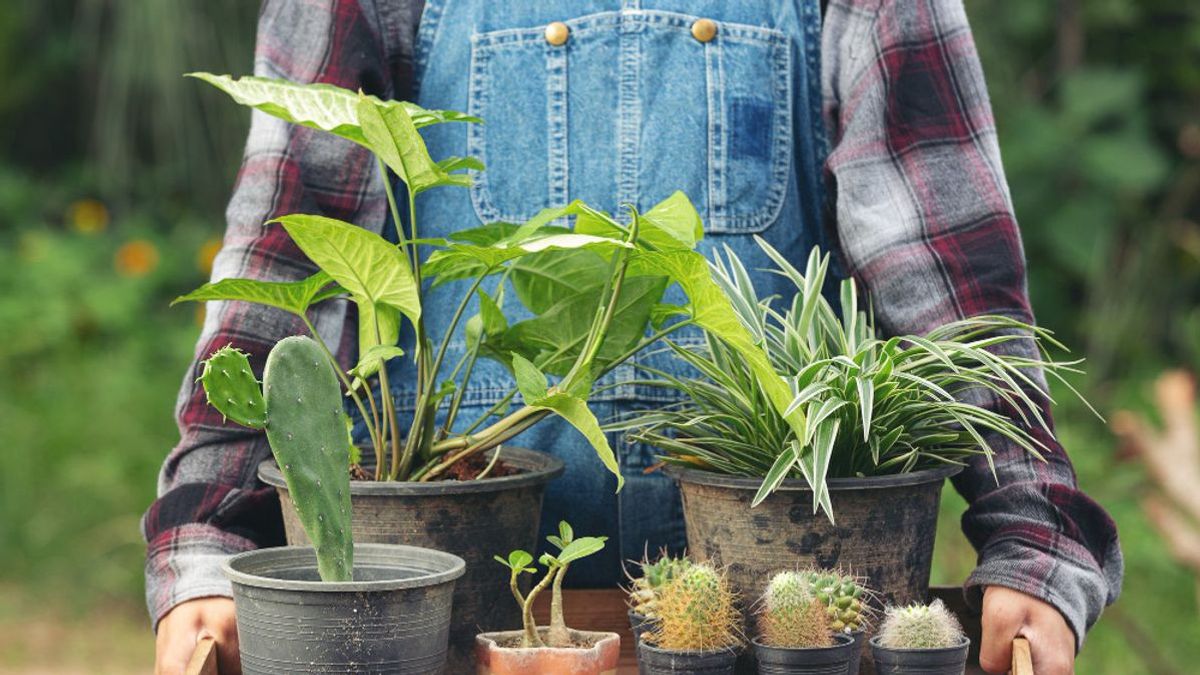


Photosynthesis is a process of making food in plants, especially plants that contain leaf green substances, namely chlorophyll with the help of solar energy.
How does this photosynthetic process occur? There are four important things needed in the photosynthesis process. First water or H2O, then carbon dioxide or CO2, chlorophyll, and then sunlight. Water is absorbed by plants from the ground through the roots and channeled to all parts of the plant, including leaves.
Furthermore, carbon dioxide is obtained from the air processed through the stomata. This deposita is located at the bottom of the leaves. The photosynthesis process occurs when the chlorophyll in the leaves captures sunlight and uses it to convert water and carbon dioxide into sugar and oxygen.
Sugar produced in this process can be used directly by plants or stored in other parts such as fruit that we often consume. In addition to sugar, photosynthesis also produces oxygen that will come out through the stomata into the air and is beneficial for humans to breathe.
Quoted from the book "SMP/MTs Class VIII Natural Knowledge Science (IPA)" by Ir. Danang Setiyono, carbon dioxide (CO2) and water (H2O) gas is the raw material for producing glucose (C6 H12 O6) and oxygen (O2).
Furthermore, glucose will be arranged into pati/amilum (C6 H10 O5)n, through polymerization reactions. Then the pati substance will be stored in plant roots.
In more detail, quoted from the book High School Learning Module, Biologically rich Susi Nurul Fitri, M.Pd., the photosynthesis process occurs in chloroplas, through two stages of reaction, namely the bright reaction stage and the dark reaction stage.
SEE ALSO:


This process of bright reaction or hill reaction relies heavily on light. The energy captured by chlorophyles is used to break water molecules. This process of breaking water molecules is called photolesis.
Different types of chlorophyllic pigments are only able to absorb wavelengths with different photons (light energy). A bright reaction occurs in the grana.
Grana is a stack of tilakoids. The light energy in the granae, which will spur the release of electrons from the photosystem that occurs inside the tiltoid membrane. Inside the leaf cells there are tilakoids, and proteins as well as other molecules, which will subsequently form a photosystem.
Photosystems are containers of hundreds of photosynthesis pigment molecules. There are two types of photosystems that work together, namely photosisten I and photosystem II, from this process then generated by ATP and NADPH2 as the main product in bright reactions.
In the bright reaction, there are two possible electron flows, namely non-cyclic paths and cyclic flows. Non-cyclic flow is the main pathway with electrons flowing from water molecules, then through photosystem II and photosystem I.
The dark reaction or calvin's reaction is also generally referred to as the Calvin-Benson cycle. Why is it called dark? Because this reaction does not depend on sunlight.
Dark reactions are ATP and NADPH processes that are made by CO2 into sugar. The process of dark reactions occurs in stroma. On stroma there is fixation, reduction, and regeneration.
The dark reaction phase consists of: the binding (fictition) of CO2 - Reduction - the formation of RuBP (Ribulosa Bifosphate).
The dark reactions are divided through several stages, including:
- Carbon dioxide is tied up by RuBp into phospholiserat (PGA).
- PGA reduced to PGAL (fosfogliseraldehida)
- PGAL will be regenerated to glucose and RuBp
That's a review of the process of making food for plants. Hopefully this information will be useful! Visit VOI.id to get other interesting information.
The English, Chinese, Japanese, Arabic, and French versions are automatically generated by the AI. So there may still be inaccuracies in translating, please always see Indonesian as our main language. (system supported by DigitalSiber.id)


