
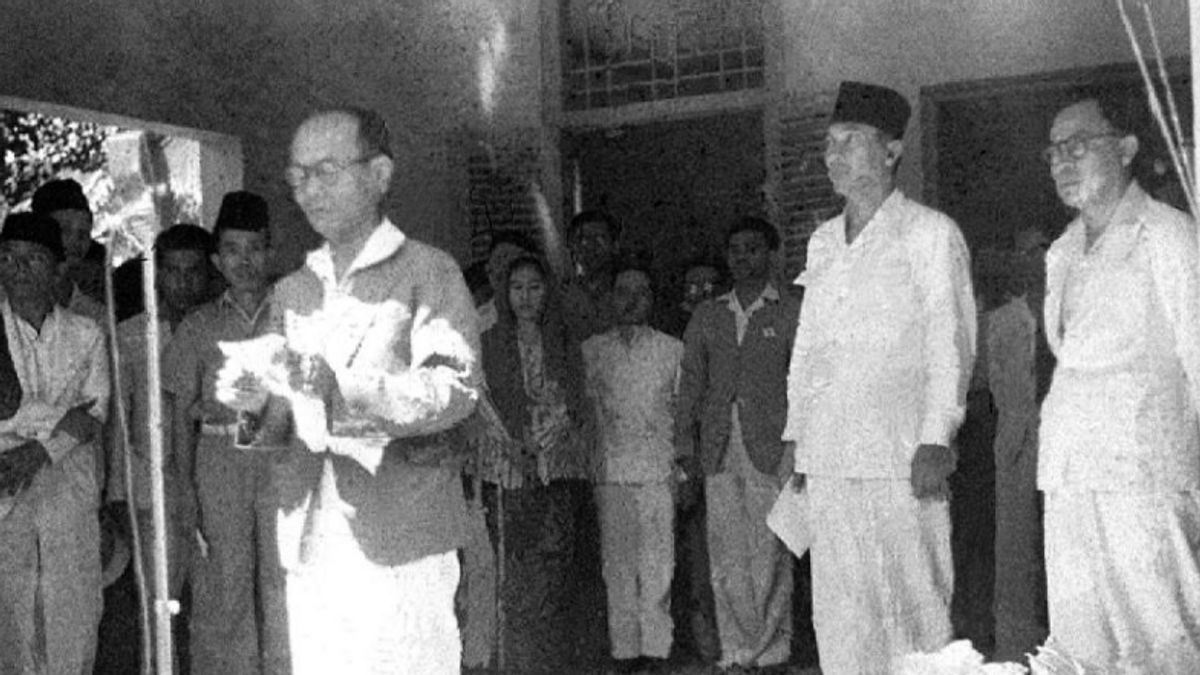


YOGYAKARTA - Officially, the Indonesian nation announced independence on August 17, 1945. Indonesia's independence process is certainly not solely obtained for the struggle from within, but also because of recognition from other countries.
There are several countries that recognize Indonesia's independence and sovereignty for the first time. So, what were the first countries to recognize Indonesia's independence?
Based on International Law in Article 1 of the Montevideo Convention Convention on Rights and Duty of States in 1933, it is explained that there are four conditions for a country to be considered new. Among other things, having a permanent human population, having a stable territorial area, forming a sovereign government structure, and obtaining recognition from other countries. Likewise with Indonesia, after the proclamation was pronounced on August 17, 1945. The Republic of Indonesia tries to realize the fourth requirement, namely recognized by other countries.
The hard work of the nation's founders to accept recognition as an independent country is certainly not an easy thing. Because, there are also countries that do not want to recognize Indonesia's independence. Below is the list of the first ten countries that recognize Indonesia's independence, summarized from various sources.
Before the proclamation was echoed, Palestine was among the first countries to congratulate Indonesia, precisely on September 6, 1944. Through Radio Berlin, Germany, Sheikh Muhammad Amin Al Husaini expressed his happiness for Indonesia's independence. The declaration from Palestine became an important moment to spur the fighting spirit of the heroes at that time.
Egypt recognized Indonesia's independence de facto on March 22, 1946. The next date on June 10, 1947, the Prime Minister of Egypt signed a de jure recognition and was witnessed by AR Baswedan and Agus Salim. This signing was the beginning of bilateral relations between the two countries. The majority of the population who embraced Islam and a sense of brotherhood became the reason Egypt recognized Indonesia's sovereignty. This agreement is stated in Azyumardi Azra's book Indonesia, Islam, and Democracy.
Lebanon recognized the independence of the Republic of Indonesia in de jure on July 29, 1947. From this statement, there was increasingly strong cooperation between countries. Furthermore, in 1996, the Indonesian embassy officially stood in the Lebanese capital, Beirut. Even during the economic crisis, relations between Indonesia and Lebanon remained closely established. One of them is marked by the provision of social assistance and development of Indonesian Corner at Leanese University.
On the basis of the same religious ties, Saudi Arabia became one of the countries that first recognized Indonesia's independence on November 18, 1946. Furthermore, the cooperation between the two has begun to exist until now. In 2017, King Salman made a visit to the archipelago to open up opportunities for the entry of Indonesian Workers (TKI) and provide convenience for Hajj and Umrah rules.
After World War II was over, Iraq recognized Indonesia as an independent country. The two countries have subsequently been in a relationship, especially in terms of diplomatic relations since 1950. At least, there were 15 agreements that were successfully inaugurated due to diplomatic relations.
SEE ALSO:
-
 | BERITA
Rangkaian Acara HUT ke-80 RI di Istana Merdeka dan Syarat Daftar Sebagai Peserta
07 Agustus 2025, 10:25 -
 | EKONOMI
Sambut HUT ke-80 RI, PLN Berikan Diskon 50 Persen Tambah Daya Listrik
10 Agustus 2025, 16:15

Syria once joined the mission of Indonesia's struggle in the Dutch Military Aggression at the UN Assembly in 1947. Luckily, through negotiations, this aggression could be stopped. Syria was one of the first countries to de jure recognized Indonesia's independence. Furthermore, relations between Syria and Indonesia are getting closer. One of them is marked by the formation of diplomatic relations.
Yemen began to recognize Indonesia's sovereignty as a country on May 3, 1948. The country in the middle east has been in a relationship in various projects with Indonesia for 74 years. Among others, in the economic, political, and socio-cultural fields. In 2018, Yemen succeeded in sending its country's leading commodities to Indonesia, namely wheat worth 632,546 US dollars.
In addition to Middle Eastern countries, countries from the European continent, namely the Vatican, provide full support for Indonesia's independence. Vatican recognition was conveyed on July 6, 1947. This was marked by the establishment of the Vatican embassy or Apostolic Delegate in Jakarta. The Vatican and Indonesia raised the same state principle, including seeking world peace and creating inter-religious harmony.
Turkey
Turkey's support for Indonesia's independence began on December 29, 1949. This of course received a negative response from the Netherlands. But Turkey is not afraid to become part of the country that participates in declaring Indonesia's independence. Various forms of cooperation are still established between the two countries. On April 10, 1957, Turkey established its embassy in Jakarta.
Afghanistan is also the first country to recognize Indonesia's independence. On September 23, 1947, Afghanistan officially declared Indonesia an independent country. As for April 24, 1955, the Treaty of Friendship agreement was signed between the two countries held in Bandung.
That's a review of the first country that recognized Indonesia's independence. Visit VOI.id to get other interesting information.
The English, Chinese, Japanese, Arabic, and French versions are automatically generated by the AI. So there may still be inaccuracies in translating, please always see Indonesian as our main language. (system supported by DigitalSiber.id)


