


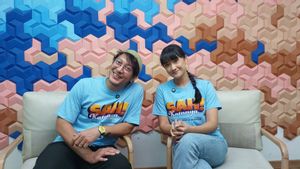
JAKARTA - Actress Nadya Arina shared her deep experience when playing the character Marni in the film Sah! She said. In the film that raised the theme of Javanese family and culture, Nadya admitted that she learned a lot and experienced a memorable emotional journey.
"(Earning the role of the youngest child) Who must have talked a lot with my youngest friends too, because in character, the youngest child is born and raised. Then come back again with Marini who was born to Javanese family, it also really affects that way," said Nadya when met at the VOI office, not long ago.
Nadya explained that the background of Marini as the youngest child of a Javanese family living in the area, as well as her work in a cooperative, became a strong foundation for the formation of this character.
"The youngest child of the Javanese family who still lives there, with his education and work who at that time he worked in a cooperative, also greatly influenced the character, Marni's actions. And fortunately we also have readings that are always accompanied by our director, Mas Loeloe Hendra. He is also very helpful, coincidentally he lives in Jogja, so he is also very helpful as to what life there is, that's how it is," he explained.
Film Sah! Katanya menjadi film keluarga pertama bagi Nadya. Ia menilai film ini berbeda dari proyek-proyek sebelumnya yang lebih menitikkan pada tema persahabatan atau pantasan. Lalu, untuknya ini lebih dari sekadar genre, menurut Nadya, kekuatan script film ini membuatnya terhubung secara emosional sejak awal membacakan naskah.
SEE ALSO:
-
 | LIFESTYLE
Nadya Arina Belajar Soal Realita Hidup Usai Main di Film Sah! Katanya
10 April 2025, 23:10
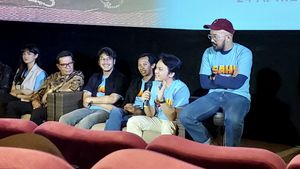
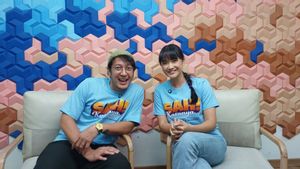
"What's different maybe, this is my first family film. Maybe previously there was a film of friendship, there were films about romance, all kinds of things, but maybe it's about family, it's more about family. Maybe if for example it's Javanese background, there have been several times, but also Java itself has many differences, there's East Java, so Central Java, coincidentally this is Central Java," said Nadya.
"Then this is comedy too, and drama too. And what's interesting, when I read the script for the first time, I'm a very visual person, so if I read it, I immediately have a picture in my brain, I can really read the script. I think this is a teaser script I've read, I've ever had, who wrote Mas Loeloe, Mas Tata, and there's one more team from them, "he explained.
"I can really laugh, after that I cried, after that I laughed again. So what I hope is that the audience can also feel what I feel as the first time I see this, but in visual form, that's how it is," he continued.
Nadya also highlighted the personal learning she got during the film production process, especially about the importance of appreciating small moments in the family.
"The new learning may be if, for example, we read scripts and play movies, that's everything will be more detailed, we will get more pregnant. And maybe there are many things that hopefully this will also be experienced with the audience later, we don't realize, we don't realize that for example it happened to us and it turns out to be important, that's it. And maybe it's a reflection for myself too that, oh yes, it turns out things like this are important when something may not exist, that's it. And maybe here Casey is my father's gone, right," he said.
He added that many touching moments in this film can be a reflection for the audience, including simple things that are often neglected.
"Yes, maybe it becomes something that becomes a tragedy when it's as simple as it is, my father in this film asks for a pie, yes, small things like that our parents want and we can't give it yet, or for example our brother or our sister. So it's more like a reflection. So I hope the audience also gets that experience because honestly, this film is really good. It's not normal but yes," he concluded.
Young actress Nadya Arina shared her views on the challenges of acting in various film projects in a row. In his statement, Nadya revealed that he is not the actor type who can directly move from one character to another without pause. He prefers to give space to recover energy before taking on the next project.
"Obviously (there are challenges playing many roles in films), because there are some of my friends who can do some back-to-back projects, that's it. And honestly I can't, that's it. So I'm really like if for example I'm involved in one project, it's finished, there's a break, I can go on vacation first and all kinds of things, then I'm like join other projects, that's it. Because I think, what, the characters, and surely some films that I'm lately involved in are quite difficult for me. So that's it, maybe more to be aware of yourself to limit, that's it," said Nadya Arina.
Furthermore, Nadya explained that the pause between projects was not only a matter of physical recovery, but also to maintain mental and emotional conditions. Hard and intense shooting activities can drain energy as a whole.
"(There is a pause in every film project) So that it doesn't get carried away and the term is filling our energy again, because shooting is really every day. The term is holiday once a week, and if for example the character, the scene is a lot, it can be from morning to finish," he explained.
"So I think it's really tired, right. Not to mention other than the heavy scenes, I think behind the camera it also socializes with people, I think it's really tiring, because I'm not the type of person who gets exclusive, so I think the whole thing about filming is tiring. So I'm indeed the person who has to reset first, at least be me and not with people filming, then we go back to work again, that's it," he explained.
Regarding preparing to shoot with significant genre differences, Nadya Arina admitted that she had to be careful and work wholeheartedly in choosing the film project she would play next.
"Actually, it (self-preparation for filming different genres) becomes a consideration of each player as well, that's it. What project do we want to get involved in, that's it. And if I actually want something different as much as possible, that's it," he said.
"But come back again, if for example, we finish the shooting process after it's finished, that's it. The term is postpro and everything, and the sales of all kinds of things are not our rights, that's it. But maybe the preparation is more of a time when we choose to be involved in it, and indeed we are happy to be on this one project, I think everyone will support it too," he concluded.
The English, Chinese, Japanese, Arabic, and French versions are automatically generated by the AI. So there may still be inaccuracies in translating, please always see Indonesian as our main language. (system supported by DigitalSiber.id)
Most Popular Tags
#Prabowo Subianto #donald trump #firearm #8791 #giias 2026Popular


