


JAKARTA - Efforts to improve the quality of tourist areas continue to be carried out, one of which is through reforestation in coastal areas.
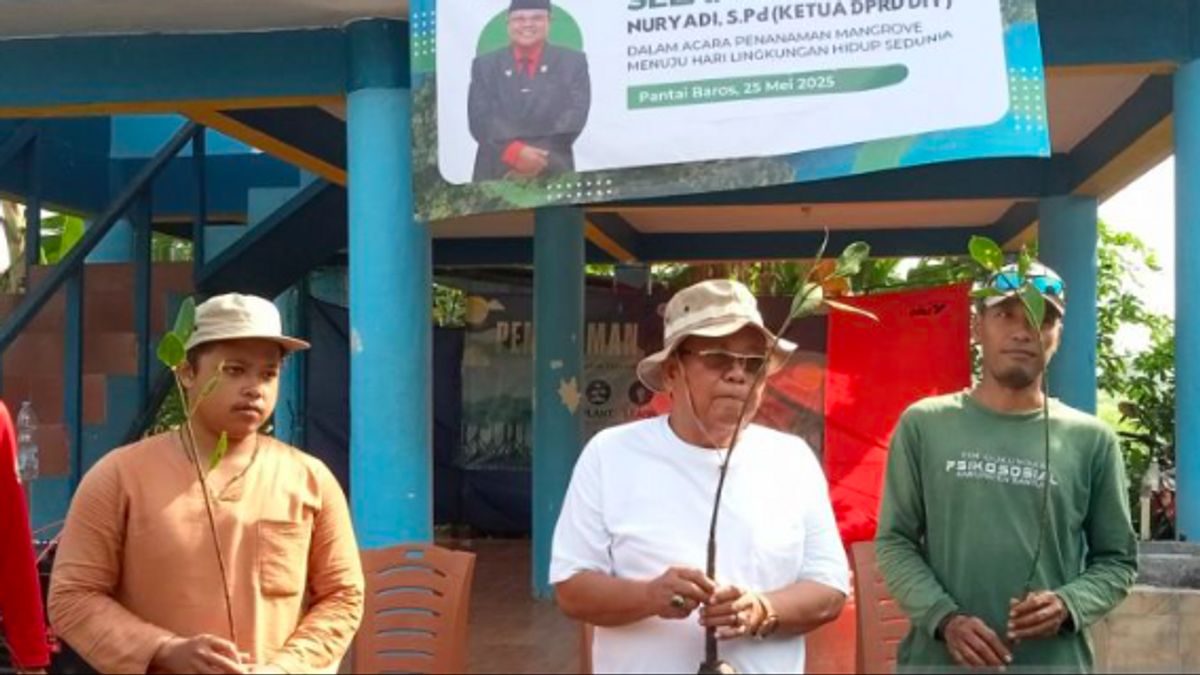
In the Baros area, Tirtohargo Village, Kretek District, Bantul Regency, planting mangrove seeds is a concrete step taken to support the sustainability of natural tourist destinations in the area.
This planting action involves the Regional House of Representatives (DPRD) of the Special Region of Yogyakarta together with the Young Generation Caring for the Environment, as a form of collaboration in maintaining the coastal ecosystem as well as supporting the development of environmentally based tourist areas.
The chairman of the DIY DPRD, Nuryadi, expressed his appreciation for the community initiative that invited his party to participate in the reforestation activity.
"This is a fun surprise. We were invited to help grow mangroves, which are part of the preservation of nature in the Baros tourist area," he said as quoted by ANTARA.
Apart from being a conservation area, the coastal area of Baros is now also developing as a water tourism destination, such as the use of canoe boats, camping areas, and other recreational activities with a beautiful beach panoramic.
Nuryadi emphasized the importance of planting mangroves as a preventive measure against abrasion and damage to the coastline due to sea waves. He considered that, even though it was the government's responsibility, community involvement must still be appreciated and supported.
"We must support the movement of this community of environmental care. Hopefully, this conservation can continue and become a shared responsibility between the community, the district government, and the DIY Regional Government," he continued.
SEE ALSO:
-
 | LIFESTYLE
Acha Septriasa Sulit Perankan Istri Qodrat: Dapat Wahyu Tengah Syuting
22 Maret 2025, 06:16


He also highlighted the need for infrastructure improvement in the area, especially road access which is considered inadequate. The road to the conservation area is partially still not tightened and bumpy, making access to visitors and managers difficult.
There are still many parties who do not know the real conditions here. Therefore, after this visit, I will propose to the relevant commission so that there is gradual attention and budgeting for the development of this region," he said.
Meanwhile, Setiyo SM as the manager of the Baros mangrove area said that the attention from academics and researchers was quite high in this area. However, support from the government is considered not optimal in the context of long-term development.
So far, the government's contribution is still incidental, it has not touched the mangrove conservation aspect as a whole. The new Privilege Fund is used to widen roads and community empowerment activities, such as canoe tourism," explained Setiyo.
He hopes that there will be more structured planning from the government, including the allocation of sustainable budgets, to support mangrove conservation which has now expanded to five to six hectares in the Baros area.
The English, Chinese, Japanese, Arabic, and French versions are automatically generated by the AI. So there may still be inaccuracies in translating, please always see Indonesian as our main language. (system supported by DigitalSiber.id)
Most Popular Tags
#Prabowo Subianto #donald trump #Febrie Adriansyah #8791 #giias 2026Popular


