
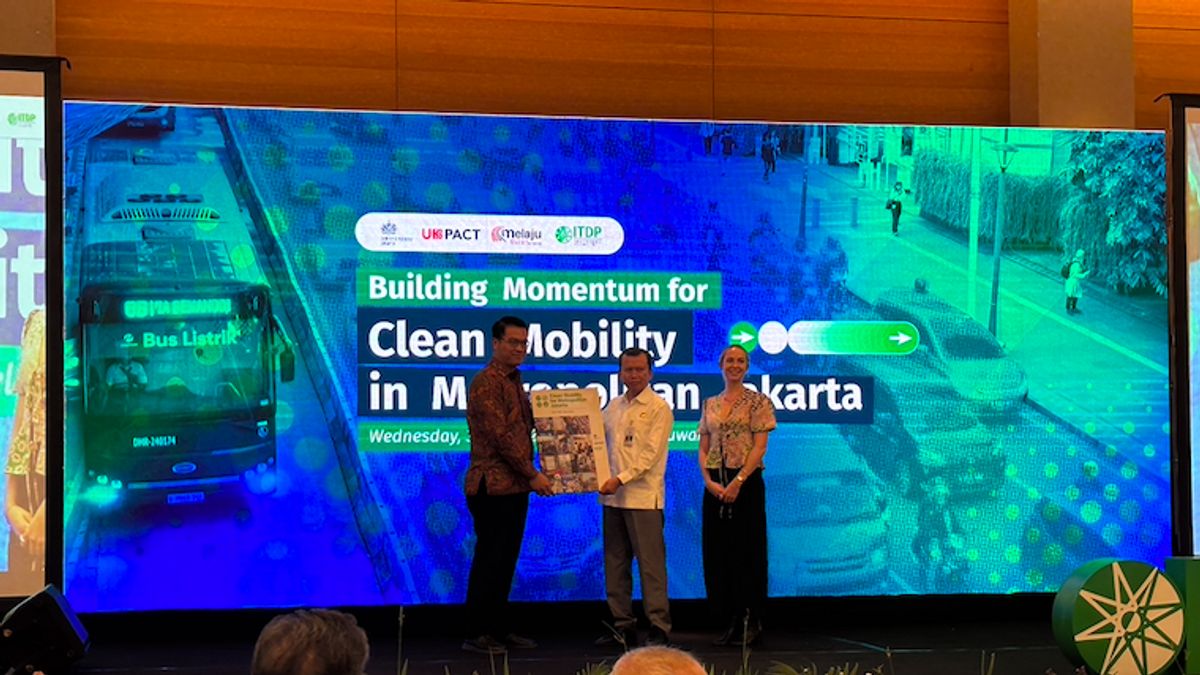


JAKARTA - The mode of transportation plays an important role in shaping the lifestyle of modern people, especially in dense metropolitan areas such as Jakarta.
The transition from fossil fuel-based private vehicles to an integrated and environmentally friendly public transportation system is a crucial element in encouraging more sustainable urban life.
With efficient, clean, and inclusive mobility, people can enjoy better quality of life while contributing to reducing carbon emissions and air pollution.
In this context, an initiative for three years has succeeded in bringing about a major transformation in the transportation system in the Metropolitan Jakarta area. This program gives birth to various innovative solutions that are able to change the way people travel, make mobility healthier, environmentally friendly, and accessible to all people.
Supported by the DKI Jakarta Provincial Government and the Ministry of Transportation, this program targets full electrification of the TransJakarta fleet by 2030, increasing the number of passengers through the integration of physical infrastructure, as well as developing an inclusive public information system.
This project is led by the Indonesian Institute for Transportation and Development Policy (ITDP) with funding from the UK Partnering for Accelerated Climate Transitions (UK PACT), through an initiative entitled Clean Mobility for Jakarta Metropolitan. This program not only produces technical strategies, but also contributes to the broad planning of transportation infrastructure in the Jabodetabek area.
Through a close partnership with the Jabodetabek Transportation Management Agency (BPTJ) which is now a member of the Directorate General of Transportation and Multimodal Integration (DITM) of this program focuses on studies of public transportation integration, electrification, fair accessibility, and sustainable transportation management.
The results of this study were used to formulate national policies and regional regulations with the final goal of improving air quality, public health, and city sustainability.
According to Suharto, Plt. Director General of Transportation and Multimodal Integration, this institutional change shows the government's strong commitment to long-term mobility planning.
"The transition from BPTJ to DITM reflects how serious we are in handling integrated and long-term mobility planning for all metropolitan areas outside Jabodetabek," said Suharto, Acting Director General of Transportation and Multimodal Integration in Jakarta, Wednesday 30 April 2025.
He said the results of the ITDP and UK PACT studies were important provisions for designing a strong and inclusive future transportation system in various cities in Indonesia.
SEE ALSO:




One of the great achievements of this program is the structure of the TransJakarta electrification evaluation framework. The commitment to total electrification by 2030 has been formalized through Governor Decree No. 1053/2022, which is projected to reduce annual emissions by 204,340 tons of CO2, 58 tons of PM2.5, and 2,893 tons of NOx.
Director of ITDP Southeast Asia, Gonggomtua Sitanggang, stated that the approach taken by this program is practical and can be replicated.
The resulting recommendations are aimed at initiating real transformation in various cities in Indonesia, by emphasizing the importance of sustainable transportation policies that can be implemented nationally.
"Recommendations from the UK PACT ITDP program are intended to inspire change and build momentum, not only in Jakarta, but also in cities throughout Indonesia, by strengthening sustainable transportation policies and enabling its implementation across the country," said Gonggomtua Sitanggang, Director of ITDP Southeast Asia.
This transformation is also seen in the field. In the Dukuh Atas area, Jakarta, for example, the physical integration between various modes of transportation has succeeded in increasing the volume of pedestrians and the quality of road services. The Multipurpose Crossing Bridge (JPM) is now used by more than 100,000 people per month as the main link between LRT and KRL.
At the TransJakarta Lebak Bulus Bus Stop, this program facilitates a more inclusive bus stop design by involving disability organizations and academics. This initiative resulted in the installation of braille maps at dozens of BRT stops, which are now part of the official TransJakarta Minimum Service Standard (SPM) based on Governor Regulation No. 2/2024.
On the same occasion, Amanda McLoughlin, Director of British International Development for Indonesia, emphasized that inclusive public transportation is not only a matter of comfort, but a basic requirement for a city that is fair and sustainable.
"Public transportation designed for everyone, regardless of age, ability, and gender, is not just a matter of comfort. This is a fundamental requirement for a city that is connected, sustainable, and fair," he explained.
He appreciated the close collaboration between the Indonesian government and the UK through this PACT UK program. Further steps from this program include the development of the Low Emission Zone in downtown Jakarta which is projected to have a significant positive impact on public health and economic efficiency.
Changes in the parking system and the implementation of the Electronic Paid Road (ERP) scheme are also expected to be able to reduce emissions while increasing revenue and travel efficiency.
The Clean Mobility Program for Jakarta Metropolitan is a clear example of how cross-sectoral synergy can produce long-term structural changes.
The English, Chinese, Japanese, Arabic, and French versions are automatically generated by the AI. So there may still be inaccuracies in translating, please always see Indonesian as our main language. (system supported by DigitalSiber.id)


