
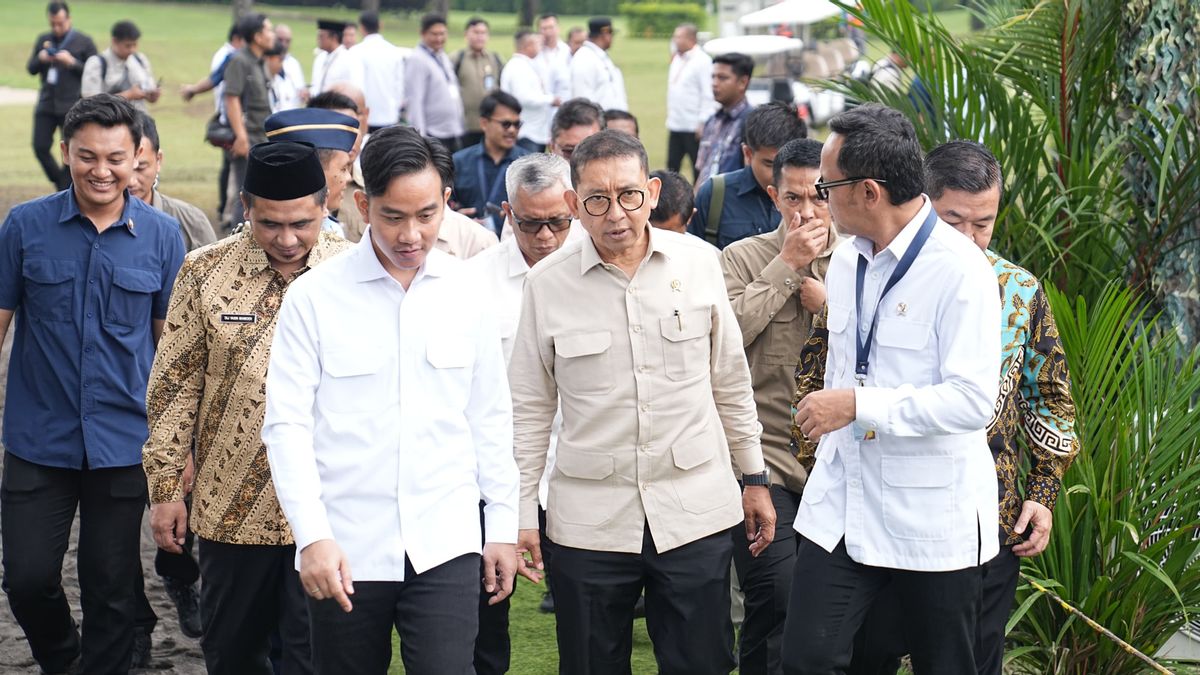


JAKARTA - The Minister of Culture, Fadli Zon, conveyed the material regarding the Advancement of Culture as Pillars for Regional Development: Synergy, Strategy, and Action in Magelang Retreat activities, leadership orientation for regional heads and deputy regional heads in 2025 at the Magelang Military Academy. He emphasized the importance of cooperation, collaboration, and synergy between the central and regional governments in efforts to accelerate national culture. Many cultural heritage sites, museums, cultural gardens, cultural heritage of non-obstacles need the attention of the Governor, Regent and Mayor.
The Minister of Culture emphasized that efforts to accelerate culture are a constitutional mandate, namely Article 32 of the 1945 Constitution which emphasizes that the state advances Indonesia's national culture in the midst of world civilization by guaranteeing people's freedom in maintaining and developing cultural values. This is also reflected in the 8th Astacita, which is President Prabowo Subianto's mission to realize a harmonious alignment of life with the environment, nature, and culture in order to achieve a just and prosperous community.
"We are obliged to protect, develop, utilize, and foster national culture to strengthen the identity of the nation, so that it can contribute to improving the welfare of the community. Local governments have an important role in advancing regional culture, including through the preparation of regional regulations which are the reference for the promotion of regional culture, the preparation and determination of the RPJPD, RPJMD, and the Basic Mind of Regional Culture (PPKD) which reflect the commitment to development through culture," said Fadli Zon in a presentation delivered in the presence of 441 Regional Heads present in this activity.
On this occasion, Fadli Zon emphasized that the promotion of culture is a collaborative effort that requires the cooperation of all parties, not only the central government but also local governments and private parties through the Public-Private-Partnership (PPP) scheme. Fadli also said that the Ministry of Culture is committed to strengthening contemporary cultural ecosystems including film, music and pop culture.
The country's film ecosystem is currently growing well, the number of Indonesian film viewers has reached more than 80 million in the period January-December 2024.
"We need a lot of Indonesian films that tell the history of the nation's struggle. Films that can be a means of education for the younger generation about heroes. We also need many screenwriters (scriptwriters) who are able to narrate various cultural assets owned by the Indonesian nation. I invite all parties to collaborate in strengthening the film ecosystem in Indonesia so that more Indonesians are proud of our own culture", said the Minister of Culture.
In addition, Minister Fadli Zon also invited local governments to strengthen the arts and cultural ecosystem in the regions, build more and more cultural spaces such as cultural gardens that become cultural enclaves or cultural pockets and spaces for community expression, increase the number and certification of cultural heritage experts (TACB) in the regions, and encourage the birth of the Cultural Council in the regions.
"As a nation with extraordinary diversity (mega-diversity), Indonesia is a nation with the oldest civilization in the world as seen in various traces of historical residences such as those in Sangiran, Goa Lidah Ajer, and Goa Leang-Leang. So, it is appropriate for us to make culture a national treasury, a wealth of an invaluable nation. With 2,213 Intangible Cultural Heritage (WBTB), 228 National Cultural Heritage (CBN), more than 1,340 ethnicities, and more than 718 local languages, it is our shared obligation to ensure that Indonesian culture continues to be sustainable and maintained. "said Minister Fadli Zon.
Various cultural objects owned by the region are the richness of the nation's culture that must be preserved. In addition, Indonesia's diversity such as local food also has the potential to strengthen cultural promotion efforts that also contribute to efforts to realize food security which is President Prabowo Subianto's priority. "We have sago in Papua, the Baduy food system in Banten, Padi Kasepuhan in West Java, and various farming traditions as practiced by the Dayak Maayan community, Dayak Iban, and others, which is proof of how local food sourced from regional culture can strengthen food security in Indonesia." added Fadli Zon.
Furthermore, Fadli Zon also added that local governments have a strategic role in strengthening Indonesia's cultural narrative as a global solution and Indonesia as the world's cultural capital.
SEE ALSO:
-
 | LIFESTYLE
Kerja Sama dengan Menbud, Raffi Ahmad Dukung Pembukaan Bioskop di 17 Kabupaten
25 November 2024, 21:10 -
 | LIFESTYLE
Menbud Fadli Zon Optimistis Indonesia Bisa Jadi Negeri Seribu Museum
22 Januari 2025, 15:25 -
 | LIFESTYLE
Lestarikan Budaya, Menbud Fadli Zon Bakal Resmikan Museum Desa di NTB
06 Januari 2025, 12:45
For this reason, he emphasized the importance of the role of museums in national culture, "The museum is a window of civilization of a nation. I hope that 469 museums spread throughout Indonesia can become a space for interaction and inspiration for the younger generation in studying national civilization. In today's modern era, it is important to optimize digitization in disseminating various museum collections to strengthen the nation's identity and promote Indonesian culture to the international community."
"The collaboration between the centers is the key to the success of cultural promotion. By carrying out the narrative of Culture for the Future, I hope that close collaboration can be realized in building an inclusive and sustainable cultural ecosystem, as well as promoting Indonesian culture through cultural diplomacy to strengthen the nation's positive image in the midst of world civilization - because in fact, as always emphasized by President Prabowo Subianto, that no one will respect and respect our culture if not ourselves," concluded Minister Fadli, who was greeted enthusiastically by all participants.
The English, Chinese, Japanese, Arabic, and French versions are automatically generated by the AI. So there may still be inaccuracies in translating, please always see Indonesian as our main language. (system supported by DigitalSiber.id)


