
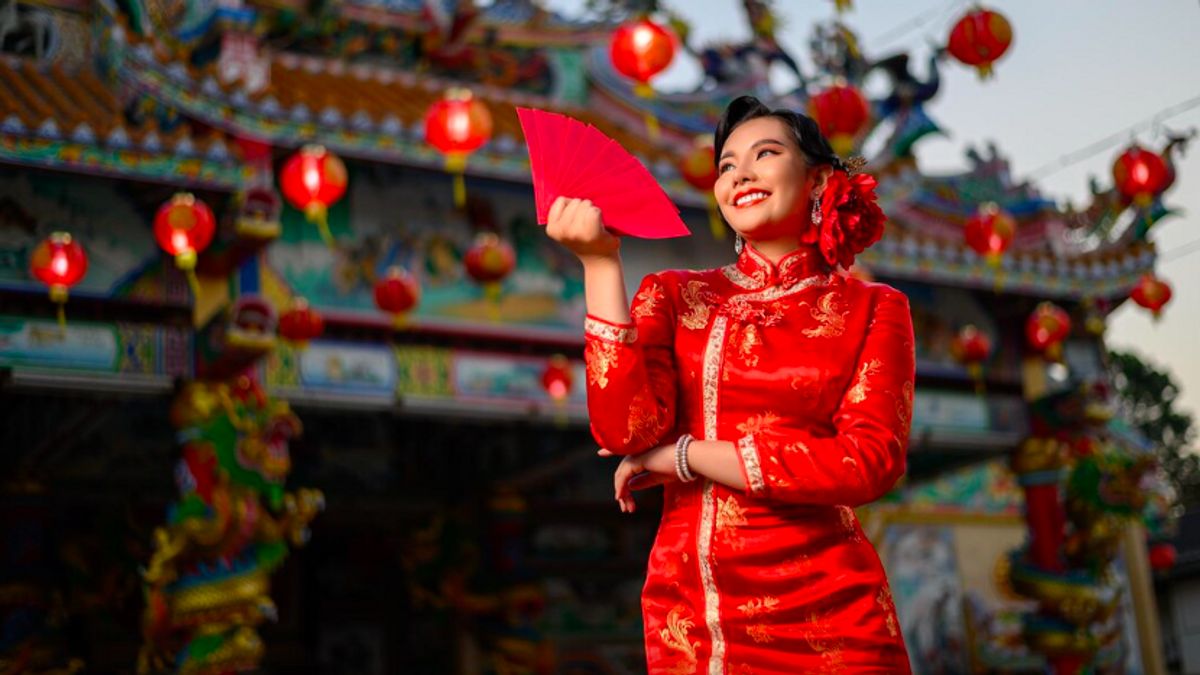


JAKARTA - Chinese New Year or Chinese New Year is an important moment for Chinese people around the world. In addition to being the time to gather with family, Chinese New Year celebrations are also synonymous with the tradition of wearing special clothes that are full of meaning.
Traditional Chinese clothes are the result of the evolution of the design of loose clothes with straight pieces, such as jackets, pants, or dresses. This outfit reflects China's traditional aesthetics, philosophy, and social values that have continued to grow for more than 3,000 years in history.
The most iconic Chinese traditional clothes are Hanfu, Zhongshan suit (Jas Mao), Tang suit, and cheongsam (qipao). Here are 4 traditional clothes from China that are often worn during Chinese New Year celebrations, as reported by the China Highlights page on Friday, January 24.
Hanfu is the most authentic traditional Chinese dress. Hanfu, literally means ' Han' clothing. Hanfu is the oldest traditional dress in China, from Han ethnicity. Legends say Hanfu existed more than 4,000 years ago, when Leizu, the wife of Emperor Huangdi, began to make cloth from silk. During various dynasties, Hanfu continued to be refined.
During the Han Dynasty, Hanfu was promoted on a large scale by the ruling class to become the national clothing of Han ethnicity. Hanfu also influenced the dress culture of neighboring countries, such as Korea, Japan, and Vietnam. Currently, Hanfu is rarely worn except at special events, such as festivals, weddings, or photo sessions. Hanfu clothing components:
- Yi (): Clothing with an open cross collar.
- better (): A long dress for men.
- Ru (): Shirt with an open cross collar.
- Shan (): Jacket worn onyi.
- Qun/Chang (/): Roks for men or women.
- Ku (): Long pants.
Ornaments such as Pei () are used to decorate Hanfu, showing the social status of the wearer. Men usually wear hats, while women wear head decorations.
Hanfu consists of three main styles, namely a jacket with a skirt, jacket with pants, and a one-piece dress. The most popular style is a jacket with a skirt, which women often wear.
Cheongsam comes from the Manchu women's clothing called changpao during the Qing Dynasty (1644' 1912). Because the Manchu people are often called 'Qi' by the Han ethnicity, this dress is called qipao.
Qipao developed into several styles, including Beijing, Shanghai, and Hong Kong styles. Each style has differences in decoration, color, material, and design:
- Qipao Beijing Style: More traditional and conservative, with bright colors and complicated decorations.
- Shanghai Style Qipao: More modern and commercial, using Western elements in its design.
- Hong Kong Style Qipao: Influenced by European fashion, with shorter arms and simpler decorations.
SEE ALSO:
Tang Suit is a traditional jacket from China. Tang suit actually did not come from the Tang Dynasty (618'907), but from magua clothing () in the Qing Dynasty era. The name 'Tang suit' was given by foreigners because the Tang Dynasty was known as a symbol of prosperity and Chinese power.
Tang suit is a jacket with a Mandarin collar and a 'cataque button' (complex strap). Usually, this outfit is decorated with Chinese characters that symbolize luck, such as fu (, happiness) and shou (, long life). Currently, the Tang suit is often worn at special events, such as the Chinese New Year, wedding, or other formal events.
Zhongshan suit is a traditional formal dress for men. Zhongshan is known as Mao's coat abroad, first introduced by Dr. Sun Yat-sen (Sun Zhongshan in Mandarin). The design combines traditional Chinese and Western styles.
The characteristic features of the Zhongshan suit are four large pockets on the front (two above and two below), five large buttons in the middle, and three small buttons on each arm. The general colors are black, white, blue, and gray, chosen according to the formal or casual situation. Zhongshan Suit gives a symmetric, elegant, and stable impression, making it suitable for various official events.
The English, Chinese, Japanese, Arabic, and French versions are automatically generated by the AI. So there may still be inaccuracies in translating, please always see Indonesian as our main language. (system supported by DigitalSiber.id)


