
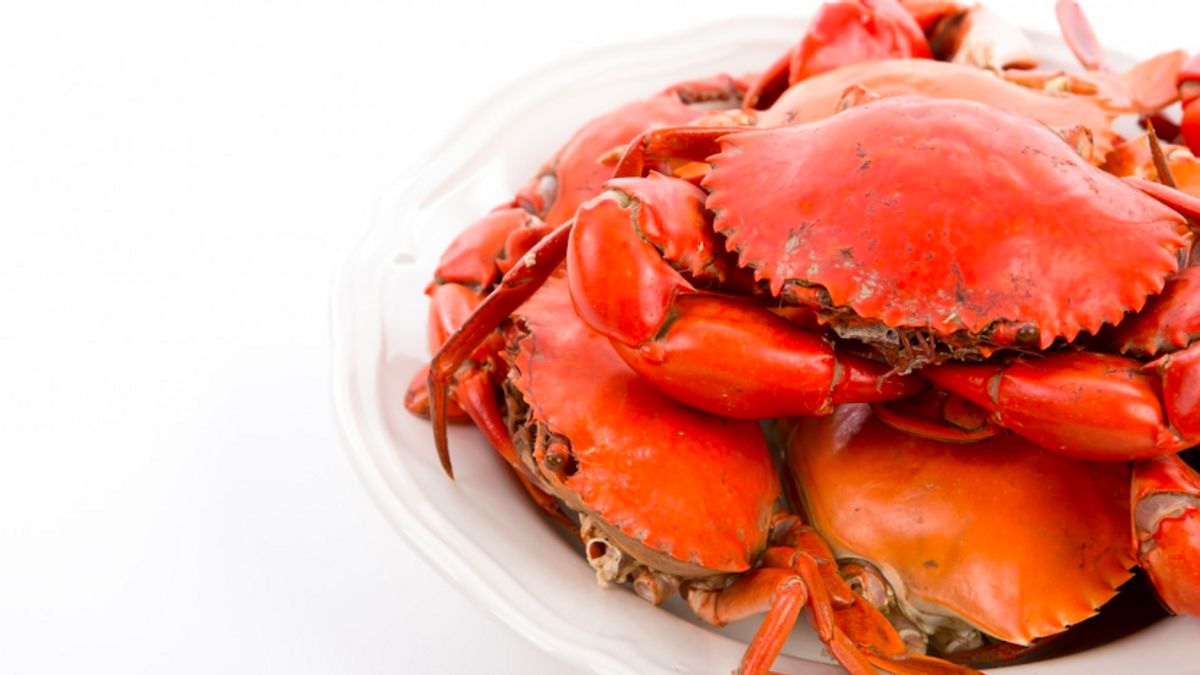


JAKARTA - Crabs are often boiled alive in the cooking process. You know, it turns out they can also feel pain. This research reveals that lobsters and crabs have a nervous system that allows them to feel pain while cooked alive.
Therefore, zoologists from Gothenburg University are now urging everyone or cooks not to boil crabs alive and call for rules in the form of prohibitions, because it is included in the category of hurting animals.
Research has proven that crabs can indeed feel pain, just like other animals. This means that the process of moving alive can be a very painful way of dying for crabs.
"We believe boiling crabs alive should be prohibited, and other techniques such as electric stabbing should be implemented as soon as the crabs are caught," Eleftherios Kasiores, lead author and Ph.D. student at Gothenburg University, quoted by VOI from the Daily Mail page on Friday, December 6, 2024.
"The evidence is increasing, including research showing that crabs are feeling pain. So we have to treat them like we treat other animals," he continued.
In the study, scientists used brain scans to see how the crab's nervous system responds to painful stimuli. The results show the first evidence that crabs process pain in the same way humans do.
The researchers took a partially paralyzed coastal crab and attached electrodes to the neural cluster that formed the central nervous system. Then, these crabs are given painful chemical or physical stimuli using a special solution of acetate acid and probes.
They found damage or stress on the claw, antenna, and leg causing disruption of electrical activity in the associated alleylia.
"Our findings show when painful stimulation is given to the coastal crab tissue, the stimulation is channeled to the brain. This response lasts a long time and is intense," explained Kasiorus.
The researchers also tested the same area with less painful stimulation using salt water, but did not see the same reaction.
"We didn't accept any response, so what we saw was definitely not a reflex. From our findings, we saw that this was a response to pain," said Kasiorus.
Previously, research has shown that most likely crabs, shrimp, and lobsters do feel pain. However, these studies rely more on observational methods, such as observing increased touch on areas that affect or try to avoid danger.
What distinguishes this latest study is that scientists are creating for the first time how the crab and lobster nervous system really responds to destructive stimuli.
In our bodies, and the bodies of many other animals, there is a special receptor called a nosyceptor that detects damage and sends signals to the central nervous system and is interpreted as pain.
In a journal published in the journal Biology, the researchers concluded that the existence of a nociceptor is the 'first criterion' for an animal to feel pain. The neural activation observed by the researchers is a strong indication of a pain receptor in a crab tissue that sends a response to the central nervous system.
SEE ALSO:
-
 | INFO SEHAT
Temuan Zat Kimia Berbahaya pada Anggur Muscat Melebihi Ambang Batas
30 Oktober 2024, 16:40




And, what applies to crabs or other types of shells that have similar structures and nervous systems. This is strong evidence that crabs and lobsters are able to feel and process pain.
Seeing these findings, the researchers said it was very important to immediately provide more legal protection for the welfare of crabs.
"Because now we have evidence that they feel and respond to pain," Kasiores said.
In Europe, crabs are one of the groups of animals that are not protected by animal welfare laws, meaning there are no guidelines on how they should be treated properly. This allows to cut or boil crabs alive, which of course does not apply to the mammals we consume.
Although the researchers admit their research is certainly painful, the number of crabs used as much as possible is reduced, in hopes of improving the welfare of all crabs in the future.
"In the UK, crabs and lobsters are seen as creatures capable of feeling, so animal welfare legislation should be bad to include this group of animals as well. More research is needed in this topic, and we look forward to announcing further guidelines in the future." said Kasiorerus.
The English, Chinese, Japanese, Arabic, and French versions are automatically generated by the AI. So there may still be inaccuracies in translating, please always see Indonesian as our main language. (system supported by DigitalSiber.id)
Most Popular Tags
#Prabowo Subianto #donald trump #firearm #8791 #giias 2026Popular


