
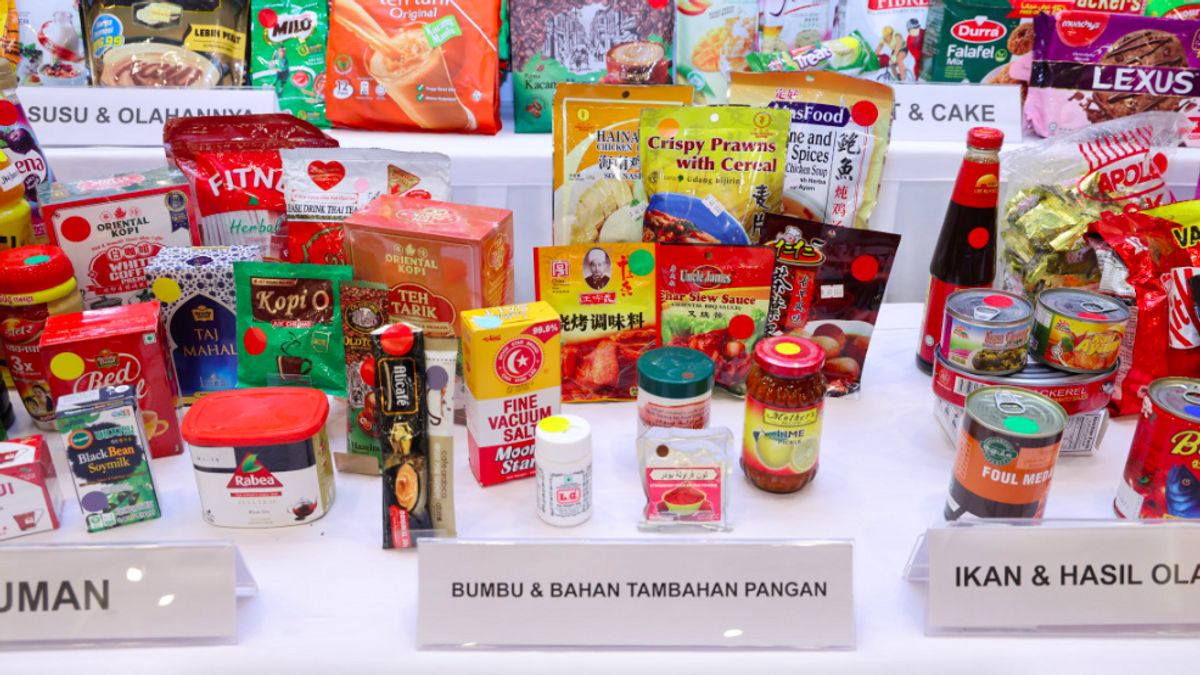


JAKARTA - The Food and Drug Supervisory Agency (BPOM) has again carried out Intensification of Food Surveillance Ahead of Christmas 2025 and New Year 2026 (Inwas Nataru). This activity is carried out to maintain the safety of the community's food, even in the midst of budget efficiency policies.
Supervision is carried out in a coordinated manner with various parties from November 28 to December 31, 2025 by 74 BPOM Technical Implementation Units (UPT) throughout Indonesia. Two UPT in Aceh, namely Loka POM Aceh Tengah and Aceh Selatan, were unable to carry out this activity due to the impact of natural disasters.
"Inwas Nataru is a routine agenda for BPOM to protect the public from dangerous food, especially during increased spending ahead of Christmas, New Year, and Harbolnas.
Until December 17, 2025, BPOM has examined 1,612 processed food circulation facilities in 38 provinces. These facilities consist of modern retail, traditional retail, distributor warehouses, importer warehouses, and marketplace warehouses.
Supervision is carried out on a risk-based basis, with a focus on facilities with a history of violations. Inspections are focused on products without a distribution permit (TIE), expired products, and damaged products.
The results, 65.1% of facilities were declared to meet the provisions (MK), while 34.9% did not meet the provisions (TMK). The most violations were found in traditional retail and modern retail.
The most common type of violation is food without a distribution permit (73.5%), followed by expired food (25.4%), and damaged food (1.1%). TIE products are found in Tarakan, Jakarta, Pekanbaru, Dumai, and Tasikmalaya, especially in border areas and souvenir shops. The illegal products are mostly from Malaysia, Korea, India, and China.
The findings of expired food were most found in Kupang, East Sumba, Ambon, Bau-Bau, and Tanimbar Islands. Meanwhile, damaged food was found in Ambon, Mamuju, Sofifi, Balikpapan, and Surabaya.
"Indonesia's geographical conditions, which have many illegal entry routes or rat routes at the border, such as Tarakan and Dumai, are difficult to be fully monitored. So it requires more intensive cross-sectoral supervision. This finding also shows that surveillance at circulation facilities needs to be tightened again," said Taruna Ikrar, from the official statement of BPOM.
BPOM also found that the length of the distribution and storage chain was not in accordance with the provisions, increasing the risk of damaged and expired products, especially in the eastern part of Indonesia.
In addition to direct supervision, BPOM conducted cyber patrols of 2,607 online sales links. The results found that TIE food sales (60.7%) and food containing drug chemicals/BKO (39.3%) were found. The online products are mostly from abroad.
The economic value of the TMK food findings from offline supervision is estimated to reach IDR 1.3 billion, while from cyber patrols it reaches IDR 40.8 billion.
"The economic value of the findings of TMK products in the intensification of food supervision in total from offline and online channels reaches more than Rp. 42 billion," explained Taruna Ikrar.
Compared to 2024, the number of facilities inspected in 2025 decreased, but the percentage of violations increased. This is due to the implementation of more targeted risk-based supervision. The economic value of the findings of the TMK also increased significantly, both from offline and online supervision.
Throughout 2025, BPOM also carried out routine supervision of 6,177 food facilities. A total of 20.4% of them were declared not to meet the provisions.
"The economic value of the findings of TMK food products in routine supervision in 2025 is IDR 2 billion. Meanwhile, the findings from routine cyber/online patrols are 27,722 links for the sale of TMK food products with an economic value of IDR 184.2 billion," explained Taruna Ikrar.
All findings have been followed up through product returns, destruction, administrative sanctions, to legal proceedings. BPOM also cooperates with idEA and the Ministry of Communication and Digital to reduce links to the sale of illegal products.
In general, the 2025 Inwas Nataru shows an increase in compliance by business actors thanks to continuous coaching and cross-sector collaboration.
"I appeal to business actors to increase compliance with regulations and ensure that the products produced meet the provisions," said Taruna Ikrar.
BPOM is also committed to assisting business actors, including UMK, through various mentoring programs and consulting services, both online and in person at BPOM offices throughout Indonesia.
The English, Chinese, Japanese, Arabic, and French versions are automatically generated by the AI. So there may still be inaccuracies in translating, please always see Indonesian as our main language. (system supported by DigitalSiber.id)
Most Popular Tags
#Prabowo Subianto #donald trump #Febrie Adriansyah #8791 #giias 2026Popular


