
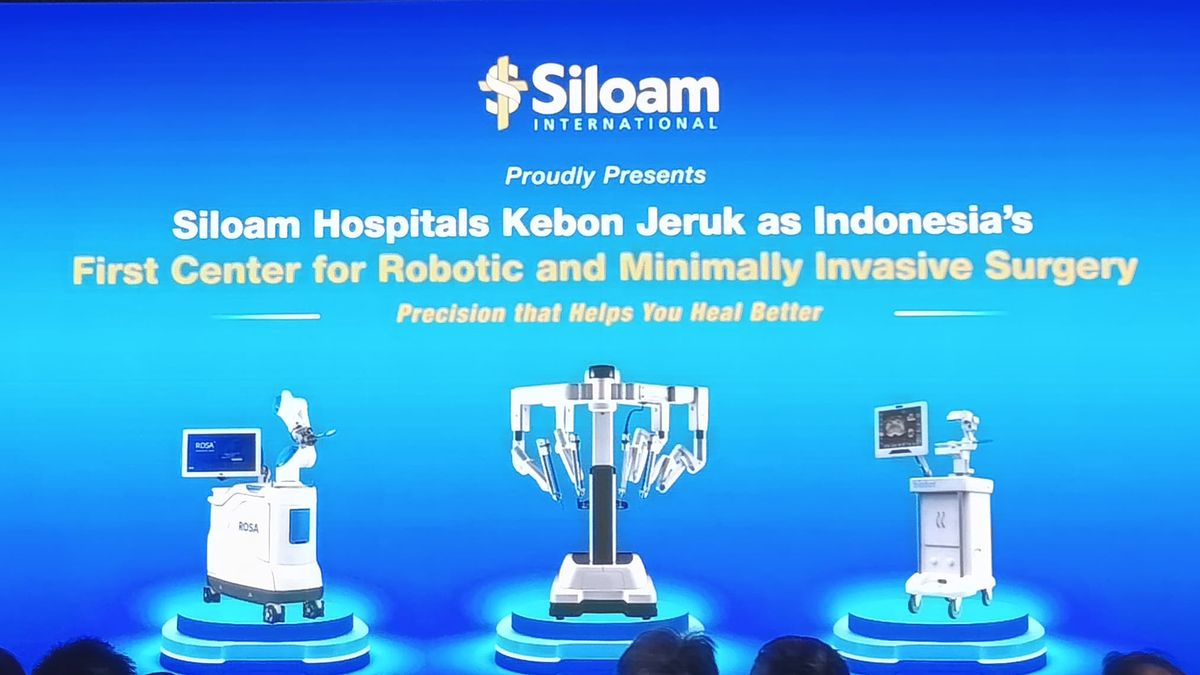


JAKARTA - The development of modern surgical technology has brought significant changes in the medical world, especially in terms of patient safety and comfort.
One of the prominent innovations is the use of robotic systems in minimally invasive surgical procedures. This technology allows for higher precision, faster recovery, and lower risk of complications compared to conventional methods.
Dr. Ferdhy Suryadi Suwandinata, SpOG-KFER, obstetri and gynecology specialist and user of the Da Vinci Xi robotic system, explained how the training process and doctor's adaptation to this technology.
"The training is very clear. We start with TR100, so that we are familiar with the advanced tools, including how to install and troubleshoot. After TR100, we can practice on patients," said Dr. Ferdhy when met at Gandaria, Kebayoran Lama, South Jakarta, Tuesday, December 16, 2025.
He added that doctors who just use robots are always accompanied by a proctor, an experienced doctor, especially in the first four surgeries.
"After the proctor assesses that we are ready, usually in the fifth operation, we can already be independent," he explained.
For doctors who are already used to performing laparoscopy, adaptation to robotics is relatively easy.
"The problem is usually just a habit. If you usually do open surgery, you must be used to that way. The robot only needs to adapt, because the surgical technique is similar to laparoscopy. So those who are used to it are not too different," said Dr. Ferdhy.
In addition, robotic technology continues to evolve. Currently, multiport systems such as Da Vinci Xi are still the standard, but robotic single port innovations are being developed to reduce the number of incisions and increase efficiency.
This system is also used in various oncology cases, such as early stage endometrial and cervical cancer, with the support of navigation and AI technology, including the Firefly feature to detect cancer tissue precisely.
"With this technology, early stage cancer can be treated more accurately. Firefly helps see tissues that are not visible to the naked eye, so the sentinel tissue removal procedure becomes more effective," said Dr. Ferdhy.
The use of robotics also makes doctors more comfortable during surgery, especially in heavy oncology cases, thus reducing fatigue. For the first case, the operating time ranges from 1-1.5 hours for simple cases and 2-3 hours for more complex cases.
"If the patient is a small child, it depends on his age. For babies 1-2 years old, an 8 mm incision is too big, so usually they still use mini-laparoscopy. But for adult patients, robotics is very helpful, including in cancer surgery that requires high precision." added Dr. Ferdhy.
With mature experience and training, Dr. Ferdhy emphasized that robotics is not only a sophisticated tool, but also improves the safety, efficiency, and comfort of patients in obstetric and gynecological procedures.
The English, Chinese, Japanese, Arabic, and French versions are automatically generated by the AI. So there may still be inaccuracies in translating, please always see Indonesian as our main language. (system supported by DigitalSiber.id)


