
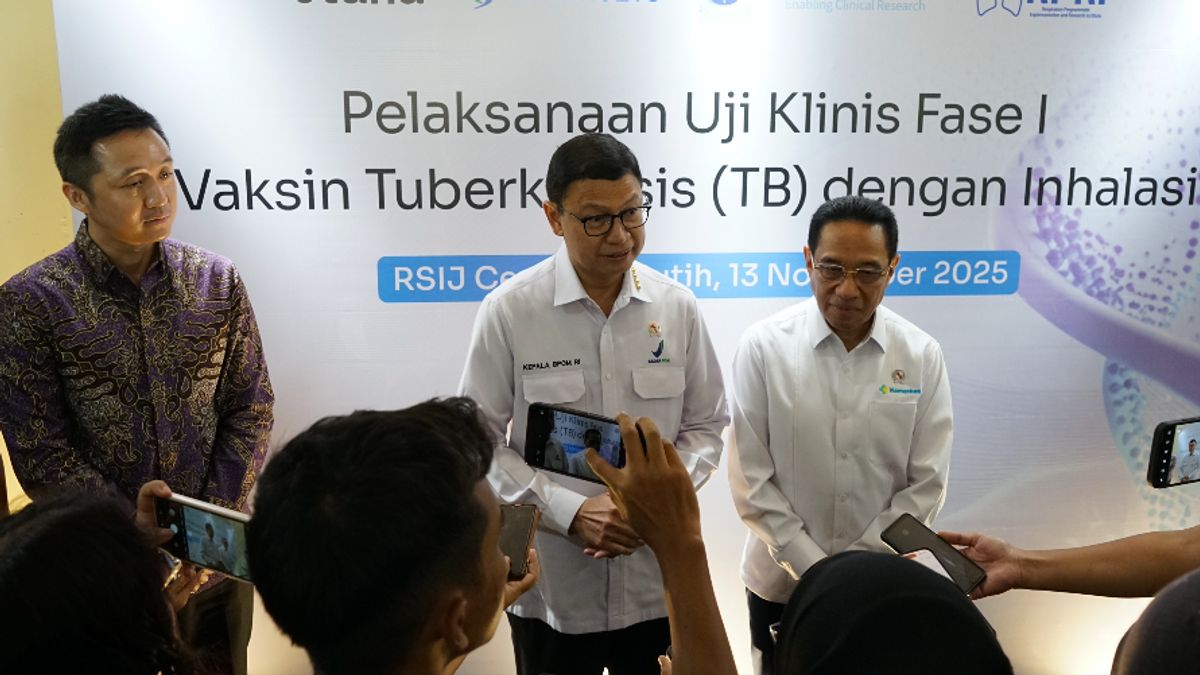


JAKARTA - Indonesia's efforts to strengthen independence in the field of biotechnology are moving forward again. The locally made tuberculosis (TBC) vaccine is now officially entering the first phase of clinical trials.
Tuberculosis is still one of the largest global health burdens, with eight countries including Indonesia contributing nearly 70 percent of all cases in the world. Without new innovations, the TB elimination target by 2030 will be difficult to achieve.
The phase of clinical trials of tuberculosis vaccine also marks an important milestone in the development of innovative vaccines developed through collaboration between PT Etana Biotechnologies Indonesia and CanSino Biologics Inc.
This vaccine, which is tested as a booster vaccine based on human type 5 recombinant adenovirus, is given through an inhalation method. This approach is considered to have the potential to increase protection in the respiratory tract of the main pathway for the entry of TB infection.
The implementation of the first phase of clinical trials was carried out at the Jakarta Cempaka Putih Islamic Hospital and attended by the Deputy Minister of Health of the Republic of Indonesia, dr. Benjamin Paulus Octavianus, Sp.P(K), FISR, as well as the Head of the Indonesian Food and Drug Supervisory Agency (BPOM), Prof. Dr. Taruna Ikrar, M.Biomed., MD., Ph.D.
This first phase clinical trial is led by Prof. Dr. dr. Erlina Burhan, M.Sc., Sp.P(K), a pulmonologist from Friendship Hospital. Research will involve 36 healthy volunteers aged 1849 years, who will receive an inhalation vaccine using a nebulizer.
The method aims to stimulate direct immunity in the respiratory tract, in contrast to the injection method that has been used in the BCG vaccine, the only TB vaccine currently available.
Although BCG is proven to protect infants and children from the form of severe TB, its effectiveness in adults and for pulmonary TB is still limited. Therefore, this inhalation vaccine is expected to provide additional protection for the wider age group.
SEE ALSO:
-
 | KESEHATAN
Dinkes Serang Catat 452 Anak Terinfeksi TBC hingga September 2025
15 September 2025, 17:25 -
 | INFO SEHAT
Digitalisasi Produksi Vaksin Jadi Kunci Ketahanan Kesehatan Nasional
02 Oktober 2025, 21:45 -
 | INFO SEHAT
Pentingnya Vaksinasi RSV untuk Ibu Hamil demi Lindungi Bayi Baru Lahir
07 Agustus 2025, 00:25

In this case, the Deputy Minister of Health of the Republic of Indonesia, dr. Benjamin Paulus Octavianus, emphasized that tuberculosis is still one of the national priorities in the health sector, with the target of eliminating TB by 2030. The government, he said, continues to strengthen cross-sectoral collaboration to accelerate control of this disease.
"This trial of the TBC inhalation vaccine is an important step to expand prevention efforts. We want to ensure that the process takes place quickly and efficiently, without ignoring scientific principles," he said, in a press statement received by VOI.
He hopes that the test results will run well so that this vaccine can be widely used in 2029. Meanwhile, the Head of BPOM RI, Prof. Taruna Ikrar, said that his agency had given approval for the first phase of clinical trials after going through a rigorous scientific evaluation of pre-clinical data, including laboratory and animal test results that showed good safety profiles.
"The BPOM team has also conducted direct inspections of vaccine production facilities in China to ensure that all safety and quality standards are met," he explained.
He added, if the results of the first phase show good safety, BPOM is ready to support the continuation to the next phase until the registration stage.
On the other hand, CanSino Biologics Inc. CEO, Dr. Xuefeng Yu, said that the vaccination approach through inhalation is believed to trigger mukosal immunity in the respiratory tract, thus providing more specific protection against pulmonary TB infection.
"National countries with high TB burdens such as Indonesia and China face similar challenges. Through this collaboration, we want to accelerate the presence of more effective vaccines for people in need," concluded Dr. Yu.
Through the implementation of this clinical trial, it is hoped that Indonesia can strengthen the independence of vaccine research, accelerate the adoption of modern biotechnology technology, and make a real contribution to TB control at the national and global levels.
The English, Chinese, Japanese, Arabic, and French versions are automatically generated by the AI. So there may still be inaccuracies in translating, please always see Indonesian as our main language. (system supported by DigitalSiber.id)
Most Popular Tags
#Prabowo Subianto #donald trump #2026 World Cup #Febrie Adriansyah #8791Popular


