
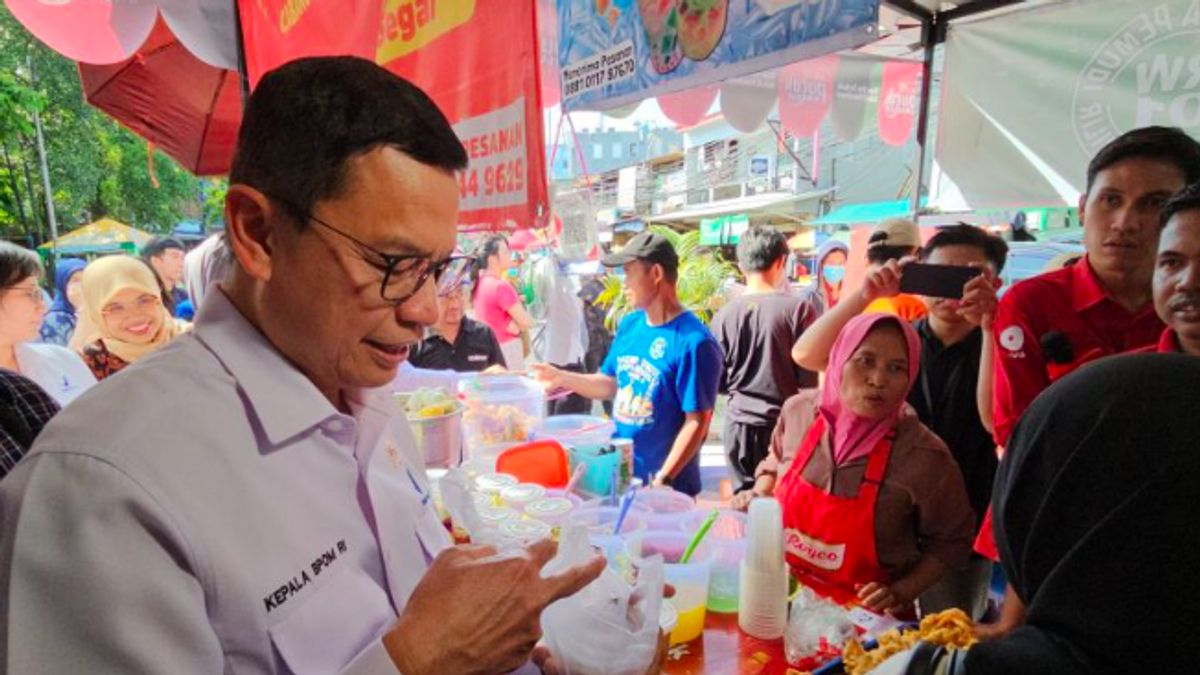


JAKARTA - Takjil that does not meet food safety standards can have a negative impact on health. The use of hazardous ingredients such as formalin, bolax, and textile dyes in food can cause digestive disorders, organ damage, and even increase the risk of cancer. Therefore, people need to be more vigilant in choosing takjil to break their fast.
The Food and Drug Administration (BPOM) reported that until March 5, 2025, out of a total of 1,221 takjil samples tested, 1,193 samples or 97.71 percent were declared eligible, while 28 samples or 2.29 percent were not suitable for consumption.
In a statement in Jakarta on Tuesday, the Head of BPOM Taruna Ikrar said that testing was carried out on 592 traders in 127 technical implementing unit (UPT) surveillance locations. The intensification of food surveillance during Ramadan has started since February 24, 2025 at 76 UPT throughout Indonesia and will last until March 26, 2025.
According to the cadets, hazardous materials such as tofu and wet noodles were found in Tangerang, Palembang, and East Jakarta, with a percentage of 42.86 percent.
"Then bolaks (35.71 percent) was found in crackers and noodles in Central Lombok and West Manggarai. Furthermore, rodmin B (21.43 percent) in red crackers and Chinese girlfriend porridge, especially in the Rejang Lebong and Payakumbuh areas," said Taruna Ikrar.
Rodamin B is a textile dye that can trigger serious health problems, including the risk of cancer if consumed in the long term. Therefore, BPOM urges the public to be more careful in choosing food.
SEE ALSO:
-
 | KESEHATAN
Lindungi Masyarakat, BPOM Kepri Awasi Keamanan Pangan Parsel Lebaran
06 Maret 2025, 15:55 -
 | KESEHATAN
BPOM Temukan 61 Obat Oplosan BKO Berbahaya, Bisa Berujung Kematian
28 Februari 2025, 14:55

In addition to testing hazardous materials on market snacks, BPOM also supervises packaged food products in retail. Inspections include distribution permits, packaging conditions, and expiration dates to prevent the circulation of illegal and dangerous products.
The cadet emphasized that takjil products that do not have a distribution permit are illegal, while expired products are at risk of containing bacteria or other harmful substances.
This surveillance effort aims to ensure food safety for the community, especially during Ramadan and Eid al-Fitr. Intensive supervision is also carried out in several large markets in Jakarta, such as Rawamangun Market and Bendungan Hilir Market, which are the centers of takjil sales.
BPOM applies two main methods under surveillance, namely sampling and intelligence. In the sampling method, officers go directly to the market by wearing BPOM's official attributes to take random food samples. Meanwhile, intelligence methods are carried out by means of officers buying food samples without BPOM attributes to ensure more in-depth monitoring.
The cadets also reminded the public to always pay attention to signs of food safety. For fresh food, it is important to check color, aroma, and hygiene. Meanwhile, for packaged food, people are advised to check packaging conditions, distribution permits, labels, and expiration dates before buying or consuming them.
The English, Chinese, Japanese, Arabic, and French versions are automatically generated by the AI. So there may still be inaccuracies in translating, please always see Indonesian as our main language. (system supported by DigitalSiber.id)
Most Popular Tags
#Prabowo Subianto #donald trump #2026 World Cup #Febrie Adriansyah #8791Popular


