
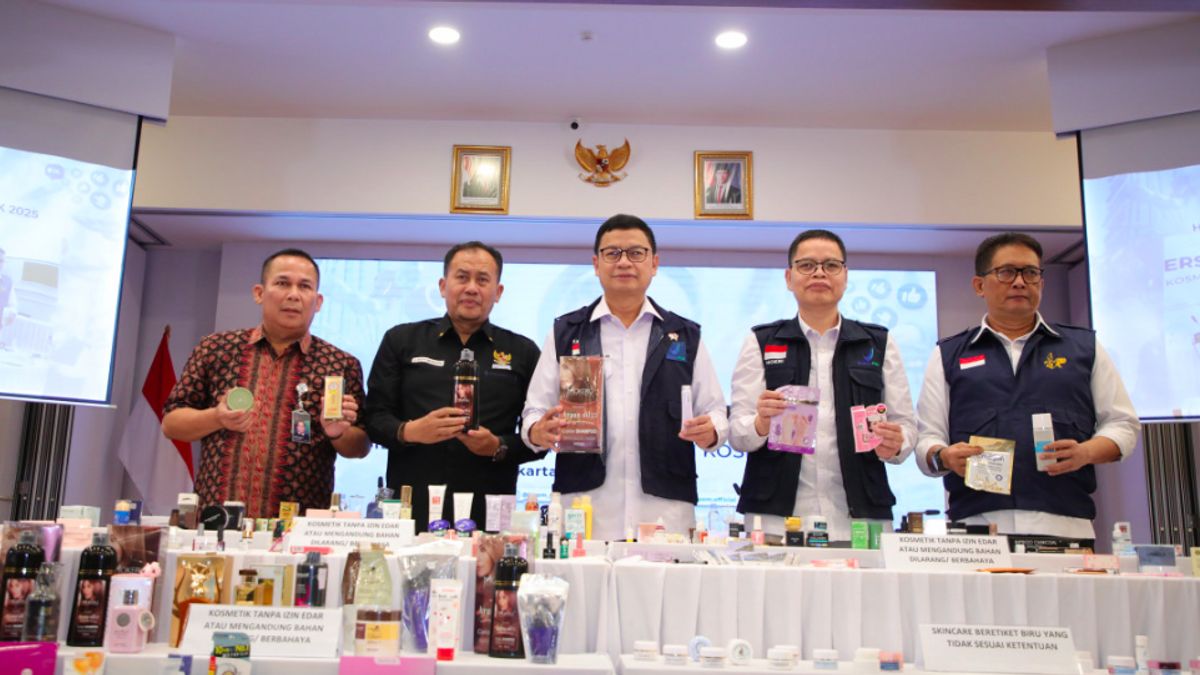


JAKARTA - The Food and Drug Supervisory Agency (BPOM) has just released the results of the intensification of cosmetic surveillance in early 2025. The results are astonishing, with the total findings reaching IDR 31.7 billion, an increase of more than 10 times compared to the same period last year which only reached IDR 2.8 billion.
The head of BPOM, Taruna Ikrar, revealed that this spike was caused by a shift in consumer behavior which increasingly relied on online cosmetic purchases based on reviews from influencers. This condition is used by irresponsible individuals to peddle illegal cosmetic products or those that contain harmful materials.
Not only products without distribution permits, illegal cosmetics currently circulating also include skincare with blue etiquette and beauty injections that should only be obtained with a doctor's prescription.
Unfortunately, these products are now widely sold on e-commerce platforms. From the results of BPOM's supervision, it was found that illegal cosmetics circulating were dominated by imported products, reaching 60%, as well as production contract products distributed through online media.
In the period from February 10 to February 18, 2025, BPOM identified 91 illegal cosmetic brands with a total of 4,334 items and 205,133 pieces of products containing hazardous materials, do not have a distribution permit, or have expired. BPOM found as many as 91 illegal cosmetic brands.
The results of supervision on February 10 18 2025 throughout Indonesia, BPOM found violations and allegations of production of the distribution of illegal cosmetics as many as 91 brands. There are 4,334 units with 205,133 pieces of sociosmetics containing prohibited materials, including the blue skincareetics that do not comply with the provisions, without distribution permits, how to use that is not in accordance with the definition of cosmetics, and expired products, explained Taruna Ikrar in his statement at the 2025 Cosmetic Supervision Intensification Results Press Conference at the BPOM Office, quoted from the BPOM website.
The Ikrar cadets also revealed a new mode used by the perpetrators regarding falsification of distribution license numbers. There are two main modes found.
First, he fakes another distribution permit number, then he produces and distributes it. This is a violation and we will continue to be pro-justitia. Second, placing the distribution license number in blue etiquette, even though it does not use a distribution permit number. This is part of tricking consumers and we will take it seriously," he said.
Based on this finding, BPOM emphasized that it would take the case to court and take firm steps against the perpetrators.
"According to the promise, BPOM will work optimally and we will do it. This is evidence (of) the public's demands for BPOM to work, so we work by paying attention to what is happening on social media and we act, like today," continued Taruna Ikrar.
SEE ALSO:
-
 | EKONOMI
Sri Mulyani Sebut Makan Bergizi Gratis Bisa Kurangi Kemiskinan 0,19 Persen
11 Februari 2025, 15:39 -
 | EKONOMI
Pemangkasan Anggaran Semata-mata Demi Program MBG Dinilai Tak Bisa Dongkrak Ekonomi RI
10 Februari 2025, 18:05 -
 | BERITA
Kiai NU: Program Makan Bergizi Gratis Tidak Boleh Menggunakan Dana Baznas
26 Januari 2025, 11:00
Despite facing budget constraints, BPOM remains committed to continuing to monitor the circulation of cosmetics in order to protect the public. Taruna Ikrar emphasized that BPOM not only responded to public complaints but also proactively monitored trends on social media to identify potential violations.
Of the total 709 facilities examined in this supervision, 340 facilities (48%) were found not to meet the provisions. Most violations were committed by distributors (40%), followed by beauty clinics (25.59%), resellers (18.24%), Business Entities Owners of Cosmetic Notifications (BUPN) (5%), industries (4.71%), brand owners (3.53%), and importers (2.94%). BPOM ensures that supervision is carried out thoroughly, from upstream to downstream, to eradicate illegal cosmetic products.
The chairman of the National Consumer Protection Agency, Muhammad Mufti Mubarok, welcomed BPOM's steps in tightening supervision as a tangible manifestation of the protection of the country against consumers. He highlighted the importance of education for the public, considering that there are still many consumers who prioritize instant results without paying attention to product security.
The Director General of Consumer Protection and Trade Order of the Ministry of Trade, Moga Simatupang, also emphasized that the government will not remain silent. He stressed that trade supervision will be further tightened with cross-sectoral cooperation to eradicate dishonest business practices.
As a precautionary measure, BPOM invites the public to become smart consumers by applying the KLIK Check (Cek Kemasan, Label, distribution and Expired Permit) principle before buying cosmetic products. BPOM also encourages the public to report findings of illegal products through the official complaint channel BPOM or the Indonesian Police so that they can be followed up immediately.
With these decisive steps, it is hoped that the circulation of illegal cosmetics can be suppressed, and the public is increasingly aware of the importance of choosing cosmetic products that are safe and licensed.
"Report to BPOM, BPOM technical implementing units (UPT) throughout Indonesia, the Indonesian Police, as well as through all BPOM complaint service channels. We have opened everything we can and will follow up immediately." concluded Taruna Ikrar.
The English, Chinese, Japanese, Arabic, and French versions are automatically generated by the AI. So there may still be inaccuracies in translating, please always see Indonesian as our main language. (system supported by DigitalSiber.id)
Most Popular Tags
#Prabowo Subianto #donald trump #2026 World Cup #Febrie Adriansyah #8791Popular


