
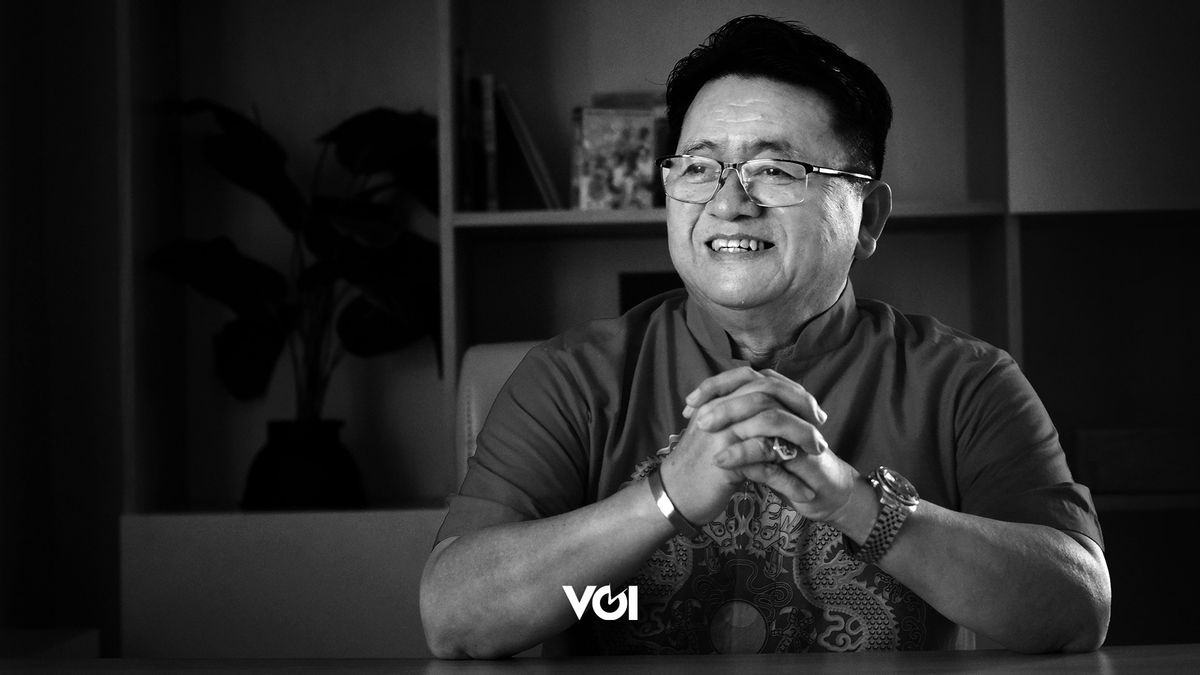


The Chinese zodiac year of the Fire Horse is a year of turbulence, high energy, and challenges. Therefore, the Deputy Chairman of the Department of Law, Human Rights, and Advocacy of the Indonesian Chinese Social Association (PSMTI) Center, Dr. Hasan Karman, SH, MM, reminded to be extra careful passing the Chinese New Year 2577 Kongzili. Although it is heavy, we must remain optimistic; the storm will pass.
***
Chinese New Year is celebrated again. Now, not only Chinese people are welcoming and celebrating Imlek 2577 Kongzili on February 17, 2026. Jakarta and other cities are starting to decorate with bright and festive Chinese ornaments here and there.
Facing the uncertain conditions in this Fire Horse Year, Hasan advised the public not to panic and remain calm. "There are many experts who predict that this Fire Horse Year will be like this and like that. But the storm will pass. We must be optimistic, calm, and flexible in dealing with any difficult situation. There must be a way out, one year is only 12 months," he said.
Even in the global context, the world is not going well. Wars are still happening in various places, while the crisis in Gaza and Palestine has not subsided. Israel continues to crush the Palestinians with various actions.
Meanwhile, domestically, natural disasters have occurred in various areas. The disaster that still leaves a deep sorrow is the flood that occurred in Aceh, North Sumatra, and West Sumatra. Not only there, disasters also occurred in other areas throughout Indonesia. As a social-based organization, PSMTI according to Hasan has moved directly to the disaster site.
Hasan Karman called on Chinese citizens and all parties to be patient in facing the difficult situation for the next year.
"The sun will shine again after the clouds. Don't panic, we have the Almighty God. If He doesn't allow it, it won't happen. Accompany all our actions with prayers to the Almighty. Ora et labora, we must continue to pray and work," he told Edy Suherli, Bambang Eros, and Irfan Meidianto when they visited the VOI office in Tanah Abang, Central Jakarta, not long ago.
What does the celebration of Chinese New Year 2026 mean for you personally and for the PSMTI family in the context of realizing a prosperous and prosperous Indonesia?
There are two things that Chinese people around the world do to celebrate the Chinese New Year. First, thank and pray to God Almighty for having led through the past year. We will enter a new year full of challenges and uncertainties.
The second is family gatherings. People who have traveled far will return home or return home if they still have parents. Yes, it's almost the same as the tradition of returning home to celebrate Eid in Indonesia. If we look at China, billions of people go home to their hometowns; train stations, airports, and ports are all full of people who want to go home. There is reconciliation and reunion in family gatherings, which are usually filled with a meal together.
For me personally, it is also like that. After everyone gathers, we are grateful and pray, then it is concluded with a meal while chatting. After that, there is a tradition of young family members visiting the older ones.
"Besides internal events, are there any external events?"
PSMTI is throughout Indonesia. In every province there is a management, as well as at the district and city levels. They all celebrate Chinese New Year. However, gathering and eating should not be interpreted as foya-foya or luxurious.
Usually there are also social service events to share with those who are less fortunate. For a year we have been given sustenance, so part of it must be shared with others in need. Sharing is also realized through angpau which is often given during Chinese New Year.
Imlek 2577 Kongzili is the Year of the Fire Horse, what does it mean?
In Chinese culture, there are five elements (Wu Xing) that are the basis of every activity, namely metal (Jin), wood (Mu), water (Shui), fire (Huo), and earth (Tu). This new year the fire element is paired with the horse zodiac. This cycle occurs every 60 years, so the next Fire Horse Year will only be in 2086. This number 60 comes from the five elements multiplied by the 12 existing zodiacs.
In this Fire Horse Year, what needs to be watched out for?
Let's unpack the two symbols, namely the horse and the fire. Fire is heat that contains energy and its nature is turbulent. The horse is a symbol of spirit. Remember, the horse is basically wild and agile so it is difficult to control, but there are people who are able to tame it and use it for various needs.
So, these two elements have something in common, namely both have great energy. This energy must be utilized to be good. However, if the two are combined without control, the situation will be turbulent. In the Chinese "primbon", the Fire Horse Year is indeed predicted to bring a lot of dynamics.
How do we face this year full of turmoil and challenges?
Chinese culture has gone through 4,000 years of history. This is not something strange because the Chinese have experienced this cycle since thousands of years ago. There are various ways to ward it off. The horse is wild, agile, and eager, so face it not emotionally, but with gentleness.
Then the hot fire must be guarded so that it does not burn. There are many ways to tame fire; fire can be used for positive things. The point is, facing this turbulent year, people do not need to be afraid. We must be optimistic. There is no problem that cannot be solved, the important thing is how we solve it.
What are the tips for facing challenges according to you?
Chinese philosophy is very rich. In facing challenges, we must first map the problem. Of course, each person, region, and tribe has its own challenges. It must be dissected to find the right solution.
There is a Sun Tzu War Strategy that is very relevant to be applied to the current conditions. This strategy emphasizes victory through ingenuity, efficiency, and thorough preparation, not just physical strength. The main principle is "winning without fighting" through intelligence, speed, intelligence, and psychological conquest. This is relevant for the military world, business, to modern conflict management.
There is also the teaching of Taoism which teaches us to be in harmony with nature, not against it. The main principle is to flow (Wu Wei) like water. Water is flexible but strong. Tao teaches humans to accept natural changes and not do any harm. We must imitate the nature of water.
There is a belief that rain on Chinese New Year's Eve is a sign of abundant sustenance, and if it does not rain, it is the opposite. How do you ask people to remain optimistic in finding sustenance?
Rain is an inevitability, a natural event that cannot be denied. Indeed, there is an ancient Chinese proverb that is still held to this day that rain for some is a blessing. But what if the rain is excessive?
According to me, we should not be trapped in superstitions that say that if it doesn't rain, then the sustenance will drag. If on Chinese New Year's Eve it doesn't rain, don't be immediately disappointed and think that sustenance throughout the year will be difficult. We must think positively to God; maybe God determines our sustenance to be postponed first, or it's not time for us to get abundant sustenance this year. Who knows at another time God will give us His sustenance.
Currently, Chinese New Year belongs to the Indonesian people, not just Chinese people. How does PSMTI see this phenomenon as a unifying tool for the nation?
"We are grateful that since a few years ago Chinese New Year has been designated as a national holiday. This means that Chinese New Year has been accepted by all of this nation. Currently, Chinese New Year is celebrated by many nations around the world, so it is universal and inclusive, not just for Chinese people anymore. Although internally there are still some rituals belonging to Chinese citizens, in general everyone can participate in celebrating.
Cultural acculturation has been happening for centuries in Indonesia. Indonesian culture is an entity consisting of various tribal and cultural elements from Sabang to Merauke. Chinese ethnicity is in it and contributes to the diversity of Indonesian culture. Examples are barongsai, bakmi, tahu, tauco, koko clothes, and others.
Even when meeting the Minister of Religion some time ago, he said that the origin of the bedug that existed in some mosques in Indonesia came from China. Bedug was indeed used as a sign of prayer in China. Admiral Cheng Ho, a Muslim from the Hui Chinese, spread this tradition to the Islamic kingdoms in Java, so that it was carried out until now. The difference is that in the temple bedug is combined with bells, while in the mosque bedug is beaten before prayer.
As a social organization, what are the flagship programs of PSMTI, especially in supporting government strategic programs such as food security or poverty alleviation?
"At PSMTI there are 18 Deputy General Chairmen who deal with various things. Each field moves together in parallel, and programs at the provincial and district/city levels are synergized. We are very active in supporting government programs. Some are published and some are missed by the media, but what we do is definitely on the right track.
Not long ago there was a disaster in Aceh, North Sumatra, West Sumatra, and other areas. What did PSMTI do to help survivors?
After the incident, PSMTI Aceh immediately moved. In our organization there are two models: the area moves directly and there are those who are coordinated by the Central PSMTI. When in the field, friends in the area report the necessary logistical needs, then we fill it and help from the center. This has happened many times, both for flood disasters, earthquakes, landslides, to fires.
So, has PSMTI taken concrete steps?
"Let alone during or after a disaster, even when there is no disaster we are moving. Of course what we do is adjusted to our capabilities and capacities.
Many Chinese friends are entrepreneurs, is there a program to nurture MSMEs?
"We have been doing this since PSMTI was established. That's why there is a department that deals with MSMEs, and the one who leads it is an entrepreneur. So, what he has done in his business is applied directly to nurturing MSMEs. We also collaborate with relevant ministries and agencies to help small business actors.
For Jakarta for example, where is the location of the UMKM training?
"We at the center play a role as a coordinator. Usually, those who go directly to the field are the PSMTI of the region because they are in direct contact with the nearest UMKM actors. We are private people, so our movements are more flexible.
How do you see the role of Chinese youth (Gen Z & Millennial) in PSMTI? Do they still hold on to the values of ancestral culture in the midst of the current modernization?
As a person, I am concerned, because with modernization and globalization, our culture is sometimes marginalized and eroded by Western culture. For example, young people now are better at English than their mother tongue. So, there is a shift in understanding among the younger generation. This is an inevitability that is difficult to avoid.
"Well, we have a wing organization, namely the Indonesian Chinese Youth Association (IPTI) and the Koko Cici Association (IKOCI). They are the ones who are expected to reach out to Chinese youth to re-instill the awareness that the ancestral culture exists and needs to be preserved.
"The PSMTI organization should be neutral, if personally you want to be political that's another matter. What is done to maintain the neutrality of PSMTI?
In AD and ART, PSMTI is a social organization, so it is not practical politics. We will support whoever wins the election. Our General Chairman frees all members and cadres to channel their political aspirations anywhere.
So, the political aspirations of each individual here are very diverse; they are in all political parties. The difference in political aspirations is normal, but if you are in an organization, we will carry out the same mission, namely the social mission. In short, as an organization, PSMTI will always be neutral. Personal affairs want to go to party A, B, or C, please. That is the personal territory of each. The same is true of religion, all religions are in PSMTI: Islam, Buddhism, Christianity, Catholicism, Taoism, Confucianism, and others. We are an inclusive organization.
Sometimes there is still a stigma or social barrier in society. What is your message to Indonesian Chinese people to continue to blend in and contribute without feeling 'exclusive' in the community?
"The stigma has been around for a long time. I was born in Singkawang, West Kalimantan. Try to play in Singkawang and see what the Chinese people who are the majority there are like. After growing up, I moved to Java for school. I saw the conditions were very different. From there my mind opened up, especially after working in many cities across Indonesia. There are many Chinese people who have blended in, even like locals. Only the appearance is still noticeable, while the language and style are very local.
So, the assumption that the Chinese are exclusive is not true. It is only a charge that is blown up by certain parties who have their own mission. We should not be provoked by this kind of infighting. Indonesia will not progress if we are still noisy about this. Other people have gone to the moon, hehehe.
The world is not in a good state because of geopolitical conflicts. From the Chinese cultural perspective that emphasizes harmony (harmony), what philosophy can Indonesia offer to the world?
"Our founding fathers have determined the direction of our foreign policy which is free and active. This is very consistent with the principles that the Chinese people follow. "Free" means that we can make friends and determine our own destiny. "Active" means seeking peace and being a mediator to help create world peace and harmony. So, we remain independent in the midst of world interaction.
Recently Donald Trump formed a Board of Peace, what is your response to this institution?
"This is a new thing, we'll see how it develops; whether this BoP will exist or just be temporary. If you ask me, the existing institutions such as the UN are actually enough. Just make it effective, what is lacking is improved, and what is weak is strengthened.
Facing this Fire Horse Year, we must be optimistic. What is your last message for PSMTI members and all VOI readers?
Indeed, many experts predict that this Fire Horse Year will be like this and like that. But the storm will pass. We must be optimistic, calm, and flexible in facing any difficult situation. There must be a way out, one year is only 12 months. The sun will shine again after the clouds. Don't panic, we have an Almighty God. If He doesn't allow it, it won't happen. Accompany all our actions with prayer. Ora et labora, we must continue to pray and work.
Hasan Karman and the Experience of Leading the City of SingkawangEven though it was only one period, Hasan Karman had an unforgettable memory when he led the city of Singkawang. (Photo: Bambang Eros VOI, DI: Raga Granada VOI)
Hasan Karman served as the Mayor of Singkawang in the 2007-2012 period. "I am very grateful to have been the number one person in the city of Singkawang. I had the opportunity to determine the direction of the development of the city of Singkawang for one period," said this man who was born in Singkawang, West Kalimantan, August 6, 1962. What did he do for his hometown?
When he first took office, with all his limitations, he tried to move the wheels of his city's development. "The Singkawang City APBD is very small. I then established cooperation with third parties. Like the Cap Go Meh Festival which takes place from Chinese New Year's Eve to the 15th day (Cap Go Meh). Every night during the bazaar, there are art activities and performances of all tribes in Indonesia that exist in Singkawang. So it's not just Chinese culture that is displayed. Singkawang is famous everywhere," he said.
The impact is huge; hotels and inns are full. MSMEs and the economy move during the festival, and the effects are still felt even after the event is over. "And until now, the Cap Go Meh Festival is still preserved," said the man with the nickname Bong Sau Fam.
As a leader, he also moved into other fields such as agriculture. "Rice production increased by more than 5% per year. Therefore, I received the award two years in a row from the President. And Singkawang City also received the Adipura award as the cleanest city for two consecutive years," said Hasan, adding that at that time there was no massive promotion for the achievement.
Equally memorable, Hasan donated an office to the Forum for Religious Harmony (FKUB). This step is what made the Setara Institute award Singkawang as a City of Tolerance. "Because there is an FKUB office, the point is big," he added.
Singkawang Latest NewsCurrently, according to Hasan, the visible growth and development of Singkawang City is good. "My note, at this time in Singkawang, we still need to pay attention to the poor and disadvantaged people. They must get the attention of the government so that they can be independent and, if possible, get out of poverty by creating jobs," he said.
Hasan continued, there are many parties who make Singkawang City as a location for social service (baksos). "I think this is a sign of something; why is an area used as a place for social service? It means there are still many people who are lacking," he said.
When he first entered politics, Hasan joined the New Indonesian Struggle Party (PIB) founded by Dr. Sjahrir. However, currently, he is no longer active in practical politics and focuses on managing a law office with colleagues and creating culinary content. "Before I really left the political party, I stopped by Gerindra and NasDem. But now I'm not in politics anymore," he explained.
The reason Hasan left the political party was because the situation was felt to be less conducive and his aspirations were not channeled. "For me, if it doesn't suit me, the choice is to leave the party. In the future, whether I will come back, I don't know. I am now focusing on social organizations only," he said.
Health and CulinaryTo maintain health, Hasan is diligent in running and jogging around his residence. "It doesn't have to be long, 30 minutes is enough," he said.
In addition, he also has a hobby of cooking and cooking. "When I was little I often accompanied my mother cooking. Since then there has been a sense of love and wanting to cook as well. Now I want to cook rawon, Chinese food, spaghetti, and others, I can do it, hehehe," he said with a distinctive laugh.
Every time he visits a place and finds delicious food, Hasan will try to cook it again at home. "Cooking is easy, the important thing is that we want to try and don't be afraid to fail. Any recipe can be found," said Hasan, who has not yet thought about doing a commercial culinary business.
Now he makes a lot of YouTube and TikTok content about cooking, the origin of food, to the acculturation of culture in Indonesia. "Although it hasn't been long, my content has increased drastically, the followers are many. I'm happy to make something useful for others," he explained.
"Indeed, many experts predict that this Fire Horse Year will be like this and like that. But the storm will pass. We must be optimistic, calm, and flexible in dealing with any difficult situation. There must be a way out, one year is only 12 months,"
Hasan Karman
The English, Chinese, Japanese, Arabic, and French versions are automatically generated by the AI. So there may still be inaccuracies in translating, please always see Indonesian as our main language. (system supported by DigitalSiber.id)
Most Popular Tags
#Prabowo Subianto #donald trump #firearm #8791 #giias 2026Popular


