
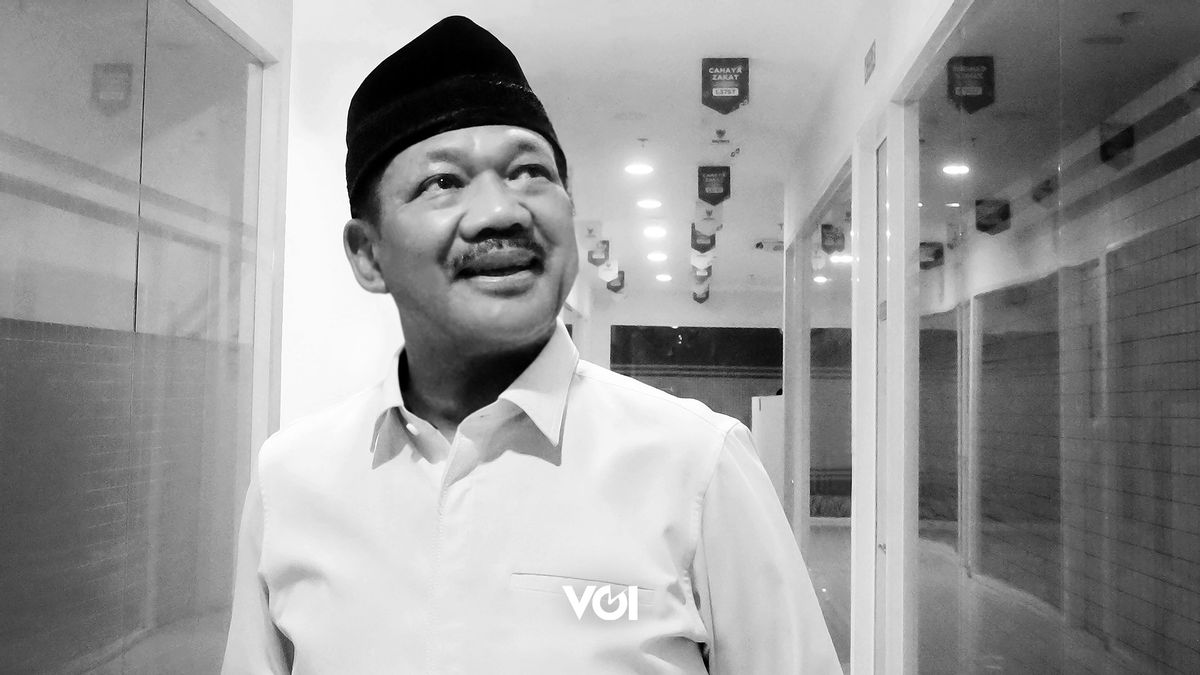


There is no conflict between the Free Nutritious Meals (MBG) program initiated by President Prabowo's administration and the work of the National Alms Agency (Baznas) of the Republic of Indonesia. According to Baznas Chairman, Prof. Dr. KH. Noor Achmad, MA., the two parties can complement each other and share their roles.
***
In reality, there was nothing wrong with the Free Nutritious Meals program promised by Prabowo Subianto and his campaign team before the simultaneous general elections last year. The program, which has been widely implemented in various countries, was offered to the Indonesian people. After the Prabowo-Gibran ticket was elected, they tried to realize this campaign promise.
Controversy began to emerge when the Speaker of the Regional Representative Council (DPD RI), Sultan B. Najamudin, proposed that the MBG funds be taken from zakat funds collected by zakat institutions. This sparked both pros and cons of the proposal.
KH. Ikhsan Abdullah, Deputy Secretary General for Law and Human Rights of the Indonesian Ulema Council (MUI), spoke out strongly. He stated that the proposed use of zakat funds to finance the MBG program was highly inappropriate because it did not fall within the categories of zakat recipients outlined in sharia. There are eight groups entitled to receive zakat: the poor, the needy, the amil (collective servants), the converts, the gharim (non-Muslims), the riqab (people who are entitled to receive zakat), the fi sabilillah (people who are entitled to receive zakat), and the ibnu sabil (people who are entitled to receive zakat).
He continued, explaining that if Baznas (National Zakat Agency) wants to use zakat to fund the Free Nutritious Meals program, it must obtain approval from the muzakki (payers of zakat). "Even if, for example, Baznas wants to select one of the eight asnaf (obligatory charity) to be included in the free meal program, Baznas must obtain approval from the muzakki. Are they happy for their zakat to be used to assist the government in the MBG program?" Ikhsan asked.
Meanwhile, although not as harsh as the MUI, the Chairman of the Central Board of Muhammadiyah, Prof. Dr. Haedar Nashir, M.Si., stated that his organization would further discuss the proposed use of zakat funds for the Free Nutritious Meals program. "It would be best to discuss it with Baznas, and then with zakat institutions managed by community organizations (ormas)," he said when met by reporters after attending the 1st Tanwir of Aisyiyah on Wednesday, January 15.
However, according to Prof. Dr. KH. Noor Achmad, MA., there is no conflict between the MBG program and what Baznas has done so far. "So, in the context of the debate over the use of funds for MBG, we are not involved. Our focus is on distributing the zakat we receive from muzakki to the eight asnaf who are entitled to receive it," he told Edy Suherli, Bambang Eros, and Irfan Meidianto from VOI who met him at the Baznas Central office in Matraman, Central Jakarta, Friday, January 17. Here is the full excerpt.

What do you think about President Prabowo's program: free nutritious meals?
This program is good, because it has been implemented in several countries and has produced quality children. In a religious context, such a program is highly recommended. "Let those who, suppose they leave behind weak offspring, be afraid." (Quran An-Nisa: 9). The MBG program aims to strengthen our future generations. This means that Mr. Prabowo's program is an important part of preparing a good generation.
At this level, there is no debate; however, what is happening now is that some are opposing the use of zakat funds for the MBG program. What is your response?
Baznas does not focus on individual individuals or institutions. Our target is the eight groups entitled to receive zakat, primarily the poor and needy. Wherever there are poor and needy, it is part of Baznas's duty to provide assistance to them. These are the people we must help.
What about school children? They may not be considered poor or needy, but they are considered sabilillah, people who are striving in the path of Allah.
If an Indonesian Ulema Council (MUI) fatwa later issues that permits the use of zakat funds for sabilillah, that's possible. However, our priority remains the poor and needy. They are everywhere and are not confined to any particular institution.
What about the MBG (Government of the Poor and Needy), a program promised during President Prabowo's campaign?
If the MBG is run by an institution and there are many people who fall into the category of poor and needy, but for some reason they are not reached, we are sinning. We cannot bring Baznas (National Zakat Agency) into a political context. We are not involved in any political matters.
Therefore, in the context of the debate about the use of funds for the MBG, we are not involved. Our focus is on distributing the zakat we receive from the muzakki (payers of zakat) to the eight eligible recipients. We must not allow political issues to neglect the rights of the poor and needy.
If anyone says that the MBG is prohibited from accepting assistance from other parties, I believe that is wrong. The rights of the poor and needy are everywhere. We will provide assistance to those who fall into the category of poor, but this is not at all related to the MBG program or any other political program. We only manage the eight asnaf (non-Muslim beneficiaries) who are eligible to receive zakat.
If someone later asks for coordination so that the poor who are supported by Baznas and those supported by the MBG program don't overlap, what is your opinion?
We have been doing this all along, even before President Prabowo launched the MBG program. We have been providing free meals and nutritious meals for a long time. This was especially true when COVID-19 hit the country.
Many Islamic boarding schools (pesantren) are still not covered by the nutritious meal program, as are communities at the grassroots level. While the MBG targets organized schools, we will target those who have not been reached by the MBG. So, what we are doing is not related to institutional or political issues.
Please, anyone who is hungry and in need of food, come to Baznas. We will give, because it is our duty to support the eight categories of beneficiaries outlined in religious teachings. I have been making this statement for the past three years. God willing, Baznas will continue to assist.

Is the current controversy a matter of differing interpretations? You at Baznas have one view, while the MUI has another. So what's the compromise?
What the government has done with the MBG (Islamic Zakat Fund) and what Regional Representative Council (DPD) Speaker Sultan Najamudin proposed to use zakat funds collected in Indonesia for the MBG program must be coordinated. However, we don't participate in that. We only focus on groups in need, namely the poor and needy. If what we're doing now is linked to the MBG, I think the mistake is making the connection.
Currently, the government has the MBG program, but available funds are limited. So, on the zakat collection side, there are funds that can be utilized. Is that what's happening now?
I don't know if government funds are currently limited. However, for us at Baznas, the funds collected from zakat, infaq, and sadaqah continue to increase every year. This means that the number of zakat recipients is quite large and growing. If the state's finances are in disarray, we don't participate in that.
How much has zakat funds increased from Baznas?
The year-over-year increase is around 30%. In 2023, the total zakat collected at Baznas Pusat reached Rp 880 billion. Across Indonesia, Rp 31 trillion was collected in 2023. In 2024, the collected funds reached Rp 41 trillion. We distribute all of these collected funds to those entitled to receive them. Therefore, all collected funds must be spent, with nothing remaining idle. Only a small amount is set aside for operational purposes and for distribution to Palestine. Distribution to Palestine is difficult.
Zakat, infaq, and sadaqah funds have enormous potential. That's just from Baznas, not including other zakat institutions. Why are so many interested?
Yes, it's substantial. However, based on collection efforts so far, only Rp 41 trillion was generated in 2024. Given the existing potential, this collection is still far from the target. Efforts are still needed to encourage and remind zakat payers to distribute their zakat. Therefore, we provide recommendations to zakat institutions so that zakat potential can be achieved.
Besides the primary program for the poor, what other programs does Baznas (National Zakat Agency) implement? Are there any for productive activities?
In accordance with the mandate of the law (Law No. 23 of 2011 concerning Zakat), Baznas's presence is to help alleviate poverty. Therefore, our programs alleviate poverty through various schemes. We have distributed scholarships to 53,000 students studying at home and abroad, including in Saudi Arabia, Egypt, Malaysia, Russia, India, and the United Kingdom. Domestically, we also provide assistance to third-grade high school or Islamic high school students to participate in tutoring. Last year, we distributed 10,000 tutoring scholarships, and all of them graduated from college.
We also build affordable housing. Currently, we have built more than 11,000 houses with Baznas funds. Each house costs approximately IDR 25 million. We also provide assistance to build Islamic schools (madrasah) that are suitable for learning. Around 1,000 Islamic schools have been built with funding of around Rp 25 million per school.
There's also the Z-Mart program, which helps small food stalls in villages grow and develop. We assist them and monitor their bookkeeping. Then there's Z-Chicken, a fried chicken cart that we've distributed throughout Indonesia. We haven't distributed many yet, only 5,000 carts. There's also Z-Auto, which provides assistance to small roadside repair shops. We also have Z-Coffee, a trendy coffee shop located in various locations and on campuses.
What else has Baznas done to help alleviate poverty?
For mosques with business units, we have a mosque-based Baznas Microfinance program. This program is aimed at mosques with MSMEs. Currently, around 150 mosques have received assistance, each receiving Rp 150 million. We monitor and assist with the management of these funds.
In the livestock sector, we are also present through the Livestock Centers, which run everything from chickens to goats, across various regions. In addition, we provide direct humanitarian assistance to victims of natural disasters.
All of these programs are already running and will continue to be implemented. So, if we talk about the ongoing or planned government-sponsored Community Empowerment Program (MBG), it is only a small part of what we have been doing. Before the MBG, we were accustomed to implementing similar programs. If there is a connection to the MBG, let it proceed as intended.
Baznas carries out numerous poverty alleviation programs. What are the requirements for individuals or organizations to receive assistance?
The main requirement is that they must be classified as destitute, poor, or other eligible beneficiaries. Assistance is provided through two mechanisms: some require a proposal, and others don't. For example, for those who are extremely poor but are embarrassed to ask, we will first conduct a verification process.
Verification is based on data from relevant agencies, and we also double-check with the nearest mosque. We do all of this with integrity to ensure that the zakat collected is truly targeted.
With the ongoing controversy surrounding the proposed use of zakat funds for the MBG (Based on the Needs of Zakat) program, what message would you like to convey to the public?
First, don't distort the facts to the detriment of the mustahik (zakat recipients). For example, if there's a call for zakat institutions to stop providing assistance to the MBG program, and all zakat management institutions follow suit, wouldn't that be a disservice to the destitute and poor?
Second, don't distort things without adequate understanding. Sometimes, some parties simply want to gain positive feedback from the public without truly understanding the substance. I think the journalists' actions in confirming the matter are appropriate. The information conveyed must be complete, not fragmented. If we are only reported as supporting the MBG without sufficient explanation, the public could misunderstand.
What is the wisdom behind the controversy surrounding the MBG's use of zakat funds?
Yes, there are many lessons to be learned from this controversy. Hopefully, more parties will care about the future of future generations. It would be better if nutritious food programs for future generations were not linked to institutions or politics.
Baznas has been considering and implementing programs like this for a long time. In fact, the MBG program can increase the income of our mustahik (zakat recipients) in the villages. They have chicken, fish, vegetable, and other farms, the proceeds of which can be used for the MBG program. The economy will improve if they are involved.
Are you ready to engage in dialogue and discussion with those who disagree with the use of zakat funds for the MBG?
We are ready to engage in dialogue anytime and anywhere. If the intentions are good and sincere, I am confident we will reach a common ground.
Noor Achmad and Unlimited Devotion

Since he was young, said Baznas Chairman Prof. Dr. KH. Noor Achmad, MA, he has been serving the community. (Photographer: Bambang Eros, Karisa Aurelia Tukan, DI: Raga Granda VOI)
Since his student days, Prof. Dr. KH. Noor Achmad, MA., has been engaged in community service. From the smallest community where he lived to a broader scale as a lecturer at his alma mater, UIN Walisongo Semarang. Now, the Chairman of the National Alms Agency (Baznas) of the Republic of Indonesia, his service continues, with no end in sight.
"Since I was a student, I've been busy not only with lectures and organizations, but also teaching Quran recitation from house to house. So, I've always been busy with community service," said the man born in Kudus on February 10, 1957.
After completing his studies at the Faculty of Sharia at IAIN Walisongo (now UIN Walisongo), he was offered a teaching position at his alma mater. "I completed the necessary documents, and a month later I received a decree appointing me as a lecturer at IAIN Walisongo," said Noor, who completed his master's and doctoral degrees at UIN Sunan Kalijaga Yogyakarta.
He not only lectured at UIN Walisongo, but along with several colleagues, he founded the Wahid Hasyim Foundation, which later gave birth to Wahid Hasyim University (Unwahas) in Semarang.
Through his community service, teaching, preaching, and other activities, he hopes that his work will be blessed by Allah SWT. "I'm not setting high expectations. By doing all this, I hope I can help many people, and hopefully they will pray for me, not only while I'm alive, but also after I'm gone. It will be a continuous charity for me," explained the Chairman of the Wahid Hasyim Foundation.
Support Children's Education

He is grateful that his five sons and daughters have now completed their medical education. "Although none of them followed in my footsteps as teachers, I am happy that my children are also pursuing community service. Alhamdulillah, all of my children graduated as doctors with cum laude honors from their universities," he said.
Now, Noor Achmad is preparing to establish an Islamic boarding school (pesantren) in Semarang. To that end, he has provided the land and buildings for the school. "I have told my children, once the school is operational, please allocate some of your zakat, infaq, and sadaqah (charity) to the school to support its sustainability," he emphasized.
According to Noor, this Islamic boarding school is specifically for orphans. "We currently have 500 m² of land and a multi-story building on it. This Islamic boarding school can accommodate around 40 children," said Noor Achmad, who supports all of his children pursuing their chosen fields of study.
Tips for a Successful Life

The dedication of Baznas Chairman Prof. Dr. KH. Noor Achmad, MA., has continued since he was young, even though he is no longer young. (Photographer: Bambang Eros, Karisa Aurelia Tukan, DI: Raga Granda VOI)
Living life in this world requires hard work. However, Prof. Noor Achmad said, one must be confident in the struggle one undertakes. "The key is to live life with sincerity and honesty," he said, adding that it's important to avoid negative assumptions and negative comments about others.
The next key is optimism and confidence in what one strives for. "With optimism in achieving our goals, our journey will be made easier by Allah SWT. After all, sincere people have many friends and no burdens," he said.
His life experiences with optimism have made his journey feel more secure. Of course, this must be accompanied by earnest effort and unceasing prayer to the Almighty. "Don't be afraid of failure, because failure is delayed success. Have faith and surrender to Allah SWT. That's what I instill in my children and my students on campus," Noor Achmad concluded.
"Don't let political issues cause the rights of the poor and needy to be neglected."
The English, Chinese, Japanese, Arabic, and French versions are automatically generated by the AI. So there may still be inaccuracies in translating, please always see Indonesian as our main language. (system supported by DigitalSiber.id)
Most Popular Tags
#Prabowo Subianto #donald trump #firearm #8791 #giias 2026Popular


