
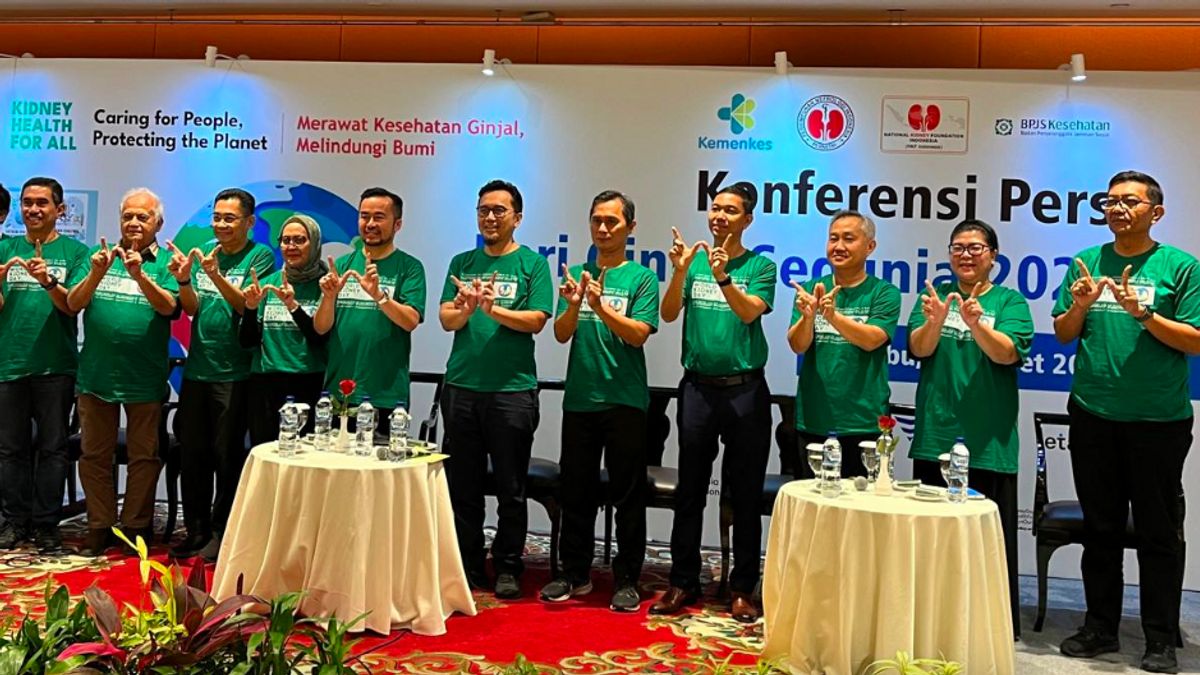


JAKARTA - On March 12, 2026, World Kidney Day (World Kidney Day) was celebrated. This year's commemoration carries the theme "Kidney Health for All: Caring for People, Protecting the Planet".
The theme highlights the close relationship between kidney health and care and environmental preservation. This is also highlighted by the Indonesian Ministry of Health, experts, and cross-sector stakeholders, related to the prevention of kidney disease can help save the environment.
As is known, patients who have experienced end-stage renal disease require therapy or transplantation. The usual therapy is hemodialysis or blood washing.
The General Chair of the Indonesian Nephrology Association (PB PERNEFRI), Dr. Pringgodigdo Nugroho, Sp.PD-KGH, said that hemodialysis therapy is generally carried out two to three times a week, adjusted to the patient's kidney condition.
The therapy procedure uses a machine to filter the blood by draining it out of the body. The blood will go through a process called artificial kidney or dialysis to remove toxins or poisons, excess fluid, before being returned to the patient's body.
This therapy is indeed effective in helping the lives of patients with kidney failure, but requires large resources. Starting from infrastructure, water, energy, which all have an impact on the environment.
"Each hemodialysis session for each patient per machine uses 120 liters of water. Electricity is also certain, also produces medical waste, from disposable medical materials, thus increasing the carbon footprint or environmental footprint," said Dr. Pringgodiggo.
Pringgodigdo also said that a number of studies have shown that hemodialysis can cause biomedical waste, which requires special management to prevent infection and environmental pollution.
Therefore, it is very important for every community to maintain kidney health. By keeping the kidneys healthy, a good quality of life is maintained and can help prevent environmental damage.
Early detection is also very necessary to prevent severe kidney damage and higher treatment burden. The implementation of the Green Dialysis concept is also important, namely an approach in nephrology that aims to reduce the environmental impact of dialysis therapy.
"Prevention, early detection, optimal therapy to inhibit the progression to end-stage kidney disease, and equally important, public education. Taking care of the kidneys early, for a healthier future and protecting the earth," he explained.
Not only that, sustainable and environmentally friendly service systems are also important to continue to be improved. So is the role of pharmaceutical innovation for safer, affordable and sustainable kidney therapy, as one of them is carried out by PT. Etana Biotechnologies Indonesia.
"If from the perspective of Etana's contribution, Etana launches environmentally friendly products, one of which is erythropoietin which we produce locally and of course it is hoped that it can help patients for a longer period of time," concluded Roy Priadi, from PT. Etana Biotechnologies Indonesia.
The English, Chinese, Japanese, Arabic, and French versions are automatically generated by the AI. So there may still be inaccuracies in translating, please always see Indonesian as our main language. (system supported by DigitalSiber.id)
Most Popular Tags
#Prabowo Subianto #donald trump #earthquake #independence day #8791 #hut riPopular


