


JAKARTA - Dengue is an infectious disease transmitted by the bite of the Aedes Aegypti mosquito and is still a major health problem in various tropical and subtropical countries.
This disease can affect all age groups and has the potential to cause serious complications and even death if not treated quickly and properly. The high rate of dengue transmission is influenced by environmental factors, climate change, and community behavior in maintaining environmental cleanliness.
The World Health Organization (WHO) estimates that around 3.9 billion people worldwide are at risk of dengue infection, with annual cases reaching approximately 390 million. This condition makes dengue one of the most significant public health threats globally.
In the Southeast Asian region, the surge in dengue cases is increasingly influenced by uncontrolled urbanization, population density, climate change, and high mobility between countries.
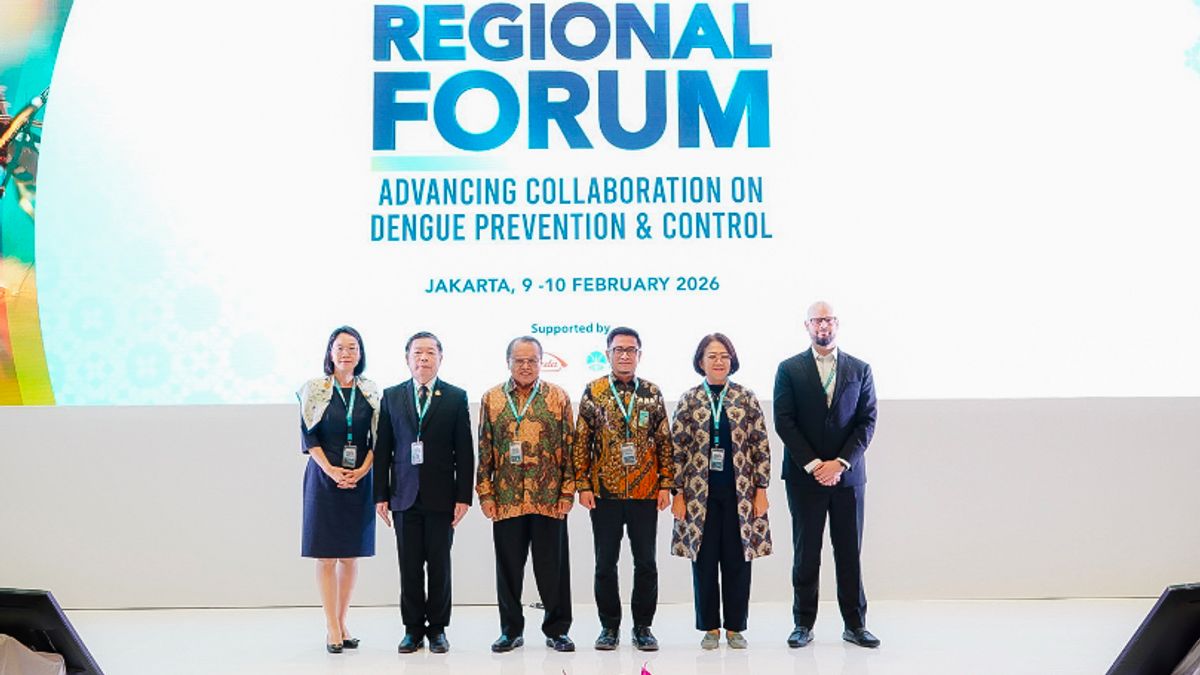
In response to this challenge, the Ministry of Health of the Republic of Indonesia together with the Joint Coalition (KOBAR) Against Dengue and regional partners held the first Southeast Asian Regional Forum for Dengue Prevention and Control.
This forum is a forum for cross-country cooperation to strengthen collective efforts in facing the threat of dengue fever (DBD).
The Director of Communicable Diseases of the Ministry of Health of the Republic of Indonesia, dr. Prima Yosephine, said that the forum aims to strengthen synergy among ASEAN countries in an integrated and sustainable effort to control dengue.
"Collaboration between countries, especially in the ASEAN region, is very important to strengthen joint dengue control measures," he said in Jakarta, Monday, January 9, 2026.
According to Dr. Prima, this forum produced various recommendations and best practices shared by each participating country. ASEAN member countries are encouraged to present dengue control strategies that have been implemented, as well as propose policies and programs that can potentially be adopted at the regional level.
Various proposals will be discussed in a follow-up meeting in the hope of creating a joint movement of ASEAN countries in tackling dengue in the region.
"The goal is for ASEAN countries to move in unison in controlling dengue," he explained.
On the other hand, ASEAN has set a long-term target in the form of achieving zero deaths from dengue by 2030. To support this target, Indonesia has consistently encouraged the implementation of three main approaches, namely environmental control through mosquito breeding management with the implementation of 3M Plus.
The second approach is to control the transmission factor, especially through vector control. While the third approach focuses on humans, including prevention efforts through vaccination.
"These three approaches must be integrated so that DBD control can be carried out more comprehensively," said Dr. Prima.
The Chairman of KOBAR, Suir Syam, added that the biggest challenge in controlling dengue is to build active involvement between the community and local governments. He highlighted that Indonesia still records a relatively high number of dengue-related illnesses and deaths in the ASEAN region.
"The central government cannot work alone. Efforts to prevent dengue must be carried out in a cooperative manner by the community and local governments in their respective regions," he said.
Support for dengue control efforts also comes from the private sector. General Manager of Takeda Indonesia, Andreas Gutknecht, expressed his company's commitment to supporting dengue control in Southeast Asia.
He said that although the ASEAN region recorded a high dengue mortality rate, this region also had early experience and significant progress in innovation, including the development of vaccines and prevention programs.
"Through the leadership of KOBAR and the Ministry of Health, this forum is a means for ASEAN countries to learn from each other, share experiences, and coordinate efforts so that progress in fighting dengue can be achieved more effectively in the future," he concluded.
The English, Chinese, Japanese, Arabic, and French versions are automatically generated by the AI. So there may still be inaccuracies in translating, please always see Indonesian as our main language. (system supported by DigitalSiber.id)
Most Popular Tags
#Prabowo Subianto #donald trump #firearm #8791 #giias 2026Popular


