
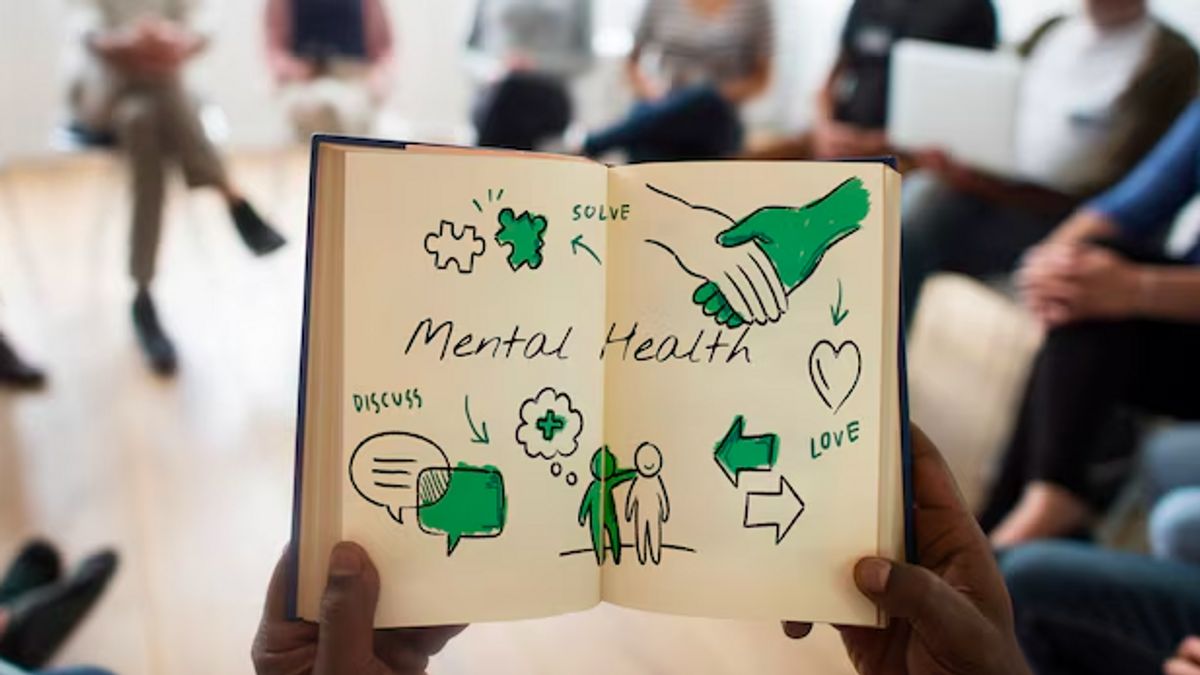


JAKARTA - Mental health is often misinterpreted only as a condition without problems or always feeling happy. In fact, the sign that a person has a healthy mentality does not mean that his life is stress-free, but is able to manage emotions, remain productive, and function well in his daily life.
Mentally healthy individuals can receive various emotions, both positive and negative, without pressing or denying them. They know when to rest, are able to calm down, and not lose their way despite the pressure.
This is in line with the view of adult clinical psychologist Natasya, who explains that mental health is not synonymous with happiness alone.
"Many people are still wrong regarding mental health. They think that mental health means we have to be happy," said Natasya in a discussion entitled Story Room: Casual Talk About Mental Health in Yogyakarta, as quoted by ANTARA.
According to him, mental health is a condition in which a person can still undergo activities and contribute in the midst of life's challenges.
"We may not be able to avoid stress. The main thing is how we manage stress well so that it doesn't continue to be a psychological disorder and instead avoid it and continue to think it doesn't exist," he said.
SEE ALSO:
-
 | INFO SEHAT
Melambat Sejenak Efektif Mereduksi Stres Sehari-hari, Sudah Tahu Caranya?
08 Oktober 2025, 17:47 -
 | LIFESTYLE
Sembuhkan Luka Tak Terselesaikan, Ini Praktik Mindfulness untuk Memutus Siklus Trauma
08 Oktober 2025, 12:47

Natasya emphasized that feelings of sadness, anger, or disappointment are a natural part of life.
" Mental health does not mean that we never feel sad, angry, or disappointed. However, how can we face and interpret that feeling so that it does not become an obstacle in the future," said Natasya.
He added that the ability to recognize and accept emotions is the key in maintaining a psychological balance.
"When we refuse or suppress emotions, it doesn't make the problem disappear, it can actually accumulate and become a burden. So, it's important to have a safe space to express yourself," he said.
The safe space in question, continued Natasya, could be in the form of the presence of close friends, family, or professionals such as psychologists.
"Our situation is like a container that has a boundary. If we keep it ourselves, one day it will overflow," he said.
Meanwhile, Mercu Buana University psychologist Yogyakarta, Patricia Melati Rosari, added the importance of recognizing signs when mentally getting tired. He said there are three main signals to watch out for: thoughts, emotions, and behavior.
"If you do campus assignments or work that should be done in 30 minutes, but it's a delay because you can't focus, it's an early sign before entering a more severe stress phase," said Patricia.
He continued, more sensitive emotional changes are also a sign that the body and mind need a break.
"For example, when asked 'Have you got together?' immediately annoyed. It needs to be realized as a signal that our bodies and minds need a break," he explained.
In addition, changing sleep and eating patterns are also another indicator.
"Usually it's nine o'clock at night, but now at eleven it's still awake looking at the ceiling, or the diet has changed drastically. That's a sign you need to pay attention to," added Patricia.
According to him, social support is important, but self-awareness remains the main factor in maintaining mental health. He emphasized that feeling sad or stressed is not a sign of weakness.
"Often if we say we are tired or sad, we are considered lecherous or less grateful. In fact, everyone has different capacities in dealing with problems," he said.
Patricia concluded that by affirming that she received negative emotions, it was part of emotional maturity.
"We can't just have good things in us. During life there will always be stress, and it's a process to become a better individual," said Patricia Melati.
The English, Chinese, Japanese, Arabic, and French versions are automatically generated by the AI. So there may still be inaccuracies in translating, please always see Indonesian as our main language. (system supported by DigitalSiber.id)


