
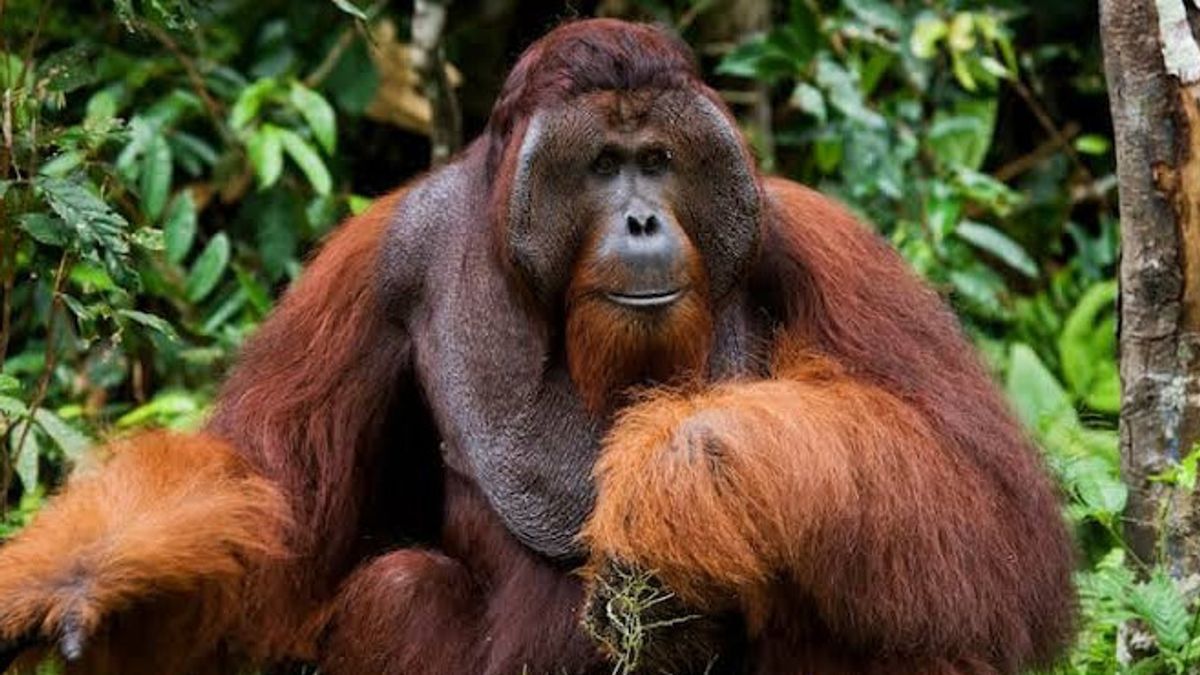


JAKARTA - Humans can apparently learn a lot from orangutans, especially about maintaining a balanced diet. International research led by Rutgers University-New Brunswick reveals how orangutans are able to survive on a flexible diet and avoid obesity, despite facing unpredictable environmental conditions.
Orangutans, great apes that live in the rainforests of Indonesia and Malaysia, have a remarkable ability to adapt to the food availability in their habitat. The findings were published in the journal Science Advances following 15 years of direct observation of wild orangutans in the forests of Borneo.
"This research shows how Bornean orangutans adjust their nutritional intake, behavior, and energy expenditure to environmental conditions," explained Erin Vogel, Rutgers professor of anthropology and lead researcher, as quoted from the Rutgers University website.
"This underscores the importance of understanding natural diets and their impact on health, for both orangutans and humans," she continued.
Orangutans prefer fruit because it is rich in carbohydrates. However, when fruit is scarce, they turn to leaves, bark, and other foods that are richer in protein. Despite this, orangutans maintain a balanced protein intake throughout the year.
Not only that, they also adapt their behavior. When food is abundant, they are more active. However, when fruit is scarce, orangutans reduce physical activity, rest more, go to bed earlier, and conserve energy.
"Orangutans can reduce activity when fruit is scarce. In contrast, modern humans, with their sedentary lifestyles, don't adjust their energy expenditure, even though their calorie intake is high. This is what triggers weight gain and metabolic disease," said Vogel.
According to Vogel, humans actually have metabolic flexibility like orangutans. However, a modern diet high in processed foods, rich in sugar and fat, but low in protein, disrupts this balance. As a result, the risk of obesity, diabetes, and metabolic disease increases.
"Essentially, this study emphasizes the importance of nutritional balance and metabolic flexibility. These two things are important not only for orangutans, but also for humans," added Vogel.
The researchers discovered several key strategies for orangutan survival:
- Avoiding obesity naturally by navigating periods of abundant food and scarcity. This pattern is similar to the concept of intermittent fasting in humans.
- Metabolic flexibility, which involves switching to fat and muscle protein reserves when food is scarce.
- Behavioral adaptations, such as increased rest to conserve energy.
- Stable protein intake, in contrast to Western diets, which are often high in calories but low in protein.
In fact, additional research found that most of the orangutans' protein in Tuanan comes from the vine Bowringia callicarpa, whose seeds and leaves serve as a primary source of energy when fruit is scarce.
This study was conducted at the Tuanan Orangutan Research Station, Central Kalimantan, located in the Mawas peatland forest conservation area, covering more than 300,000 hectares. This habitat is not only home to orangutans, but also one of the most biodiverse ancient ecosystems.
"This research also reminds us that protecting orangutan habitat is crucial for their survival," Vogel emphasized.
The English, Chinese, Japanese, Arabic, and French versions are automatically generated by the AI. So there may still be inaccuracies in translating, please always see Indonesian as our main language. (system supported by DigitalSiber.id)


