

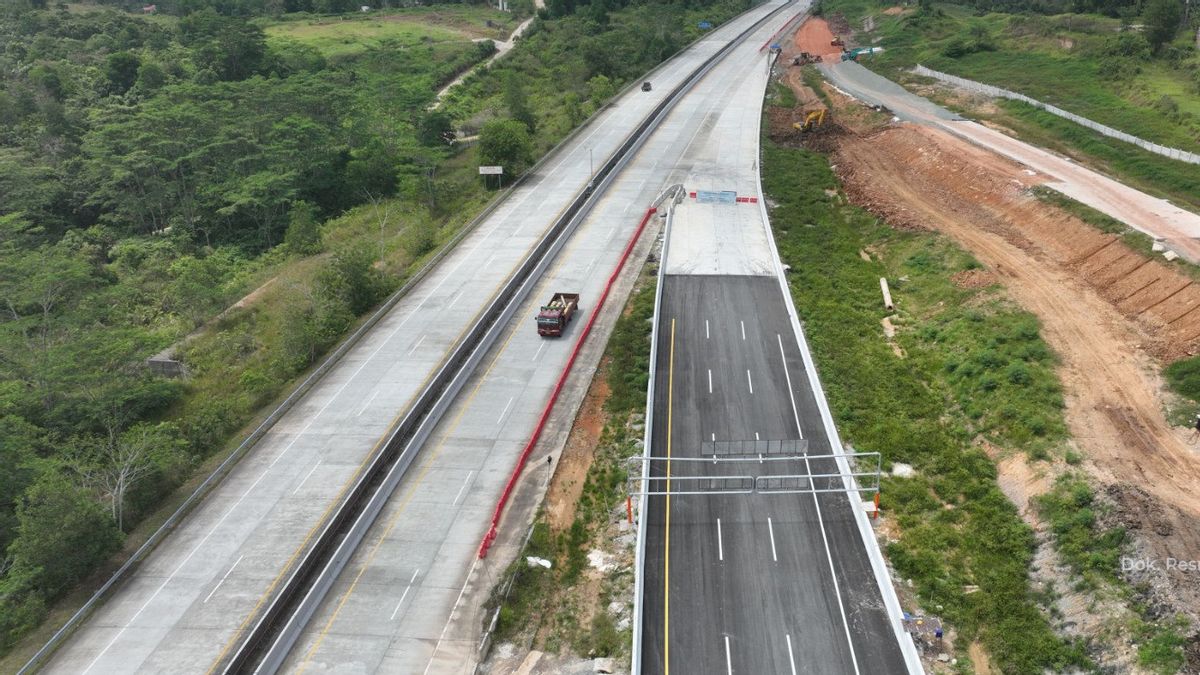


JAKARTA - Access to the Nusantara Capital City (IKN) from Balikpapan will be shorter as the progress of the IKN Toll Road Section 3A-2 is now at the functional stage.
The toll road, which is part of the National Strategic Project (PSN), is targeted to be completed by the end of 2026 and to start operating fully in January 2027.
The presence of the toll will reduce the travel time from Sultan Aji Muhammad Sulaiman International Airport to IKN to around 60 minutes.
The construction of the IKN Toll Section 3A-2, which started since December 21, 2023, has been limited to the Christmas and New Year 2025/2026 period on December 20, 2025.
The functional status allows the toll road to be used to support traffic flow during certain periods even though the construction process is still ongoing.
Furthermore, the section was again functional during the 2026 Lebaran homecoming and return flow starting on March 13, 2026 or after 813 days of project implementation.
Overall, the completion of the project is targeted for December 31, 2026 and will begin to be fully operational in January 2027 after undergoing feasibility tests by the relevant authorities.
The IKN Toll Section 3A-2 section is a link between the Balikpapan-Samarinda Toll Road and the IKN area and Penajam Paser Utara (PPU).
With an access length of around 70 kilometers, the toll road is claimed to be able to cut travel time by up to 90 minutes compared to the previous condition.
The scope of work for the project includes the construction of an at-grade road along 2.34 kilometers, an elevated pile slab structure along 1.745 kilometers, a bridge, the Karangjoang Junction to the toll exit.
The road is designed to have two lanes and a width of 11.25 meters using a combination of at-grade and slab on pile structures that are adapted to the soil conditions in East Kalimantan.
Currently, a number of follow-up works are still underway, including the completion of ramps, slab on pile structures, erection of steel box girders at several points, road pavement as well as slope protection and beautification in a number of segments.
The project was carried out through an Integrated Joint Operation scheme involving a number of SOEs, namely PT Hutama Karya (Persero), PT Adhi Karya (Persero) Tbk, PT Nindya Karya (Persero) and PT Brantas Abipraya (Persero).
During the construction process, the project faced challenges in the form of unstable soil conditions of clay shale type that easily shifted and high rainfall that affected the stability of the slope and productivity of the work.
To overcome this, a number of construction technologies are used, such as Building Information Modeling (BIM), Light Detection and Ranging (LiDAR), drone photogrammetry, and digital-based project management systems.
The application of this technology is said to be able to increase work safety, construction quality, and time efficiency compared to conventional land-based methods.
A total of 527 workers were involved in the project with about 15 percent being local workers from East Kalimantan. Hutama Karya also carried out technical training and certification of professions to increase worker competence.
Acting Executive Vice President (EVP) Secretary of Hutama Karya Hamdani said that the achievement of the functional stage showed the company's readiness in handling strategic projects with high complexity.
"The functionality of this section shows Hutama Karya's readiness to work on strategic projects with high complexity, both in terms of technical and geographical conditions and to support the acceleration of connectivity to IKN," said Hamdani as quoted from a written statement, Thursday, May 7.
The English, Chinese, Japanese, Arabic, and French versions are automatically generated by the AI. So there may still be inaccuracies in translating, please always see Indonesian as our main language. (system supported by DigitalSiber.id)


