

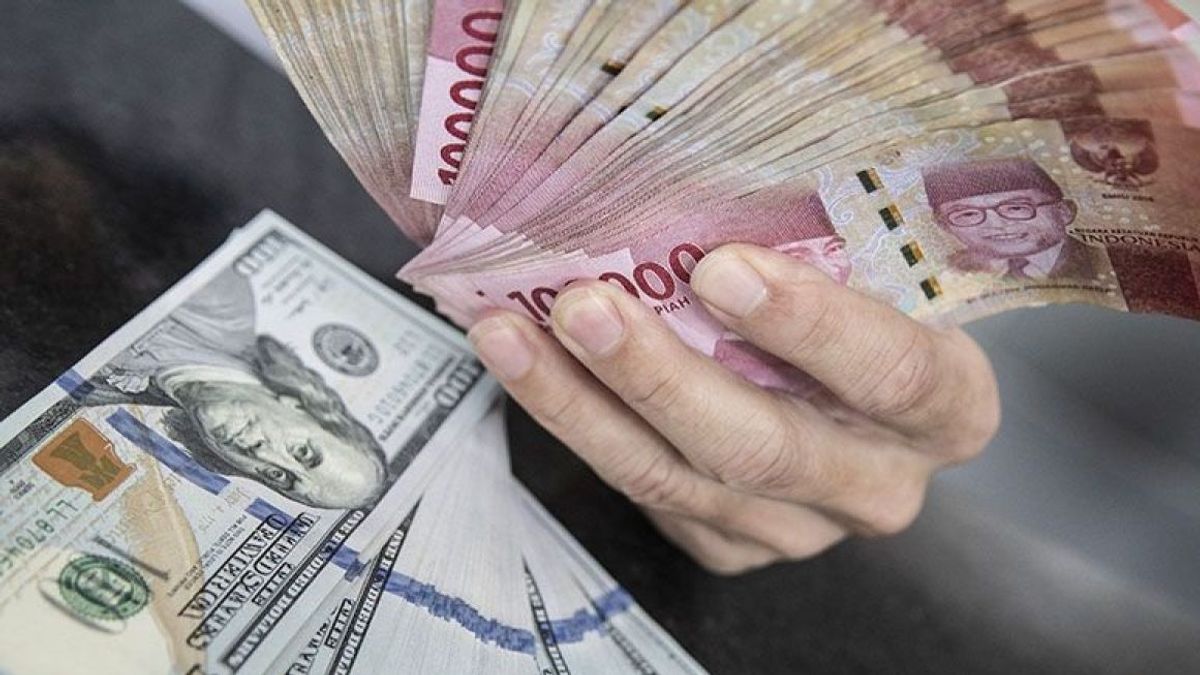


JAKARTA - Bank Indonesia Governor Perry Warjiyo explained seven strategic steps to strengthen the rupiah exchange rate against the US dollar. The strategy has been conveyed to President Prabowo Subianto.
Perry explained that the current rupiah exchange rate is in an undervalued condition, but it is believed to be stable and strengthening again.
According to him, this is supported by Indonesia's strong economic fundamentals, such as economic growth of 5.61 percent, low inflation, high credit growth, and adequate foreign exchange reserves, so that these conditions should encourage the rupiah to remain stable and tend to strengthen.
However, he added that in the short term there was pressure on the exchange rate that came from global and seasonal factors.
"What are the global factors that cause this short-term exchange rate pressure? One is high oil prices, two are high US interest rates, the yield of US Treasury 10-year is now 4.47 percent, so is the strengthening dollar and the Coordinating Minister (Economy) said that there was capital flight from emerging markets including Indonesia," he explained in his statement, quoted Wednesday, May 6.
Meanwhile, on the seasonal side, demand for the dollar increased in the April-June period, including for the need for dividend payments, debt repayment, and Hajj requirements. Even so, Perry emphasized that the rupiah still has the potential to strengthen in the future.
Perry also conveyed that President Prabowo had given approval for seven steps to strengthen the rupiah that Bank Indonesia would take.
"We reported to the President and the President approved and then provided reinforcement of seven important steps taken by Bank Indonesia to make the rupiah strong, to make the rupiah stable in the future," he said.
The first step is sustainable market intervention, both domestically and abroad through Domestic Non-Deliverable Forward (DNDF) and Non-Deliverable Forward (NDF) instruments, with the support of strong foreign exchange reserves.
"In overseas markets in Hong Kong, Singapore, London, New York, we will continue to intervene to stabilize the rupiah both domestically and abroad. Our foreign exchange reserves are more than enough to stabilize the rupiah exchange rate," he said.
He added that the second was to encourage the flow of foreign capital through the Rupiah Securities instrument of Bank Indonesia (SRBI), in order to balance the outflow from SBN and the stock market.
"We agree that for the time being SRBI is needed to be made so that the inflow of SRBI can meet the outflow of SBN and shares, that is our coordination with the Minister of Finance so that we really maintain the inflow from the foreign portfolio, it is still year to date, it is still happening inflow and it strengthens the rupiah exchange rate," said Perry.
Third, strengthen coordination with the Ministry of Finance in the purchase of SBN in the secondary market, which has so far reached Rp. 123.1 trillion.
"We will coordinate, including later the Minister of Finance can do the buyback and all sorts of things, very close coordination between fiscal and monetary," he said.
Fourth, maintain the liquidity of the banking and money market to remain loose, with consistent primary money growth at a double-digit level, with the latest primary money growth reaching 14.1 percent.
Fifth, limiting the purchase of dollars in the domestic market without underlying assets, with a gradual reduction in the transaction limit from the original purchase of a maximum of 100 thousand US dollars per month, now to 50 thousand US dollars per month, and in the near future will be reduced again to 25 thousand US dollars per month to reduce pressure on the rupiah.
In addition, he added that the strengthening of local currency transactions such as the yuan and rupiah is also being developed.
"That is what we immediately coordinated with the KSSK for strengthening, including in the country, it is the Yuan market, Chinese Yuan with Rupiah has developed in the country because our local currency with China is the same Chinese Yuan as the rupiah is very high and now it has started to form a domestic market Yuan is the same as Rupiah including this local currency so that it reduces or diversifies from the dollar so that it can strengthen," he said.
Sixth, increase intervention in the Non-Deliverable Forward (NDF) offshore market and involve domestic banks to participate, so that foreign exchange supply increases and rupiah stability is better maintained and can control exchange rate developments in the offshore sector abroad.
"In addition to the interventions we continue to carry out, we also allow domestic banks to participate in the sale of Offshore NDF abroad so that the supply is more abundant so that it will strengthen the stabilization of the Rupiah exchange rate," he said.
Seventh, tighten supervision of banks and corporations that have activities to buy dollars in large quantities, through coordination with the Financial Services Authority.
"We sent supervisors there, coordinating with Ms. Frederica Widyasari from the Head of OJK to ensure that the stability of the financial system is maintained," he concluded.
The English, Chinese, Japanese, Arabic, and French versions are automatically generated by the AI. So there may still be inaccuracies in translating, please always see Indonesian as our main language. (system supported by DigitalSiber.id)


