

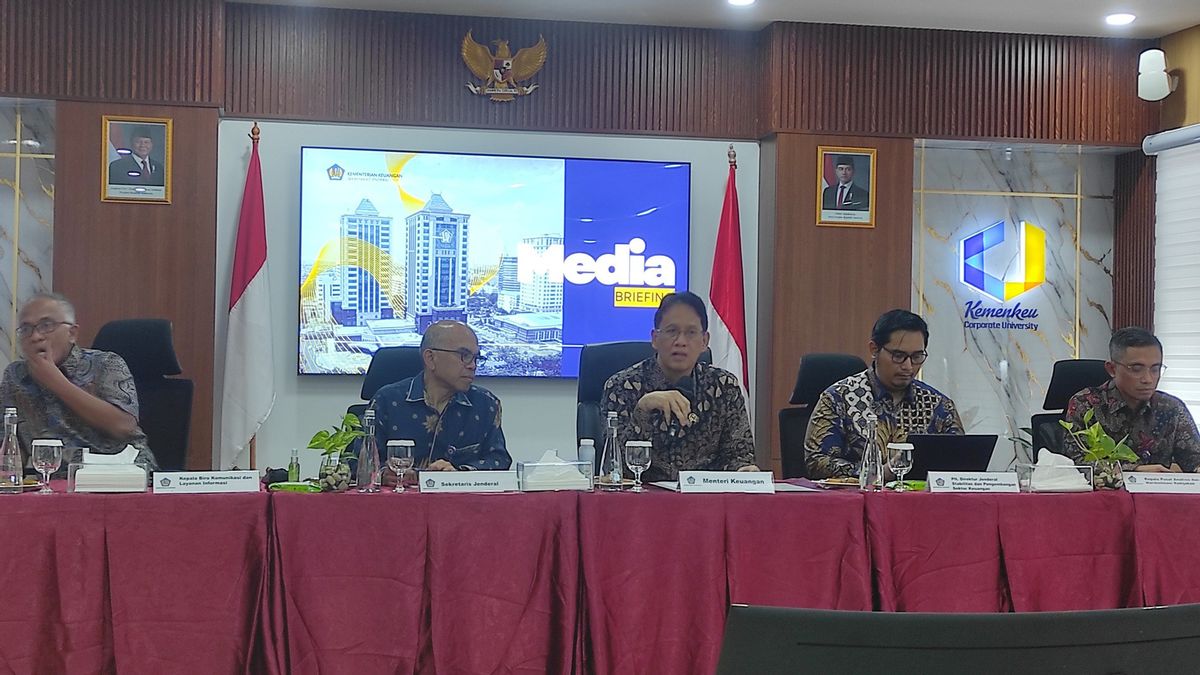


JAKARTA - Minister of Finance Purbaya Yudhi Sadewa said that the availability of national fertilizer is currently in a safe condition, even has the potential to be exported. This occurs in the midst of disruption of fertilizer production in a number of countries due to conflicts in the Middle East region.
The application of fertilizer subsidies paid at the beginning of the year is considered capable of reducing the burden on producers, and with this scheme, the performance of domestic fertilizer production is maintained.
Purbaya explained that the government had disbursed more than Rp20 trillion in subsidies since the beginning of the year.
"Because we pay fertilizer subsidies in advance, more than Rp. 20 trillion at the beginning of the year. So their cost of capital goes down, they don't have to borrow from banks," said Purbaya in a media briefing, quoted Sunday, April 26.
For information, fertilizer subsidies are given in advance to support the procurement of raw materials, and the funds are disbursed before the production and distribution process, with calculations based on the difference between the market price and the Highest Retail Price (HET).
He added that through this mechanism, manufacturers can run operations faster and more efficiently.
"They can operate quickly and more efficiently. If you have money, it's easy to buy this, buy that. So that we are now producing, said the Minister of Agriculture, it is high and even ready to export when the world is still confused in fertilizer," he said.
Purbaya also highlighted that Indonesia's situation is different from many other countries affected by geopolitical conflicts, especially the tension between Iran and the United States.
According to him, the conflict disrupted global supply chains, including distribution through the Strait of Hormuz, and triggered a rise in natural gas prices which had an impact on the cost of fertilizer production, especially urea.
He added that as a result, many countries experienced a shortage of fertilizer, and even, the issue of fertilizer was also a concern for international institutions such as the World Bank and the IMF, in addition to energy issues.
"In fact, we think it (the crisis) is just fuel, but the World Bank and IMF also mention fertilizer," he said.
Previously, Minister of Agriculture Andi Amran Sulaiman previously revealed that there was a demand for urea fertilizer imports from several countries, namely India, Australia, the Philippines, and Brazil, amid global supply dynamics.
He said that India had requested about 500 thousand tons, while Australia had agreed to an initial shipment of 250 thousand tons.
The English, Chinese, Japanese, Arabic, and French versions are automatically generated by the AI. So there may still be inaccuracies in translating, please always see Indonesian as our main language. (system supported by DigitalSiber.id)


