

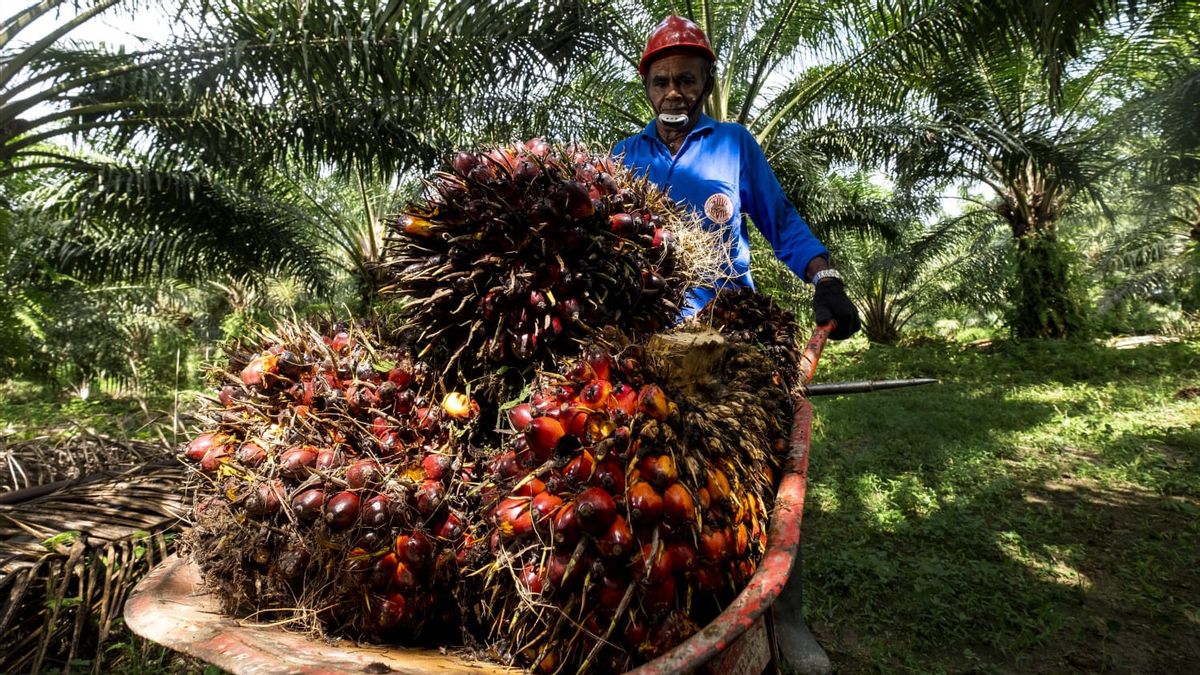


JAKARTA - The palm oil industry has a very strategic role in meeting national food needs.
Chairman of the Agriculture Sector and Chairman of the Food Task Force of the Indonesian Young Entrepreneurs Association (HIPMI) Central Management Board, M Hadi Nainggolan, said the palm oil industry is a national food strength. The palm oil industry, from upstream to downstream, has provided food for 280 million people spread throughout Indonesia.
Palm oil has the advantage of being a raw material for food products because it has characteristics of competitive prices, high productivity, stable supply, and very wide use applications.
"From palm oil, we produce various types of derivative products in the food sector. There are many food products produced from palm oil," he said.
M Hadi Nainggolan emphasized that the area of oil palm plantations in Indonesia which has reached almost 17 million hectares needs to be seen as a source of national food security. It is known that the palm oil commodity does not know seasonal patterns with a relatively consistent production volume from month to month and from year to year.
This condition provides certainty and comfort for entrepreneurs who use palm oil as a raw material for production.
"I agree that this palm oil is a flagship crop and mainstay of Indonesia that must be optimized as much as possible," he said.
The founder of HANN Corp said that entrepreneurs, especially those who are members of HIPMI, can encourage the downstreaming of palm oil in the food sector so that products with added value can be created and beneficial to the community.
So far, palm oil has produced various derivative products in the food sector such as cooking oil, margarine, bread, coffee drinks, chocolate, biscuits, to white butter (shortening). The creation of palm oil-based food products can meet consumer needs related to quality, stability, and nutrition.
"Currently, almost all successful entrepreneurs in HIPMI have oil palm plantations, but only as far as producing TBS and CPO. We still need to encourage entrepreneurs to enter the downstream sector," he said.
He hopes that there will be close cooperation between entrepreneurs and the Plantation Fund Management Agency or BPDP to realize the downstreaming of palm oil in the food sector. Currently, BPDP has a Food and Downstream Program which aims to strengthen the national palm oil industry, ensure food security, and increase the competitiveness of downstream palm products in the global market.
"We invite BPDP to jump higher by creating an industrial-scale incubation program in the food program," he said.
The success of entrepreneurs in realizing palm oil downstream in the food sector will certainly have a positive impact such as strengthening national food security to opening more jobs. The more entrepreneurs who engage in palm oil downstream in the food sector, the greater the positive impact produced.
"We encourage that in HIPMI, there is one entrepreneur in each province who will enter the palm oil downstream food sector. There must be entrepreneurs who can process palm oil plantations into food products such as butter to cheese," he concluded.
The English, Chinese, Japanese, Arabic, and French versions are automatically generated by the AI. So there may still be inaccuracies in translating, please always see Indonesian as our main language. (system supported by DigitalSiber.id)
Most Popular Tags
#Prabowo Subianto #donald trump #2026 World Cup #Febrie Adriansyah #8791Popular


