

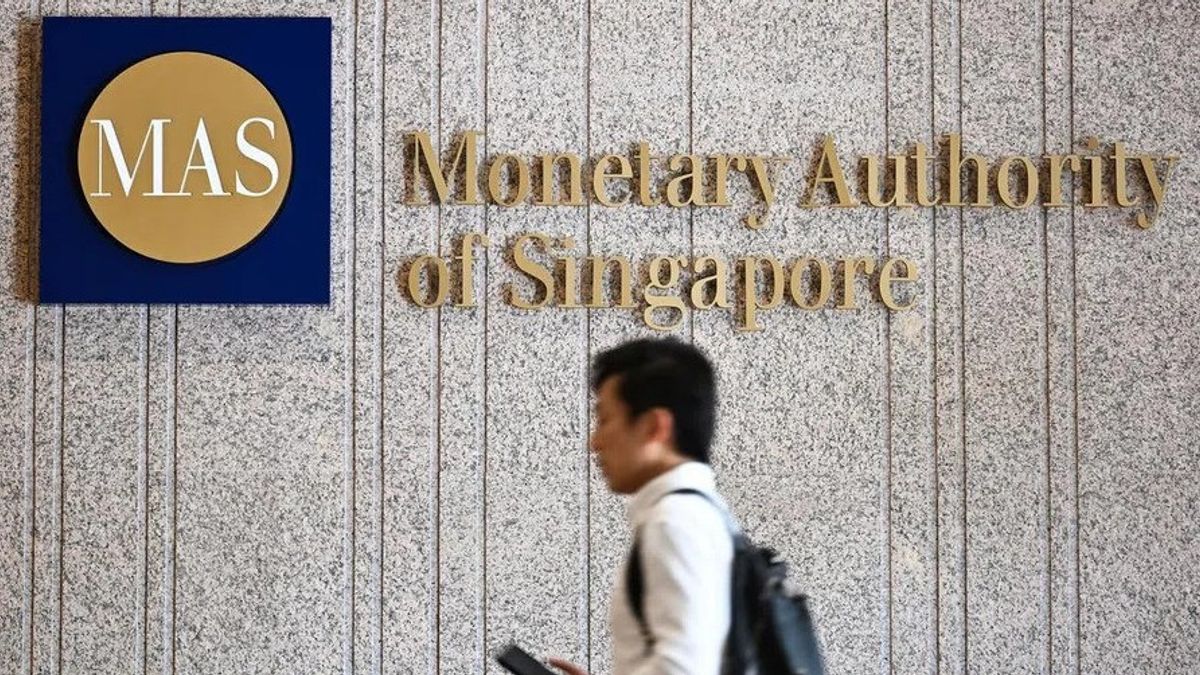


JAKARTA - Singapore has started to tighten its monetary policy after the surge in oil and gas prices due to the Iran war put pressure on import costs. Citing The Straits Times, Tuesday, April 14, this step was taken by giving room for the Singapore dollar to strengthen so that the increase in the price of goods from outside does not burden inflation.
The decision was announced by the Monetary Authority of Singapore (MAS) on April 14. The Straits Times reported that this was the first policy tightening since 2022. MAS tightened the rate of appreciation of the nominal effective exchange rate policy band of the Singapore dollar or S$NEER, without changing the width of the band or its midpoint.
In conjunction with this, MAS raised its 2026 general and core inflation projections to an average of 1.5 percent to 2.5 percent, from the previous 1 percent to 2 percent. The Singapore central bank assessed that the cost of imported energy had risen and the impact would spill over to more goods and services in the next few quarters.
"Singapore's import energy costs have risen. The prices of a wider range of imported goods and services are expected to increase in the next few quarters," MAS said, as quoted by The Straits Times. MAS added that core inflation will rise and remain high in the coming quarters.
The pressure does not stop at electricity, gas, and transportation. MAS also estimates that the prices of imported consumer goods and intermediate goods will rise. The impact can be felt on non-cooked food, retail goods, and other daily necessities.
The source of the pressure comes from the conflict in the Middle East. World oil and gas prices have soared since February 28, when the US and Israel launched air strikes on Iran. Iran then effectively blocked the Strait of Hormuz, an important route for about a fifth of the world's oil and gas supplies from the Persian Gulf. A two-week ceasefire has also failed to calm things down after US-Iranian peace talks in Pakistan last weekend failed to reach an agreement.
At the same time, Singapore's economy began to lose momentum. The Singapore Ministry of Trade and Industry recorded the country's economy grew 4.6 percent year-on-year in the first quarter of 2026, down from 5.7 percent in the previous quarter. On a quarterly basis, the economy actually shrank 0.3 percent, reversing from growth of 1.3 percent in the fourth quarter of 2025.
MAS acknowledged that energy pressures and rising input costs would weigh on Singapore's economic outlook. "This will put pressure on value added in energy-dependent industries such as petrochemicals and transportation," MAS said, quoted by The Straits Times.
For Indonesia, this should be noted. If Singapore starts to slow down the economy because of expensive energy, other countries in the region also find it difficult to regard energy price fluctuations as a distant matter. Because in the end, rising energy costs almost always spill over into the cost of living and business costs.
The English, Chinese, Japanese, Arabic, and French versions are automatically generated by the AI. So there may still be inaccuracies in translating, please always see Indonesian as our main language. (system supported by DigitalSiber.id)
Most Popular Tags
#Prabowo Subianto #donald trump #2026 World Cup #Febrie Adriansyah #8791Popular


