

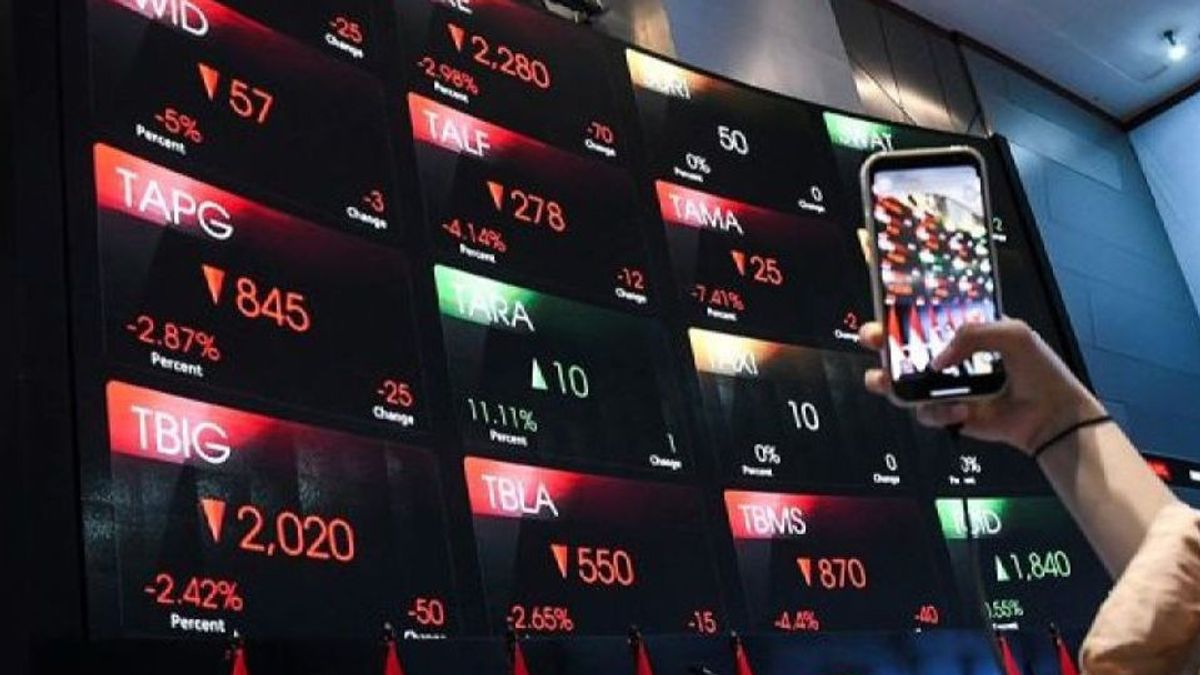


JAKARTA - Oil prices soared after the United States blocked the Strait of Hormuz. However, the stock market did not fall as deep as it had feared. According to a report by CNBC quoted on Monday, April 13, this shows that market participants are beginning to recalculate the risk of war, no longer reacting in panic whenever new news emerges.
In Asia, most exchanges on Monday fell by about 1 percent. Futures contracts on major US indices also fell by less than 1 percent. The figure shows that there is pressure, but it has not yet turned into a major sell-off as in the early stages of the conflict. The most aggressive moves are oil, the US dollar, and bond yields.
Billy Leung, investment strategist at Global X ETFs, assessed that the market was beginning to see Washington's move with a cooler head. "There is a belief that much of this is just a negotiating tactic," he said. He added, "The market has reached the peak of uncertainty. The reaction is no longer as extreme as before. "
A similar view comes from Jun Bei Liu, Ten Cap's chief portfolio manager. According to him, volatility indicators signal the worst phase of the panic is likely over. "We saw the VIX rise a few weeks ago, and that may be the peak of fear and selling," he said.
Even so, the market can't really relax. Leung reminded that there is political pressure in Washington because the Trump administration has limited time to secure congressional approval if it wants to continue military action. US lawmakers are also said to be pushing for a resolution for Trump to seek congressional approval before launching further attacks on Iran.
In the energy market, the pressure is more tangible. The Strait of Hormuz is an important route for about a fifth of the world's oil flows. Since the war began, traffic on the route has dropped sharply. The impact is felt quickly. Concerns about supply are rising, oil prices are being pushed up, and global inflation is haunting again.
CNBC noted that the yield on US Treasury bonds with a 10-year tenor rose by more than 333 basis points since the war began. The US dollar index also strengthened by about 1.4 percent. Meanwhile, US oil prices have jumped more than 55 percent. US crude oil contracts for May delivery rose more than 8 percent to US$104.93 per barrel, while Brent for June delivery rose 7 percent to US$102.17.
A number of analysts believe the spike will not last forever. Michael Yoshikami of Destination Wealth Management said, "I'm pretty sure oil prices will go down from here ... we'll see oil back to $80 a barrel." According to him, it could happen if the US and Iran return to the negotiating table and the risk premium starts to disappear.
Steve Brice of Standard Chartered also sees rising oil, dollar, and bond yields as temporary symptoms. "We believe the US is looking for ways to defuse the escalation," he said.
So, the market is not yet fully calm. Oil is still high, US politics is still moving, and the risk of war has not disappeared. But market participants are no longer automatically running every time a conflict heats up. They are starting to sort out, which is a momentary threat, which can really shake the market for longer.
The English, Chinese, Japanese, Arabic, and French versions are automatically generated by the AI. So there may still be inaccuracies in translating, please always see Indonesian as our main language. (system supported by DigitalSiber.id)
Most Popular Tags
#Prabowo Subianto #donald trump #firearm #8791 #giias 2026Popular


